
 Script Planner Assistant▸
 AI Apps
 AI News
DeepSeek Open Source Week Day 5: 3FS, a High-Performance Distributed File System
小编 ·

DeepSeek Open Source Week Day 5: 3FS, a High-Performance Distributed File System
While GPT4.5 has just been released, DeepSeek's Open Source Week enters the fifth day's open source project. The final day's open source project is: 3FS (Fire-Flyer File System).
What is 3FS (Fire-Flyer File System)?
3FS (Fire-Flyer File System) is a high-performance distributed file system self-developed by DeepSeek, specifically designed to address the challenges of AI training and inference workloads.
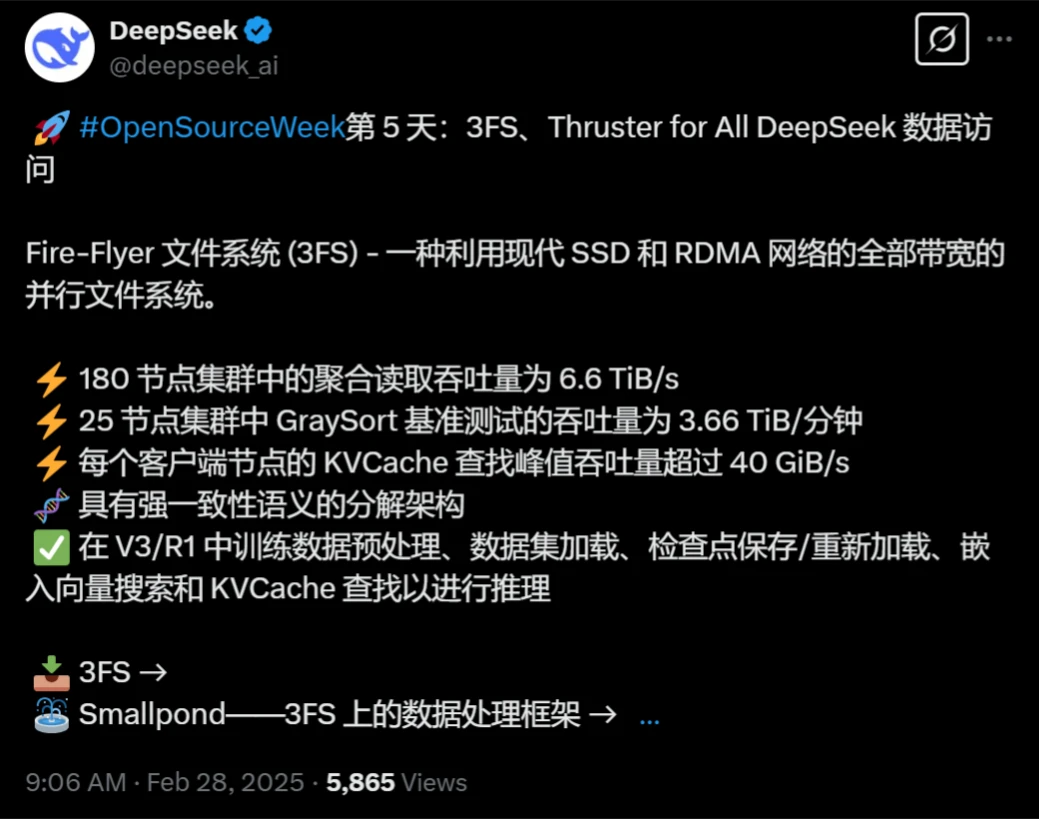
Features of 3FS
High Performance:
Leverages modern SSDs and RDMA networking to provide high throughput and low latency data access.
Combines the throughput of thousands of SSDs with the network bandwidth of hundreds of storage nodes, enabling applications to access storage resources in a geography-independent manner.
Strong Consistency:
Ensures strong consistency by implementing Chained Replication with Apportioned Queries (CRAQ), making application code simpler and easier to reason about.
File Interface:
Employs a stateless metadata service backed by a transactional key-value store (such as FoundationDB).
Familiar file interface with no new storage API to master.
Diverse Workload Support:
Data Preparation: Organizes the output of data analysis pipelines into hierarchical directory structures, effectively managing large volumes of intermediate output.
Data Loader: Eliminates the need for prefetching or data shuffling by supporting random access to training samples across compute nodes.
Checkpoints: Supports high-throughput parallel checkpointing for large-scale training.
Inference KV Cache: Provides a cost-effective alternative to DRAM caching, offering higher throughput and significantly greater capacity.
Disaggregated Storage and Compute:
The data storage service is separated from compute nodes and dedicated to storing sample data required for model training.
Each storage service node is equipped with 16 SSDs of 15TB each and 2 high-speed network cards, delivering powerful read performance and robust network bandwidth, with read/write bandwidth of 7.0TB/s.
Self-Developed Communication Tools:
Such as hfreduce, which optimizes multi-card parallel communication, replaces NVIDIA's NCCL, and reduces PCIe traffic and computational overhead.
Dedicated Data Format FFRecord:
Reduces the overhead of opening numerous small files during training by merging multiple small files.
Improves random batch read performance through the use of sample file offsets.
Applications of 3FS
AI Training and Inference:
3FS is specifically designed for AI training and inference workloads and can significantly enhance the efficiency of these tasks.
Through high performance and strong consistency, 3FS supports large-scale model training and high-throughput inference.
Data Preparation and Loading:
3FS's data preparation and loader functionality makes handling large volumes of data more efficient, reducing the need for prefetching and data shuffling.
Checkpoints and Inference Cache:
3FS supports high-throughput parallel checkpointing, ensuring stability and fault tolerance during the training process.
The inference KV cache provides a cost-effective alternative, improving inference throughput and capacity.
Usage of 3FS
Installation and Configuration:
3FS can be installed and configured through its open source project on GitHub.
Data Format Conversion:
Use the FFRecord format for data storage and loading, requiring sample data to be converted into FFRecord format.
An FFRecord conversion tool is provided to facilitate data format conversion for users.
Integration with PyTorch:
3FS is adapted to PyTorch's Dataset and DataLoader interfaces, making it very convenient to load data and initiate training.
GitHub Project URL:https://github.com/deepseek-ai/3FS
Review of the First Four Days' Open Source Projects
Day One: FlashMLA, an efficient decoding kernel for NVIDIA Hopper GPUs that optimizes the performance of Multi-head Latent Attention (MLA), significantly boosting the response speed of AI tools in content creation.
Day Two: DeepeEP, the first open source communication library for Mixture of Experts (MoE) model training and inference, which optimizes communication efficiency and reduces latency in large-scale distributed training.
Day Three: DeepGEMM, an FP8 computation library supporting dense and MoE models, specifically designed for NVIDIA Hopper architecture GPUs, significantly enhancing computational efficiency and hardware utilization.
Day Four: DualPipe, a bidirectional pipeline parallelism algorithm designed to optimize the overlap of computation and communication in V3/R1 model training. EPLB, an Expert Parallelism Load Balancer, specifically addresses load imbalance issues in expert parallel tasks within large-scale AI models.









