
 Script Planner Assistant▸
 AI Apps
 AI News
FlashMLA: DeepSeek's Efficient MLA Decoding Kernel Optimized for Variable-Length Sequences
小编 ·

FlashMLA: DeepSeek's Efficient MLA Decoding Kernel Optimized for Variable-Length Sequences
What is FlashMLA?
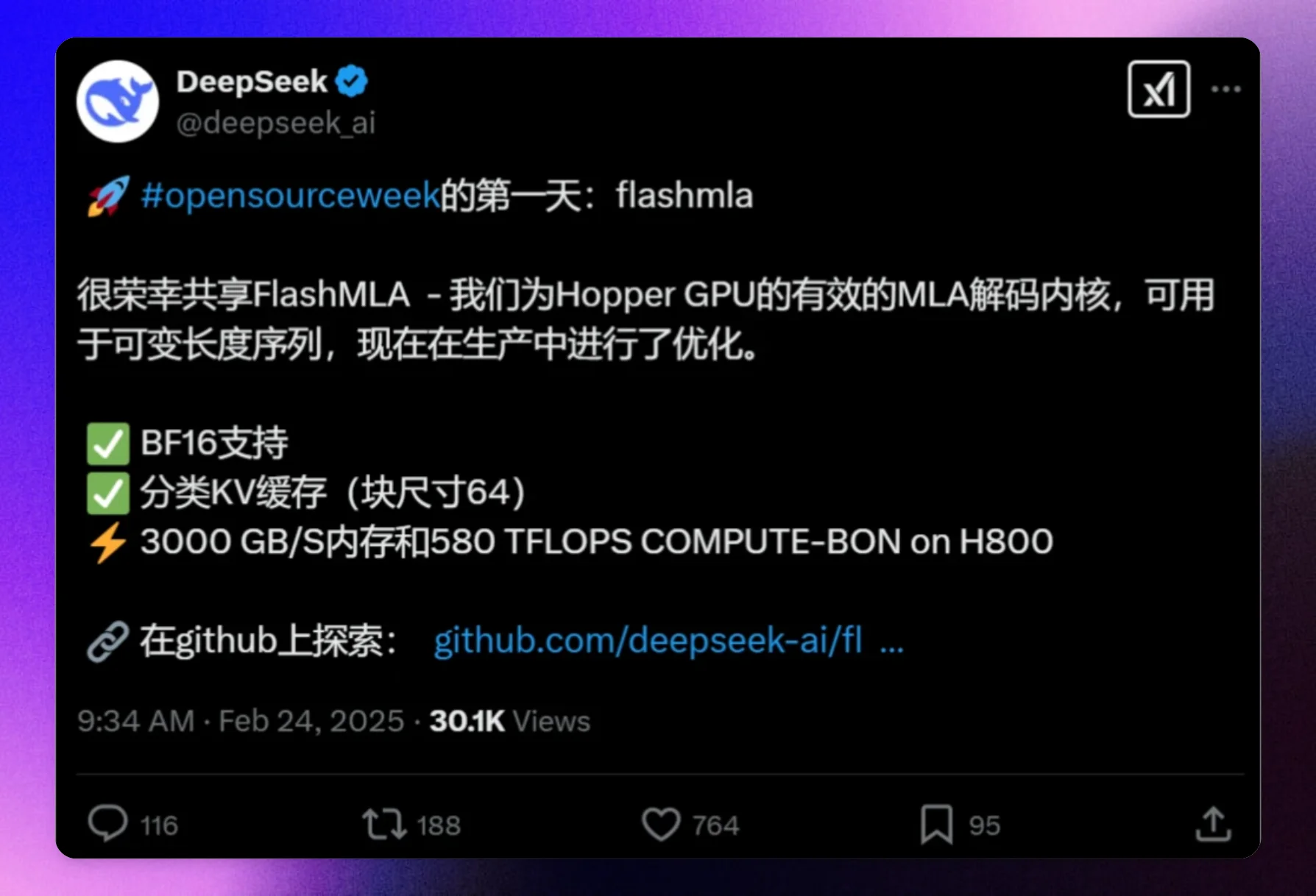
FlashMLA is an MLA (Multi-Head Latent Attention) decoding kernel launched by DeepSeek on February 24, 2025, optimized for NVIDIA Hopper architecture GPUs (such as the H800), with special optimization for variable-length sequence processing services.
Key Features of FlashMLA:
BF16 Support: FlashMLA supports the BF16 (Bfloat16) data type, making it more efficient in computation and memory usage.
Paged KV Cache: Manages the key-value (KV) cache through a paging mechanism with a block size of 64, enabling efficient handling of large-scale sequences.
High Performance: FlashMLA achieves memory bandwidth of up to 3000 GB/s (in memory-bound scenarios) and computational performance of up to 580 TFLOPS (in compute-bound scenarios, based on the BF16 data type).
Technical Background of FlashMLA:
FlashMLA was created to address the compute and memory bottlenecks that large language models face during inference. Traditional Multi-Head Attention (MHA) requires substantial memory to store key-value pair (KV) caches when processing long sequences, which limits model deployment on hardware with limited resources. MLA reduces the size of the KV cache by introducing a latent attention mechanism while maintaining model performance.
Application Scenarios of FlashMLA:
FlashMLA is particularly well-suited for natural language processing (NLP) tasks that require efficient decoding, such as large language model (LLM) inference. It is optimized for variable-length sequences and has been validated in real production environments, making it especially suitable for high-performance computing needs.
Technical Implementation of FlashMLA
Low-Rank Compression: MLA achieves effective compression of the KV cache through low-rank matrix factorization, reducing memory usage.
KV Cache Optimization: Optimizes the KV cache mechanism, significantly reducing hardware resource requirements and thereby lowering inference costs.
Parallel Decoding: Introduces a parallel decoding mechanism that allows multiple tokens to be processed simultaneously, significantly boosting inference speed.
Performance Improvements of FlashMLA
After adopting FlashMLA, DeepSeek saw approximately a 5% improvement in accuracy on natural language processing tasks, a 20% increase in inference speed, and a 15% reduction in computational resource consumption. These improvements enable DeepSeek to perform better in real-time interactive scenarios (such as conversational ai and real-time translation).
FlashMLAInstallation and Usage
Environment Requirements:
Hopper architecture GPU (such as NVIDIA A100)
CUDA 12.3 or later
PyTorch 2.0 or later
1. First, you need to install the FlashMLA library. You can install it using the following commands:
git clone https://github.com/deepseek-ai/FlashMLA.git
cd FlashMLA
python setup.py install
Or if you have already cloned the repository and want to rebuild:
python setup.py clean --all && python setup.py build_ext --inplace
2. Get MLA Metadata
Before using FlashMLA, you need to obtain the MLA metadata. This typically involves preparing input tensors and other necessary parameters.
from flash_mla import get_mla_metadata, flash_mla_with_kvcache

# Assume you already have cache_seqlens and other related variables
cache_seqlens = [...]  # list of lengths for each sequence
s_q = ...              # query dimension
h_q = ...              # number of heads
h_kv = ...             # number of key-value heads

tile_scheduler_metadata, num_splits = get_mla_metadata(cache_seqlens, s_q * h_q // h_kv, h_kv)
3. Perform MLA Decoding
Next, you can perform MLA decoding operations. Assume you already have the necessary components such as the query matrix q_i, key-value cache kvcache_i, and block table.
dv = ...               # output dimension

for i in range(num_layers):  # iterate over each layer
    o_i, lse_i = flash_mla_with_kvcache(
        q_i[i],                # query matrix for the current layer
        kvcache_i[i],           # key-value cache for the current layer
        block_table,            # block table
        cache_seqlens,          # cache sequence lengths
        dv,                     # output dimension
        tile_scheduler_metadata,# MLA metadata
        num_splits,             # number of splits
        causal=True             # whether to use causal masking
    )
    # Continue processing the output results o_i and lse_i
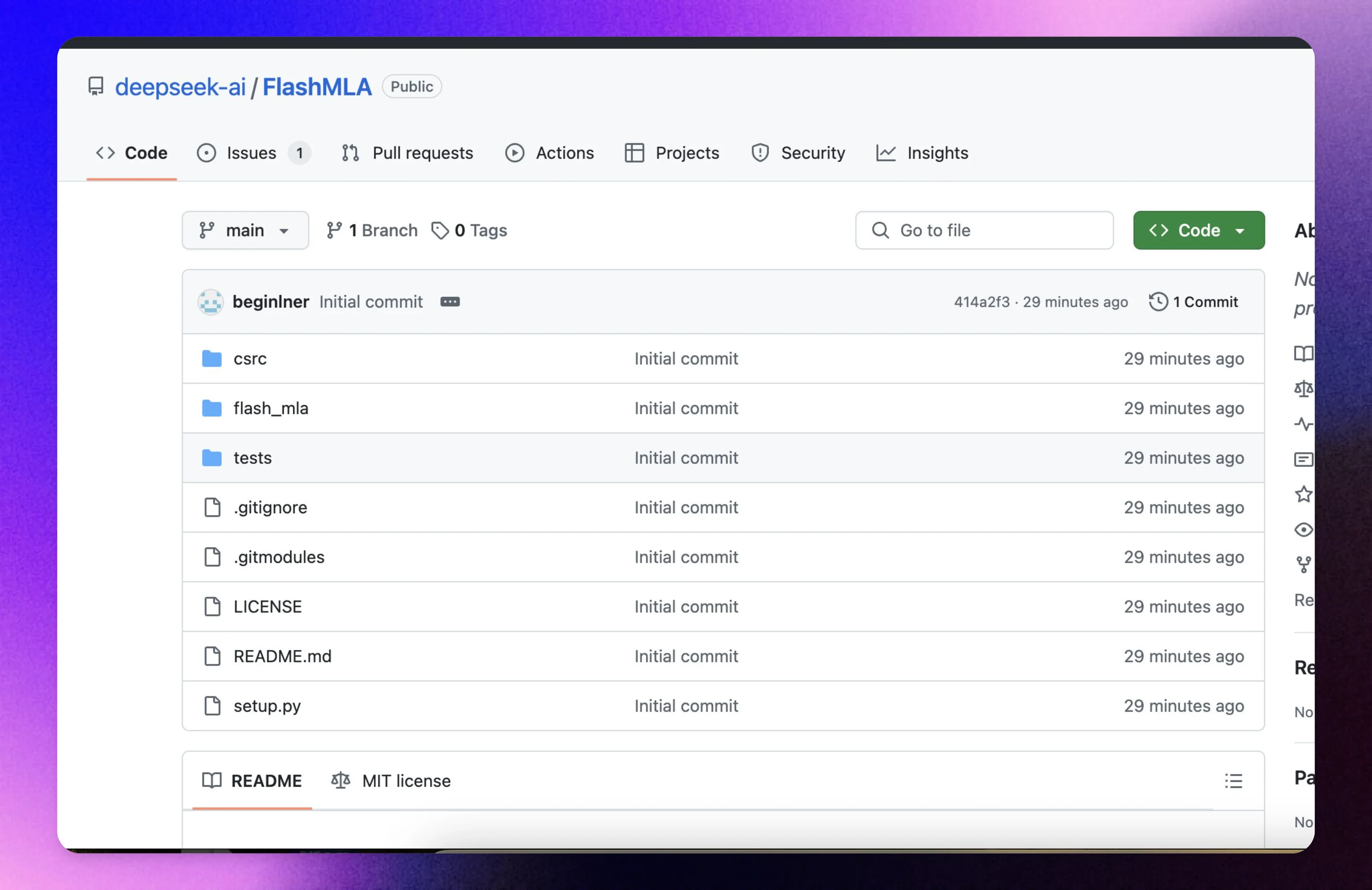
FlashMLA GitHub:https://github.com/deepseek-ai/FlashMLA









