
 Script Planner Assistant▸
 AI Apps
 AI News
DeepSeek Open-Source Week Day 2: DeepEP
小编 ·

DeepSeek Open-Source Week Day 2: DeepEP
Yesterday was the first day of DeepSeek ai's open-source week. The open-sourced project was FlashMLA. Within less than half an hour, it already had over 300 Stars on Github, and in just 1 hour, it surpassed 100K reads, making it extremely popular. Today is the second day of DeepSeek's open-source week, and DeepSeek open-sourced its second project: Deepep.
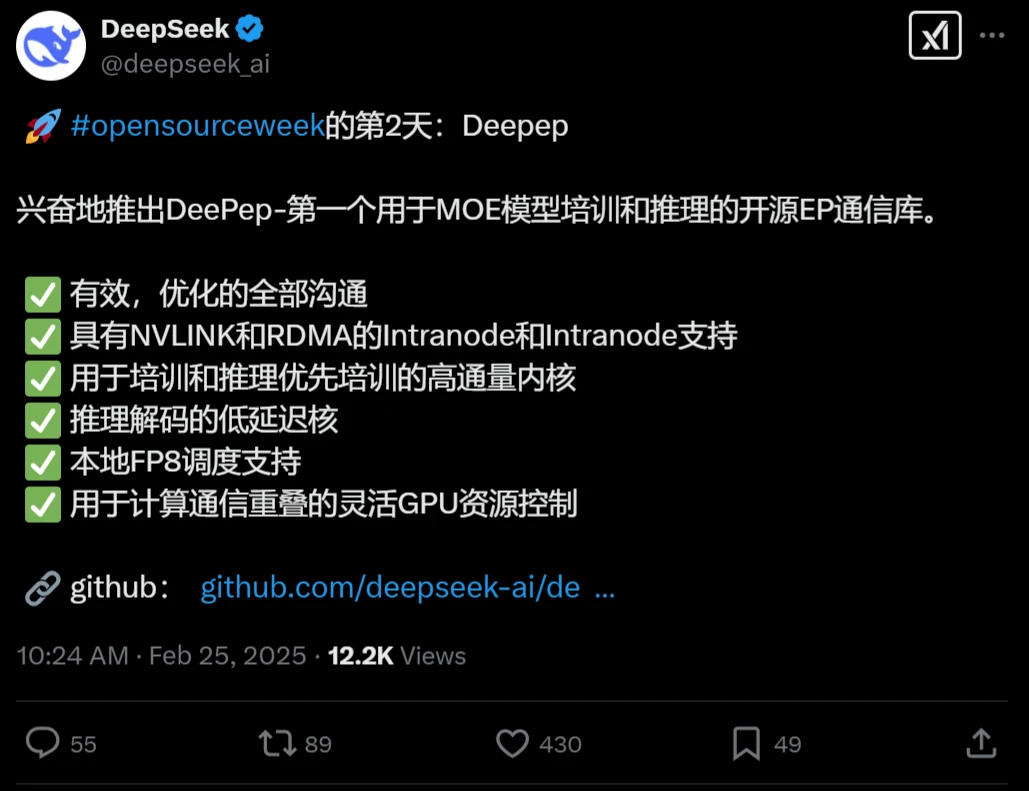
What is Deepep?
Deepep is an open-source EP communication library for MOE model training and inference. It is based on an advanced mixture-of-experts architecture, fully leveraging large-scale datasets to improve the effectiveness of pre-training and fine-tuning. DeepEP's design orientation is to reduce computational burden and memory usage, enabling users to efficiently run large-scale models on conventional hardware.
Features of Deepep
MoE Architecture Optimization:
DeepEP is specifically designed for Mixture-of-Experts (MoE) and Expert Parallelism (EP), providing efficient all-to-all GPU kernels suitable for training and inference tasks.
Supports low-precision operations, including FP8 and BF16, improving computational efficiency and saving video memory.
High-Performance Communication:
Provides high-throughput and low-latency communication kernels, supporting NVLink and RDMA networks. Tested on H800 GPUs, the maximum bandwidth can reach 153 GB/s (NVLink) and 46 GB/s (RDMA).
Optimized for asymmetric bandwidth forwarding scenarios from NVLink to RDMA, ensuring high throughput performance.
Low-Latency Communication:
Provides pure RDMA low-latency kernels, especially suitable for the inference decoding stage, with latency as low as 163 microseconds.
Introduces a hook-based communication-computation overlap method that does not occupy GPU SM resources, maximizing computational efficiency.
Hardware Optimization:
Leverages undisclosed PTX instructions to boost the performance of the Hopper architecture.
Supports InfiniBand networks and is theoretically compatible with RoCE, providing flexible network configuration options.
Use Cases for Deepep
Large-Scale Model Training:
Suitable for training Mixture-of-Experts (MoE) models, providing efficient parallel communication support and significantly improving training efficiency.
Inference Tasks:
Particularly suitable for latency-sensitive inference decoding scenarios, significantly improving efficiency, reducing latency, and increasing inference throughput.
High-Performance Computing Needs:
Perfectly fits modern high-performance computing needs, supports multiple hardware platforms including the Hopper GPU architecture, and may expand to more devices in the future.
Usage and Integration of Deepep
Ease of Use:
Supports the Hopper GPU architecture and requires Python 3.8+, CUDA 12.3+, and PyTorch 2.1+ environments.
Installation requires the team's modified version of NVSHMEM, with detailed installation instructions.
Integration Methods:
Open-source and easy to integrate, only requiring a few lines of commands to build and run tests.
After installation, simply import the deep_ep module to use it directly, with example code and test scripts provided.
DeepEP has been open-sourced on GitHub at: https://github.com/deepseek-ai/DeepEP
1. DeepSeek Open-Source Week Day 1 Project: DeepSeek FlashMLA









