
 Script Planner Assistant▸
 AI Apps
 AI News
DeepSeek Open Source Week Day 4: DualPipe
小编 ·

DeepSeek Open Source Week Day 4: DualPipe
What is DualPipe?
DualPipe is an innovative bidirectional pipeline parallelism algorithm, first proposed in the DeepSeek-V3 technical report. By achieving full overlap of forward and backward computation with communication phases, it significantly improves the efficiency and resource utilization of large-scale model training, while effectively reducing the "bubble" phenomenon in the pipeline.
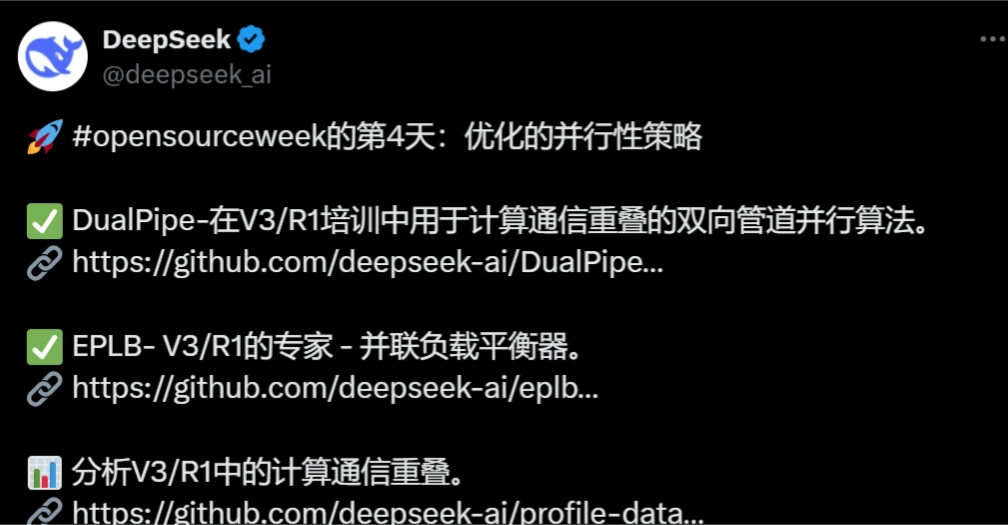
DualPipe Overview
DualPipe is an innovative bidirectional pipeline parallelism algorithm, first proposed in the DeepSeek-V3 technical report. By achieving full overlap of forward and backward computation with communication phases, it significantly improves the efficiency and resource utilization of large-scale model training, while effectively reducing the "bubble" phenomenon in the pipeline.
DualPipe Core Innovations
Overlap of Computation and Communication
At the core of DualPipe is the bidirectional scheduling of micro-batch data, achieving full overlap of forward and backward computation with communication. This design ensures that computational resources do not sit idle while waiting for communication to complete, thereby greatly improving GPU utilization.
Reducing Pipeline Bubbles
Traditional pipeline parallelism methods (such as 1F1B and ZB1P) often encounter efficiency bottlenecks when handling large-scale models due to the separation of computation and communication phases. DualPipe effectively reduces the bubble phenomenon in the pipeline by optimizing the arrangement of functional modules and precisely regulating GPU resource allocation ratios.
Memory Usage Optimization
Although DualPipe requires maintaining two copies of model parameters, the training process adopts large-scale gradient accumulation (EP), so this redundancy does not lead to a significant increase in memory overhead. In addition, its peak active memory increases by only 2x, making it more efficient than traditional methods.
DualPipe Implementation Details
Functional Module Division
Each computation block is divided into four functional modules: attention mechanism, all-to-all data dispatch, MLP processing, and all-to-all data combination. In backward computation blocks, the attention and MLP modules are further subdivided into two parts for input gradient computation and weight gradient computation.
Scheduling Mechanism
DualPipe adopts an innovative bidirectional pipeline scheduling strategy, enabling micro-batch data to be input simultaneously from both ends of the pipeline. This design ensures that even as the model scale further expands, as long as an appropriate computation-to-communication ratio is maintained, fine-grained expert partitioning can be achieved across nodes while reducing all-to-all communication overhead to near zero.
Performance Comparison
Compared with traditional 1F1B and ZB1P methods, DualPipe excels at reducing pipeline stalls and memory usage. Its "bubble" time is significantly reduced, while peak active memory increases only slightly. This efficient scheduling approach gives DualPipe a significant performance advantage in large-scale parallel scenarios.
DualPipe Application Prospects
The emergence of DualPipe provides an efficient and feasible parallel training tool for large-scale model training. Whether in academic research or industrial applications, this technology is expected to drive further development in the field of AI training.
DualPipe GitHub Repository:https://github.com/deepseek-ai/DualPipe
Review of the First Three Days' Open Source Projects
FlashMLA: An efficient decoding kernel for NVIDIA Hopper GPUs, optimizing the performance of Multi-head Latent Attention (MLA) and significantly improving the response speed of AI tools in content creation.
DeepeEP: The first open-source communication library for training and inference of Mixture of Experts (MoE) models, optimizing communication efficiency in large-scale distributed training and reducing latency.
DeepGEMM: An FP8 computing library supporting dense and MoE models, designed specifically for NVIDIA Hopper architecture GPUs, significantly improving computational efficiency and hardware utilization.









