Script Planner Assistant▸
 AI Apps
 AI News

China Genealogy Knowledge Service Platform: A Free Online Family Tree Lookup Tool
China Genealogy Knowledge Service Platform: A Free Online Family Tree Lookup ToolIntroduction
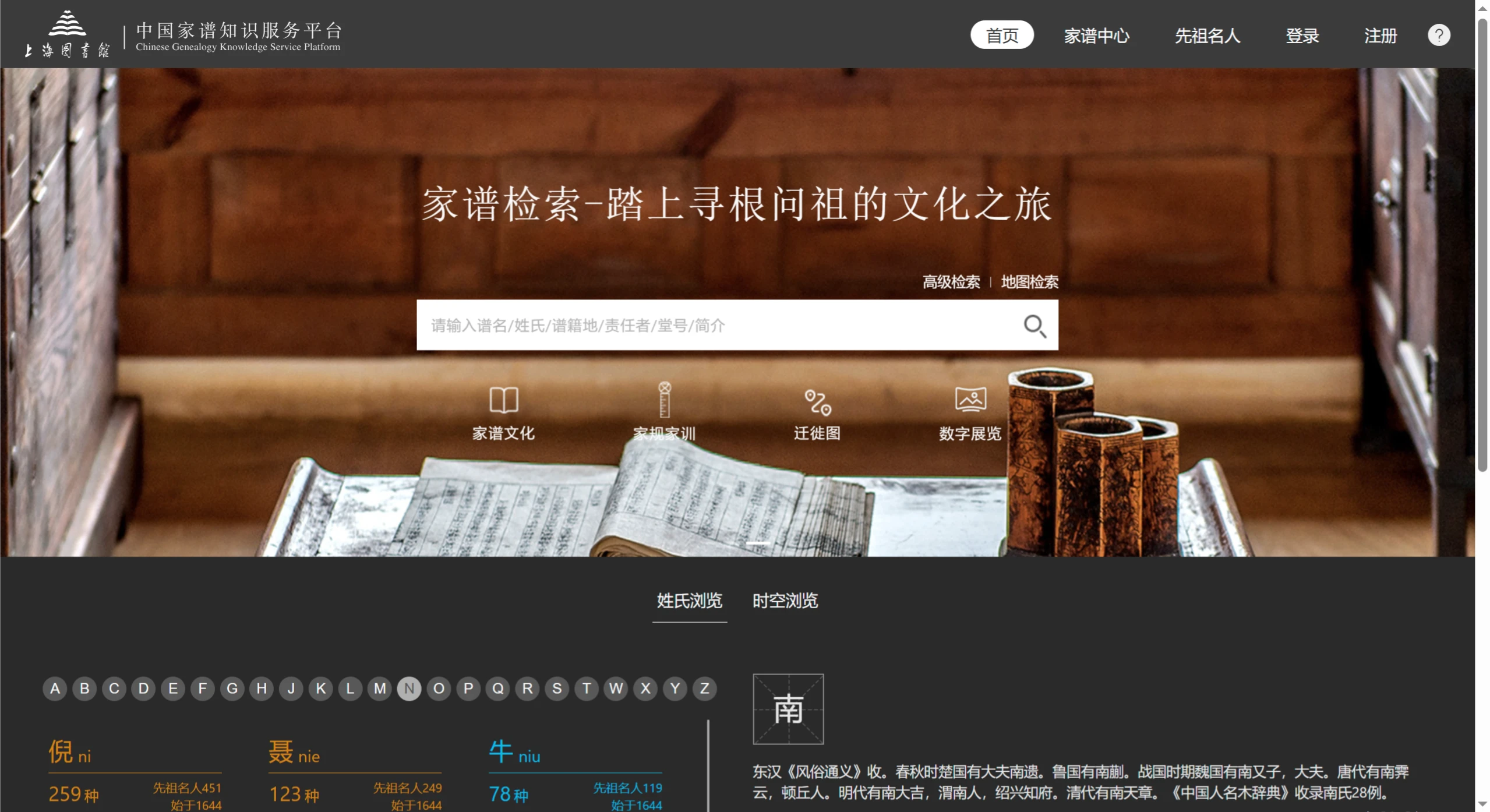
China Genealogy Knowledge Service Platform is a genealogy query website developed by the Shanghai Library, using digital technology and linked data to organize global genealogy resources. Here you can search the catalogs of more than 100,000 genealogies held by 630 institutions around the world. You can precisely locate genealogies by surname, ancestral homeland, hall name, and other information. You can also view family migration routes through maps and see intuitive displays such as family trees and statistical charts. In addition, the China Genealogy Knowledge Service Platform offers collaborative features such as online genealogy donation, transcription, and compilation.
China Genealogy Knowledge Service Platform Resources
Broad collection scope: Based on the "General Catalog of Chinese Genealogies," the China Genealogy Knowledge Service Platform has collected more than 54,000 genealogies from around the world (including Hong Kong, Macao, Taiwan, Japan, Korea, North America, Germany, and other regions), covering 608 surnames. The platform currently holds more than 100,000 genealogies in total, of which 38,000 belong to the Shanghai Library itself.
Data is continuously updated: The China Genealogy Knowledge Service Platform shares data with the "Joint Genealogy Cataloging System" used by multiple institutions, so newly cataloged data can be used directly, meaning the platform's content keeps growing.
Main Features of the China Genealogy Knowledge Service Platform
Convenient search: You can find genealogies by surname, ancestral homeland, edition, and other methods, and view genealogy catalogs, original texts, images, and related materials.
Abundant auxiliary tools: It offers tools such as family trees, migration maps, and statistical charts to help users better understand and analyze genealogy information.
User participation: It provides features such as uploading genealogies, online transcription, and online compilation, allowing users to contribute their own knowledge. To donate a genealogy, upload genealogy images in the format required by the website and provide information such as ancestral homeland, compiler, and binding method. Each field includes instructions and examples.
Intuitive data presentation: It provides data visualization, statistical analysis, multi-dimensional exploration (such as people, places, time, events), as well as geographic spatial services based on standardized place names.
Usage Characteristics
Free to use: It offers free services such as genealogy digitization, searching, and reading.
Simple to operate: The interface is clear and easy to understand, making it suitable for all kinds of users.
Value of the China Genealogy Knowledge Service Platform
Supports multidisciplinary research: It provides data for disciplines such as history, economics, sociology, education, folklore, demography, and genetics.
Innovative knowledge organization: Beyond displaying bibliographic information, it also mines knowledge and data related to people, places, time, and events within genealogies, exploring organizational approaches for family lineage charts and migration maps.
Applicable Scenarios for the China Genealogy Knowledge Service Platform
Family cultural heritage and research: Search genealogies to understand family origins, development, and migration, preserving family culture; upload genealogies to supplement and correct information, completing family records.
Academic research: It provides research materials for disciplines such as history, demography, and sociology; combined with digital technology, it supports the study of family culture and promotes academic progress.
Public cultural services and education: It supports cultural exhibitions such as migration maps, surname walls, and family trees to enhance visitor experience; as an educational resource, it disseminates family culture in schools and public education.
Data sharing and openness: It publicly provides foundational databases and literature knowledge bases and offers data interfaces to promote sharing; users can upload genealogies and transcribe content to enrich collections.
Technology application and innovation: Charts are used to display genealogy information intuitively for easier understanding; artificial intelligence and big data are leveraged to improve search efficiency and accuracy.
Commercial and cultural product development: Develop cultural products such as printed genealogies and personalized souvenirs; explore sustainable operating models including advertising and membership services.
How to Use the China Genealogy Knowledge Service Platform
Access the platform: Open the official website of the China Genealogy Knowledge Service Platform in your browser: https://jiapu.library.sh.cn
Find a genealogy:
Basic search: Enter the genealogy name, hall name, or ancestral homeland information directly in the search box on the homepage to quickly locate what you need. If the information is unclear, try the "Map Drawing" feature to circle a geographic area and filter results.
Advanced search: It supports field-restricted searches by title, author, era, and more. You can also combine multiple keywords using logical operators such as "AND," "OR," and "NOT" to improve search accuracy.
Use the knowledge service features:
View family trees: The family lineages of notable families such as Hu Shi and Li Hongzhang are presented dynamically in 3D. On a tablet, you can control the viewing angle to intuitively experience family heritage.
View migration maps: Based on 70,000 genealogies, machine learning is used to extract ancestor migration events and generate interactive spatiotemporal maps, helping you understand family migration history and distribution.
Experience the AR surname wall: Visit the "Genealogy Experience Hall" at the Shanghai Library East Hall in person. Scan the surnames on the physical wall to see information such as the surname's origin, notable figures, and family rules and teachings. Some ancestors even have AI dynamic portraits.
Participate in co-creation: After registering an account, you can download full texts, add notes, and apply to edit genealogies online. You can upload genealogies, correct lineage charts online, and also donate genealogies.
Look up family rules and teachings: Click "Family Rules and Teachings" on the homepage to perform full-text searches of family mottos within 303 genealogies. Vertical reading mode is supported, suitable for users in Hong Kong and Taiwan.