
 Script Planner Assistant▸
 AI Apps
 AI News

DreamBooth: Personalized Text-to-Image Technology
DreamBooth: Personalized Text-to-Image TechnologyIntroduction
DreamBooth is a personalization technique for text-to-image generation developed by Google Research and Boston University in 2022. Its goal is to use a very small number of samples to make a pretrained diffusion model "remember" a specific object, such as a person, pet, item, or a particular style, so that it can later generate high-quality images of that object in various scenes and styles. It was originally demonstrated together with Google's Imagen, and was later applied to models like Stable Diffusion, becoming a common method for personalization.
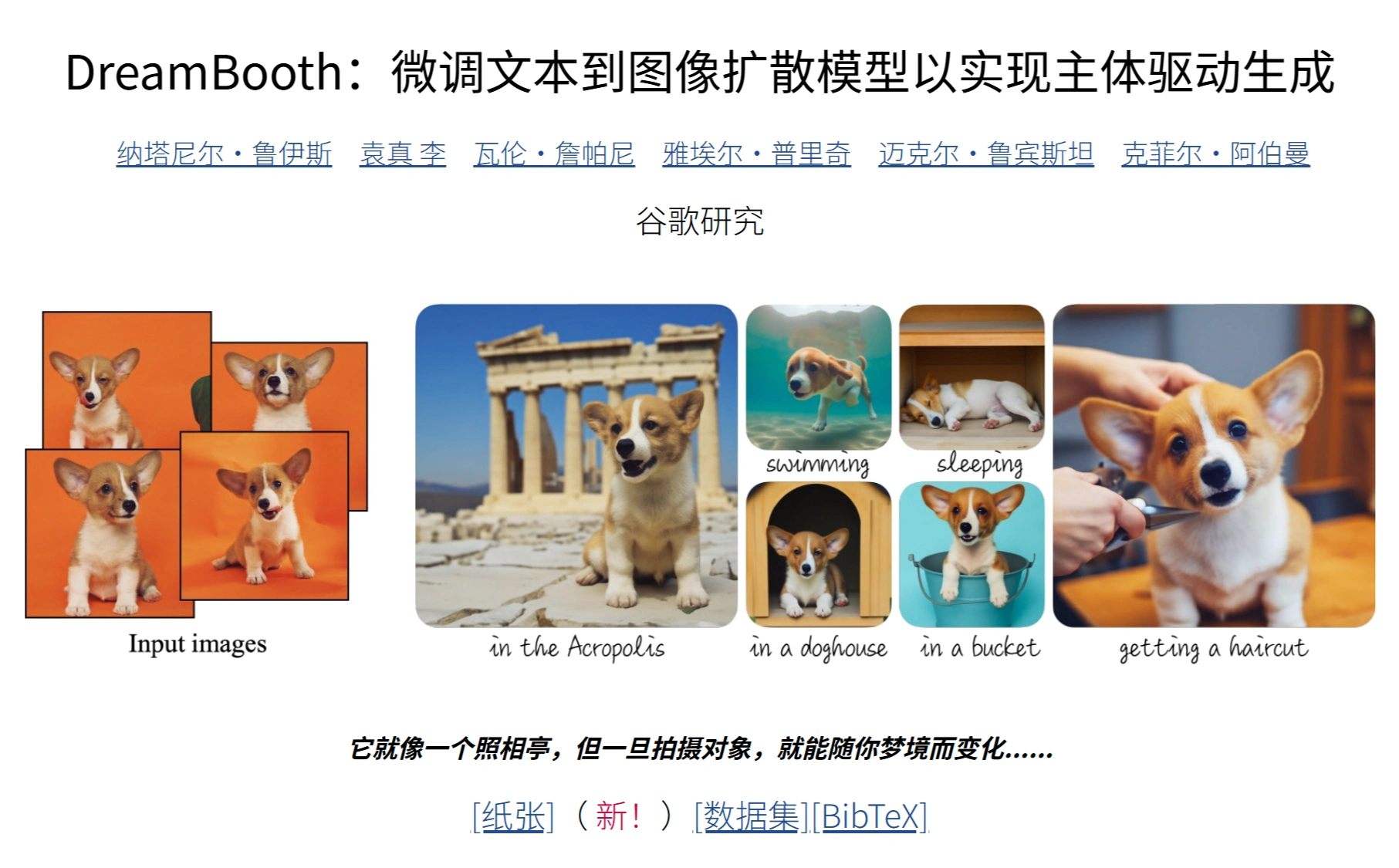
How DreamBooth Works
Fine-tuning with very few images. Usually only 3–5 images of the target object are needed, paired with text prompts containing a "unique identifier + class name", such as "a photo of [V] dog", linking the new object into the model's semantic space.
A class-specific prior preservation loss is added during training, so that the model retains the diverse appearances of the original class. This prevents overfitting and language drift, allowing the object to be generated differently across various scenes.
Super-resolution fine-tuning is then applied. Low-resolution images are generated first, and an SR module progressively enhances their clarity — commonly going 64×64 → 256×256 → 1024×1024 — to make details and textures more realistic.
Steps for Using DreamBooth
First, prepare 3–5 high-resolution images of the target object; different angles work better.
Give the object a rare token and write a simple class description, for example "a photo of sks dog".
Choose a suitable learning rate and reference image set, then start fine-tuning. On a single GPU, 8–24 GB of VRAM is required, taking about 1–2 hours.
Once training is done, input prompts like "sks dog wearing spacesuit on Mars" and you can get an image of your corgi on Mars.
Main Features of DreamBooth
Significantly changes the output with very few samples.
Can be plugged into many text-to-image diffusion models, such as Stable Diffusion.
The community provides ready-made weights, Colab tutorials, and various tools with interfaces, making it easy to learn and use.
Benefits and Issues of DreamBooth
Benefits:
Only a few images are needed; paired text-image data is not required.
Captures individual details, such as patterns, facial features, or product logos.
High generation quality. Leveraging the rich information of Stable Diffusion, the results look very realistic in detail.
Issues:
High VRAM requirements: full-parameter fine-tuning needs 15–24 GB, while using LoRA can reduce this to 8–12 GB.
Prone to overfitting. If not controlled well, the model may only recognize the trained object, and outputs of other instances from the same class can become distorted.
Slower to train than LoRA. LoRA only takes 30–60 minutes, while full DreamBooth fine-tuning takes 1–2 hours.
Common Use Cases of DreamBooth
Create virtual avatars for individuals or pets, placing yourself or your cats and dogs into game or movie scenes.
Produce customized images for products. Upload product photos and generate advertising images in different styles in one go.
Character design: film or game companies can quickly generate different poses and lighting drafts of the same character.
Things to Note
Training is very VRAM-intensive and can be expensive on ordinary graphics cards. Using cloud GPUs or optimization methods can save some cost.
It is best to use 3–10 images with multiple angles, different backgrounds, and clear quality, so generation is more stable and accurate.
To put it simply, DreamBooth is a way to make a large model "remember" a specific individual. It is a representative personalization method in AIGC and works well for anime-style content.













