Script Planner Assistant▸
 AI Apps
 AI News

Hanyu Pinyin Net: Learn Chinese Pinyin Online
Hanyu Pinyin Net: Learn Chinese Pinyin OnlineIntroduction
The Hanyu Pinyin website mainly introduces the basics of Hanyu Pinyin, including 23 initials (such as b, p, m, each with a corresponding Chinese character pronunciation, for example, b corresponds to "玻"), 24 finals (including single vowels such as a, o, e, compound vowels like ai, ei, among which two special finals are annotated with pronunciation notes), and 16 syllable wholes (整体认读音节) (such as zhi, chi, shi, all also paired with corresponding Chinese characters, for example, zhi corresponds to "织"), clearly presenting the basic composition of Hanyu Pinyin.
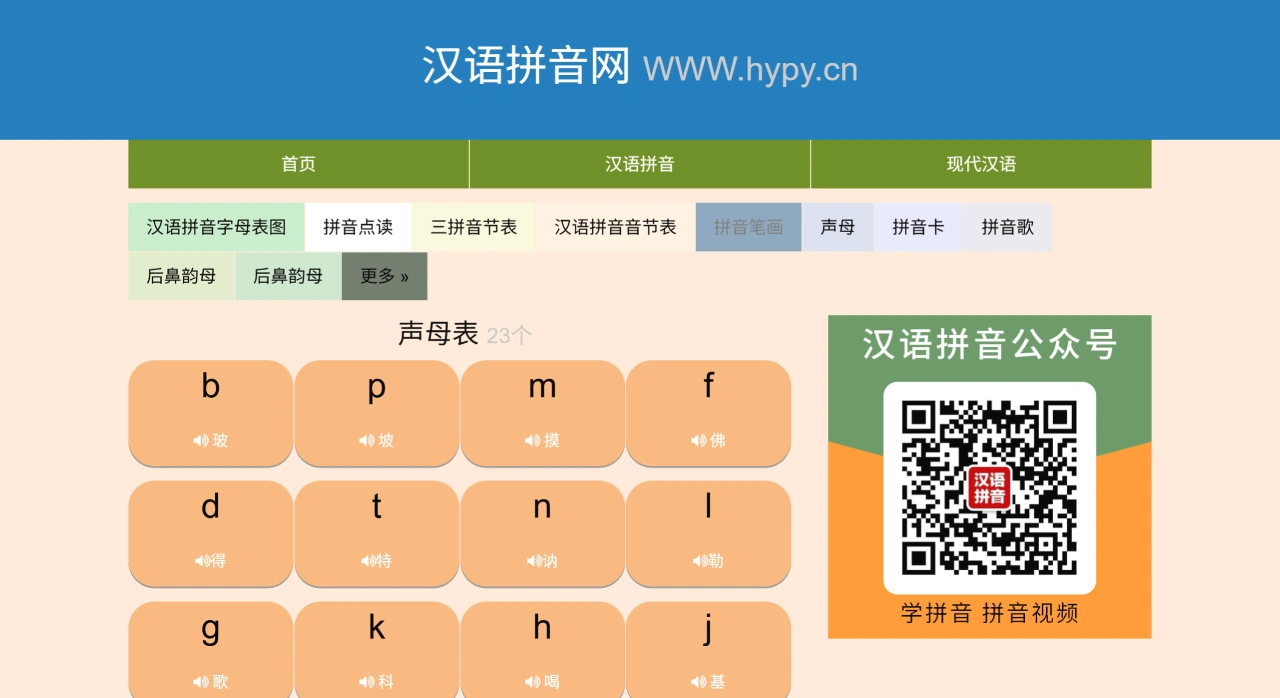
I. Initials (23)
| Letter | Pronunciation Character | Letter | Pronunciation Character | Letter | Pronunciation Character | Letter | Pronunciation Character |
|---|---|---|---|---|---|---|---|
| b | 玻 | p | 坡 | m | 摸 | f | 佛 |
| d | 得 | t | 特 | n | 讷 | l | 勒 |
| g | 歌 | k | 科 | h | 喝 | j | 基 |
| q | 欺 | x | 希 | zh | 知 | ch | 蚩 |
| sh | 诗 | r | 日 | z | 资 | c | 雌 |
| s | 诗 | y | 衣 | w | 乌 | - | - |
II. Finals (24)
| Letter | Supplementary Notes | Letter | Supplementary Notes | Letter | Supplementary Notes | Letter | Supplementary Notes |
|---|---|---|---|---|---|---|---|
| ɑ | - | o | - | e | - | i | - |
| u | - | ü | - | ai | - | ei | - |
| ui | - | ao | - | ou | - | iu | - |
| ie | - | üe | - | er | - | ɑn | - |
| en | - | in | - | un | - | ün | - |
| ɑng | - | eng | 亨的韵母 | ing | - | ong | 轰的韵母 |
III. Syllable Wholes (整体认读音节) (16)
| Letter | Pronunciation Character | Letter | Pronunciation Character | Letter | Pronunciation Character | Letter | Pronunciation Character |
|---|---|---|---|---|---|---|---|
| zhi | 织 | chi | 吃 | shi | 狮 | ri | 日 |
| zi | 资 | ci | 刺 | si | 丝 | yi | 衣 |
| wu | 屋 | yu | 雨 | ye | 椰 | yue | 月 |
| yuɑn | 圆 | yin | 印 | yun | 云 | ying | 鹰 |
Questions and Answers:
How many initials, finals, and syllable wholes are there in Hanyu Pinyin? What is the relationship among them?
Answer: There are 23 initials, 24 finals, and 16 syllable wholes. These three categories together form the foundation of Hanyu Pinyin. There is no direct numerical calculation relationship among them, but their roles are different — initials are the consonants at the beginning of a pinyin syllable (such as b, p), finals are the vowels or vowel combinations in a pinyin syllable (such as a, ai), and syllable wholes need to be memorized and read as a whole without being split apart (such as zhi).
Which two special finals are marked on the webpage? What are their pronunciation notes?
Answer: There are two special finals: eng and ong. The pronunciation note for eng is "亨的韵母" (the final in 亨), and for ong is "轰的韵母" (the final in 轰), using common Chinese characters to help users master the pronunciation of these two finals more accurately.
What is the main difference between syllable wholes and initials/finals? Give an example to illustrate.
Answer: The main difference is that syllable wholes do not need to be split into initials and finals; they must be memorized and read as a whole; while initials are the consonant part at the beginning of a pinyin syllable, and finals are the vowel or vowel combination part, which need to be combined together to form a syllable. For example, the syllable whole "zhi" is read directly as "织" without being split into "z" (initial) and "hi" (there is no such final); while the initial "zh" and the final "i" can be combined to form "知", but "zhi" as a syllable whole has a different pronunciation method from the combination of an initial plus a final.