Script Planner Assistant▸
 AI Apps
 AI News
Voicv Voice Cloning
Voicv Voice CloningIntroduction
Voicv is a platform for AI voice cloning and text-to-speech. Users can replicate a voice with just a few seconds of audio and produce speech that sounds like a real person talking. It leverages advanced deep-learning voice models, faithfully recreating timbre, tone, emotion, and speaking style. It can also generate speech in multiple languages, with various emotions and timbres.
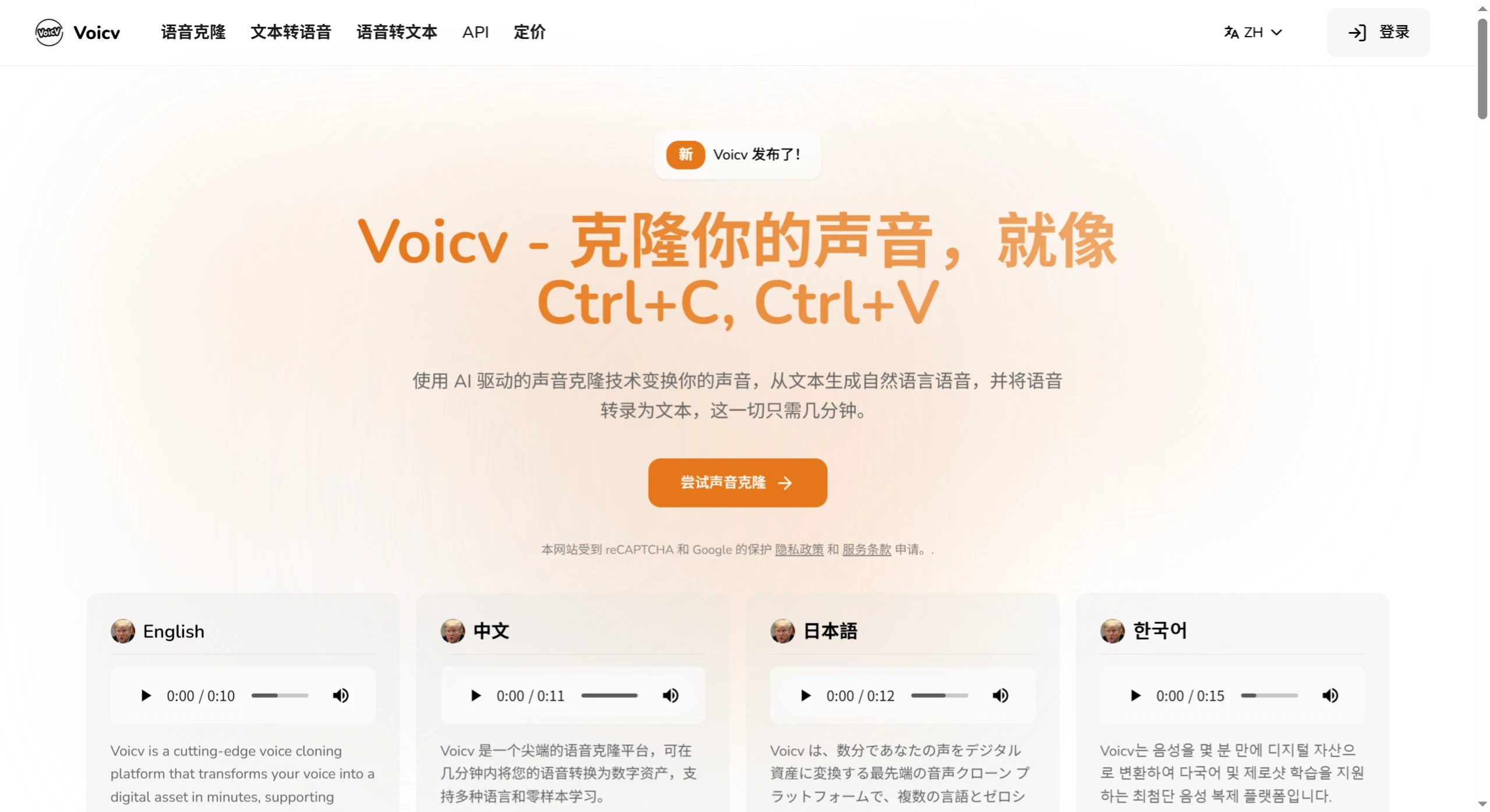
Voicv's main features include one-click voice cloning, multilingual speech generation, emotion and tone adjustment, pitch and speed control, customizable speaking styles, long-form text reading, and an API for developers to integrate the voice into apps, games, virtual characters, or automated workflows. It can be used for video dubbing, content creation, brand voice production, virtual streamers, podcasts, audiobooks, online education, intelligent customer service, and similar scenarios. No specialized recording equipment is needed to capture a voice, making it accessible to individuals, teams, and developers.
Voicv Key Capabilities
Zero-shot cloning: With just 10–30 seconds of original audio, you can create a high-fidelity digital voice—no lengthy training required.
Multilingual output in one go: A single cloned voice can speak 8 common languages (Chinese, English, Japanese, Korean, French, German, Spanish, Arabic) with consistent timbre, emotion, and rhythm.
Emotion and style control: Add pauses, breathing, laughter, and other fine details during synthesis to make the speech more natural.
Real-time generation and API: Audio is produced in seconds, and a production-ready API supports batch or embedded calls.
Cross-platform: Available as a web version, plus clients for Windows, macOS, and Linux—accessible anytime.
Voicv Main Benefits
Easy to use: Powered by zero-shot learning, it doesn't require a large amount of audio—just 10–30 seconds of samples are enough to clone, keeping usage costs low.
Multilingual: Supports 8 languages including Chinese, English, Japanese, Korean, French, German, Arabic, and Spanish—ideal for cross-language needs.
Fast processing: Real-time generation with an optimized engine delivers quick output, suitable for frequent updates and production use.
High quality: High precision with few errors; the speech is clear, accurate, and natural, reaching professional standards.
Expressive: Emotions can be adjusted, and pauses, breathing, laughter, and other details can be added to make the speech sound more like a real person.
Enterprise-friendly: Comes with a ready-to-use API and detailed documentation, making it easy for enterprises to deploy on their own and meet commercial needs.
How to Use Voicv
Go to voicv.com/zh and register or log in.
Go to "Voice Cloning" and upload 10–30 seconds of clean human audio (wav, mp3, or m4a formats are supported).
The system creates the voiceprint in 1–2 minutes and automatically adds it to your "My Voices" library.
Select a language, enter text or upload audio, adjust emotion parameters, and click "Generate".
Preview the result, and if satisfied, download as WAV or MP3, or use the API for batch synthesis.
Voicv Common Scenarios
Content creation and multilingual publishing: Quickly produce multilingual video or podcast narration in your own voice, keeping your personal brand consistent.
Corporate brand announcements: Unify the "brand voice" used in customer service, navigation, and news broadcasts.
Audiobooks and accessibility: Create natural-sounding voices for individuals, or help people with speech impairments preserve their unique vocal characteristics.
Voicv Free and Paid Plans
Free quota: Approximately 2,000–3,000 characters per week (figures vary slightly by region), enough for trying it out.
Paid options: Charged by character count or monthly subscription. Enterprises can opt for custom voice hosting and private cloud deployment—check the official site for specific pricing.
FAQ
What is voice cloning?
It uses AI technology to create a digital replica of your voice in just a few minutes.
It can be used to help content creators, podcast hosts, enterprises, and others produce a unified brand voice.
How does voice cloning work?
AI algorithms analyze 10–30 seconds of audio samples to capture the voice's characteristics.
Zero-shot learning is used to create a high-fidelity, natural replica.
Is voice cloning safe and ethical?
In terms of security, encryption is used to protect data, ensuring voice samples and cloned voices are stored and transmitted securely.
In terms of ethics, strict rules must be followed, and you must obtain the voice owner's consent before uploading their voice.
What can I do with Voicv voice cloning?
Content creation: Add your own voiceover for videos, podcasts, audiobooks, and more.
Corporate communications: Create a unified brand voice for ads, customer service, etc.
Multilingual localization: Translate content into multiple languages while preserving the original voice.
Accessibility: Create personalized synthetic speech for people with speech impairments.
How accurate is Voicv voice cloning?
It accurately captures and reproduces voice characteristics such as timbre, intonation, and rhythm.
The generated speech sounds natural, with subtle emotional variations.
What languages does Voicv voice cloning support?
It supports English, Japanese, Korean, Chinese, French, German, Arabic, Spanish, and more.
How long does it take to clone a voice with Voicv?
Just 10–30 seconds of audio samples are needed, and cloning is completed in a few minutes.
Can Voicv voice cloning modify the emotion of a cloned voice?
Yes, you can adjust emotional expressions such as pauses, breathing, and laughter to make the speech more expressive and natural.
Can Voicv voice cloning be used for impersonation?
It cannot be used to impersonate someone's voice for fraud or deception. Usage must be legal, proper, and follow ethical rules.
Can I use Voicv voice cloning commercially?
It can be used commercially, but you must first obtain the voice owner's consent and comply with relevant laws.