Script Planner Assistant▸
 AI Apps
 AI News

AMiner: Science & Technology Analysis and Mining Platform
AMiner: Science & Technology Analysis and Mining PlatformIntroduction
AMiner, a science and technology intelligence mining platform based on knowledge-driven and big data technologies, provides researchers with comprehensive and accurate academic resources and information services.
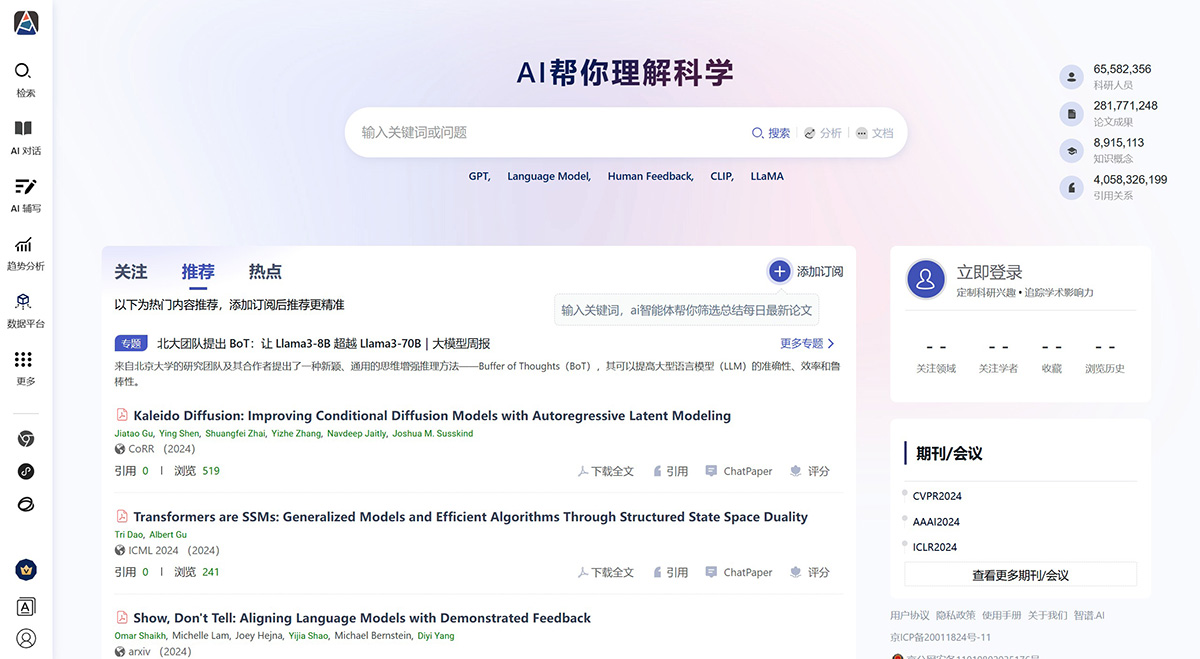
We focus on:
Creating a semantic profile for each researcher by extracting information from distributed networks;
Integrating academic data from multiple sources (e.g., bibliographic data and researcher profiles);
Accurately searching heterogeneous networks;
Analyzing and discovering interesting patterns from the established researcher social network.
Main search and analysis features in AMiner:
Profile Search:
Enter a researcher's name (e.g., Jie Tang), and the system will return a semantic profile created for the researcher using information extraction techniques. On the profile page, the extracted and integrated information includes: contact information, photos, citation statistics, academic achievement evaluations, (temporal) research interests, educational background, personal social graph, research funding (currently limited to the U.S. and China), and publication records (including citation information, with papers automatically assigned to several different fields).
Expert Finding:
Enter a query (e.g., data mining), and the system will return experts on that topic. In addition, the system will recommend top conferences on that topic and the highest-ranked papers. There are two ranking algorithms, VSM and ACT. The former is similar to traditional language models, while the latter is based on our Author-Conference-Topic (ACT) model. Users can also provide feedback on the search results.
Conference Analysis: Enter a conference name (e.g., KDD), and the system returns who are the most active researchers at this conference, along with top-ranked papers.
Course Search: Enter a query (e.g., data mining), and the system will tell you who is teaching courses related to the query.
Subgraph Search: Enter a query (e.g., data mining), and the system first tells you which topics are related to the query (e.g., five topics—"Data Mining," "XML Data," "Data Mining/Query Processing," "Web Data/Database Design," and "Web Mining"—are related), then displays the most important subgraphs discovered on each related topic, accompanied by summaries of the subgraphs.
Topic Browser:
Based on our Author-Conference-Topic (ACT) model, we automatically discover 200 hot topics from publications. For each topic, we automatically assign a label to represent its meaning. In addition, the browser showcases the most active researchers, the most relevant conferences/papers, and discovers the evolving trends of that topic.
Academic Rankings:
We have defined 8 metrics to evaluate researchers' achievements. These metrics include "h-index," "Citation," "Rising Star," "Activity," "Longevity," "Diversity," "Sociability," and "New Star." For each metric, we output ranked lists across different fields. For example, you can search for who has the most citations in the "Data Mining" field.
User Management:
Register as a user;
Modify extracted profile information;
Provide feedback on search results;
Follow researchers on AMiner;
Create an AMiner page (can be used to promote conferences/workshops or recruit students)
Main ways AMiner helps researchers with literature retrieval:
aiIntelligent Paper Filtering: AMiner leverages AI technology to intelligently filter out the latest relevant papers based on users' research interests and fields, ensuring users can access the latest academic research and developments.
Broad Coverage: The platform covers a wide range of literature resources, including ArXiv, various academic journals, and conference papers, providing users with a comprehensive academic perspective.
Concise Paper Summaries: AI technology extracts the key information from papers and generates concise and accurate paper summaries, helping users quickly understand the main content of papers without spending a lot of time reading the entire paper.
Personalized Recommendations: Users can customize prompts based on their research interests and needs to obtain more personalized paper recommendations that meet different research requirements.
Flexible Search Options: Provides flexible search options, including keywords, authors, institutions, etc., to meet the needs of different users.
Information Push: Supports pushing paper information to users' email or WeChat, making it convenient for users to check at any time and customize information push based on personal needs.
AMiner is a next-generation science and technology intelligence analysis and mining platform developed by a team led by Professor Tang Jie of the Department of Computer Science and Technology at Tsinghua University. Since its launch in 2006, the AMiner platform has become an important tool for researchers worldwide, attracting over 8 million unique IP visits from 220 countries and regions, with data downloads reaching 2.3 million and annual visits exceeding 10 million. The core value of AMiner lies in its powerful data foundation, including 331 million paper records, 135 million scholar records, 1.122 billion paper citation relationships, and 8.79 million knowledge entities.