
 Script Planner Assistant▸
 AI Apps
 AI News
What's the Difference Between DeepSeek Full-Version R1 and Distilled R1?
小编 ·

What's the Difference Between DeepSeek Full-Version R1 and Distilled R1?
Deepseek has two main versions: the full R1 and the distilled R1, which have significant differences in performance and application scenarios. After the Deepseek R1 official service crashed, many third-party cloud service providers saw an opportunity and began deploying models. Some third-party providers pass off distilled R1 as the full R1 to charge more money, and many beginners can't tell the difference. Let's compare the two:
1. Performance Comparison
Full R1
Parameter scale: The full R1 has 671 billion parameters. As a large model, it has stronger semantic understanding and generation capabilities.
Reasoning capability: It performs excellently in mathematics, coding, and complex reasoning tasks, capable of handling more complex scenarios and tasks. It is suitable for high-precision needs such as scientific computing and long document analysis.
Main advantages: The full R1 has strong contextual understanding, making it suitable for highly complex applications such as intelligent assistants, scientific research, and technology development.
Distilled R1
Parameter scale: Distilled R1 is provided through model distillation technology in multiple models of different scales, with parameters ranging from 1.5B to 32B, suitable for various hardware configurations.
Reasoning capability: Although distilled R1 generally doesn't perform as well as the full R1, its smaller parameter scale allows it to maintain good reasoning capabilities in resource-constrained environments, making it suitable for intelligent customer service and real-time response scenarios.
Main advantages: Distilled R1 is easier to deploy and suitable for applications that require quick response and simplified operations, such as AI application development for small businesses and embedded ai solutions.
2. Application Comparison
Full R1 application areas: Suitable for scenarios requiring highly complex reasoning, such as scientific computing, programming assistants, and precise data analysis, providing users with richer and more accurate outputs.
Developer use: Developers can call the DeepSeek-R1 API for application development, leveraging its powerful model capabilities to meet high-quality application requirements.
Distilled R1 application areas: More suitable for resource-limited small environments, such as chat bots, customer service systems, and low-latency response applications. Due to its lightweight nature, enterprises have more flexibility in application costs and resource allocation.
Developer use: For developers looking for quick deployment, distilled R1 offers an easier-to-get-started option, reducing the complexity of configuration and maintenance.
3. How to Determine Whether It's Full R1 or Distilled R1?
First, use some complex questions to observe the thinking time, then compare the answer quality for complex questions.
The DeepSeek-R1 online full version takes longer to think, and throughout the entire thinking process, the DeepSeek-R1 online full version outputs very stably and quickly. Distilled R1 basically has no thinking process. Nami AI Search has both the distilled 32B model (Deepseek-R1-360 high-speed dedicated line) and the full 671B R1 (Deepseek-R1 online full version). We can test with some popular questions to help you judge, such as the currently trending DeepSeek Eight Character (Bazi) chart on Xiaohongshu (Little Red Book).
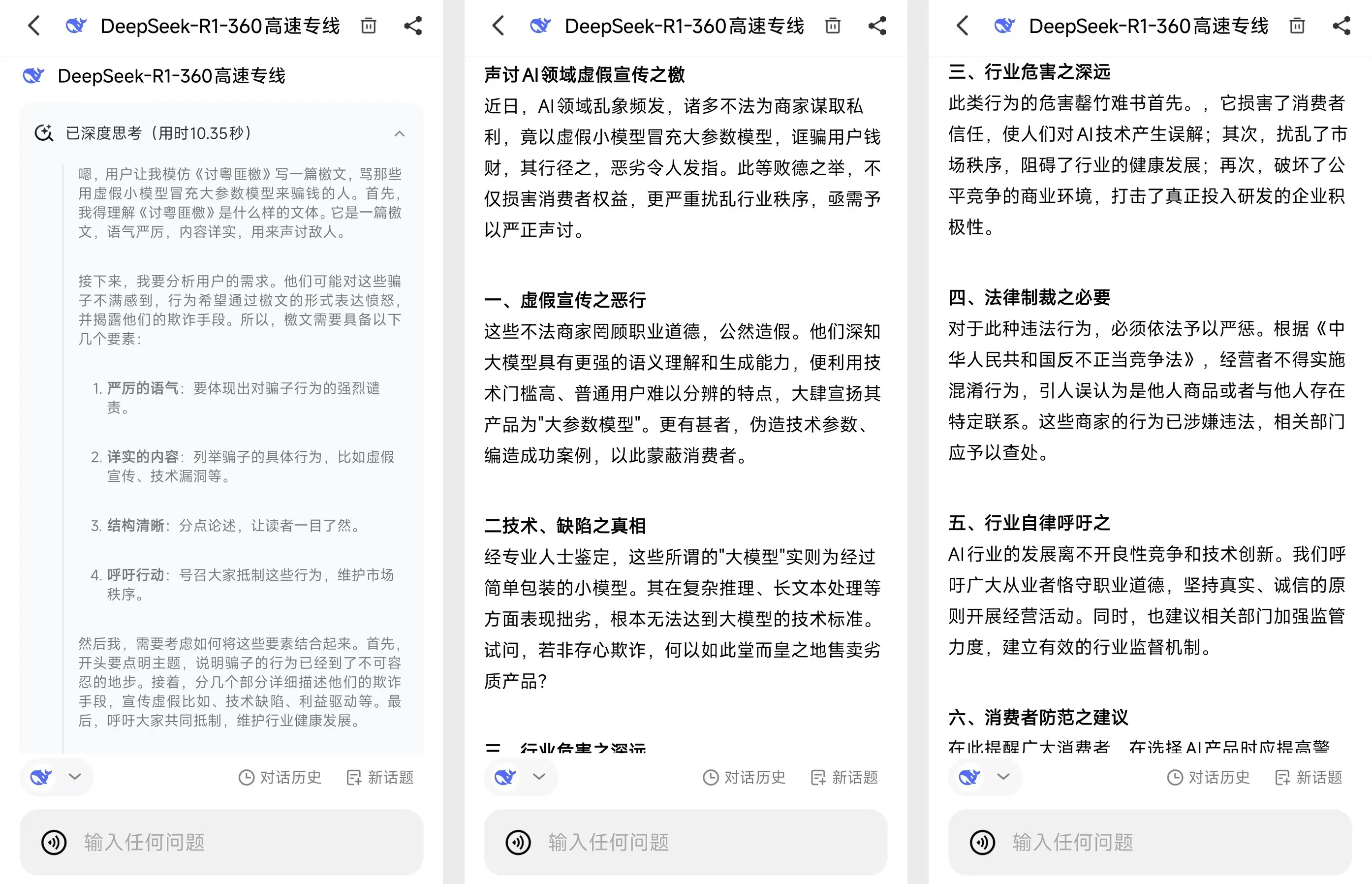
The full and distilled versions of Deepseek-R1 differ in applications across multiple scenarios. The full version mainly targets high-performance demanding tasks, such as scientific research, coding, and complex financial analysis, and its superiority becomes especially apparent when handling long text and high-precision reasoning tasks.
Although the distilled version has fewer parameters, its advantage lies in being able to effectively execute tasks under lower computing resources. It is suitable for small and medium-sized enterprises and mobile applications, and developers can easily adopt and quickly iterate deployments. For example, most of the local deployments currently mentioned online basically use this version. The distilled version usually has a relatively fast response speed, making it suitable for real-time interaction scenarios, such as online customer service and terminal intelligent assistants.
Full R1 and distilled R1 each have their own advantages. Which version to choose depends on the requirements of the target application scenario, available resources, and development complexity. Of course, if you want to use third-party DeepSeek service providers, please keep your eyes open.
Related information: Metasearch AI accesses the full version DeepSeek-R1 reasoning model









