
 Script Planner Assistant▸
 AI Apps
 AI News
Janus-Pro vs. JanusFlow: What Are the Differences and Similarities?
小编 ·

Janus-Pro vs. JanusFlow: What Are the Differences and Similarities?
Janus-Pro and JanusFlow are two multimodal AI models released by DeepSeek. Although both focus on image understanding and generation tasks, they differ notably in technical architecture, design philosophy, and application scenarios. The differences between them are introduced below:
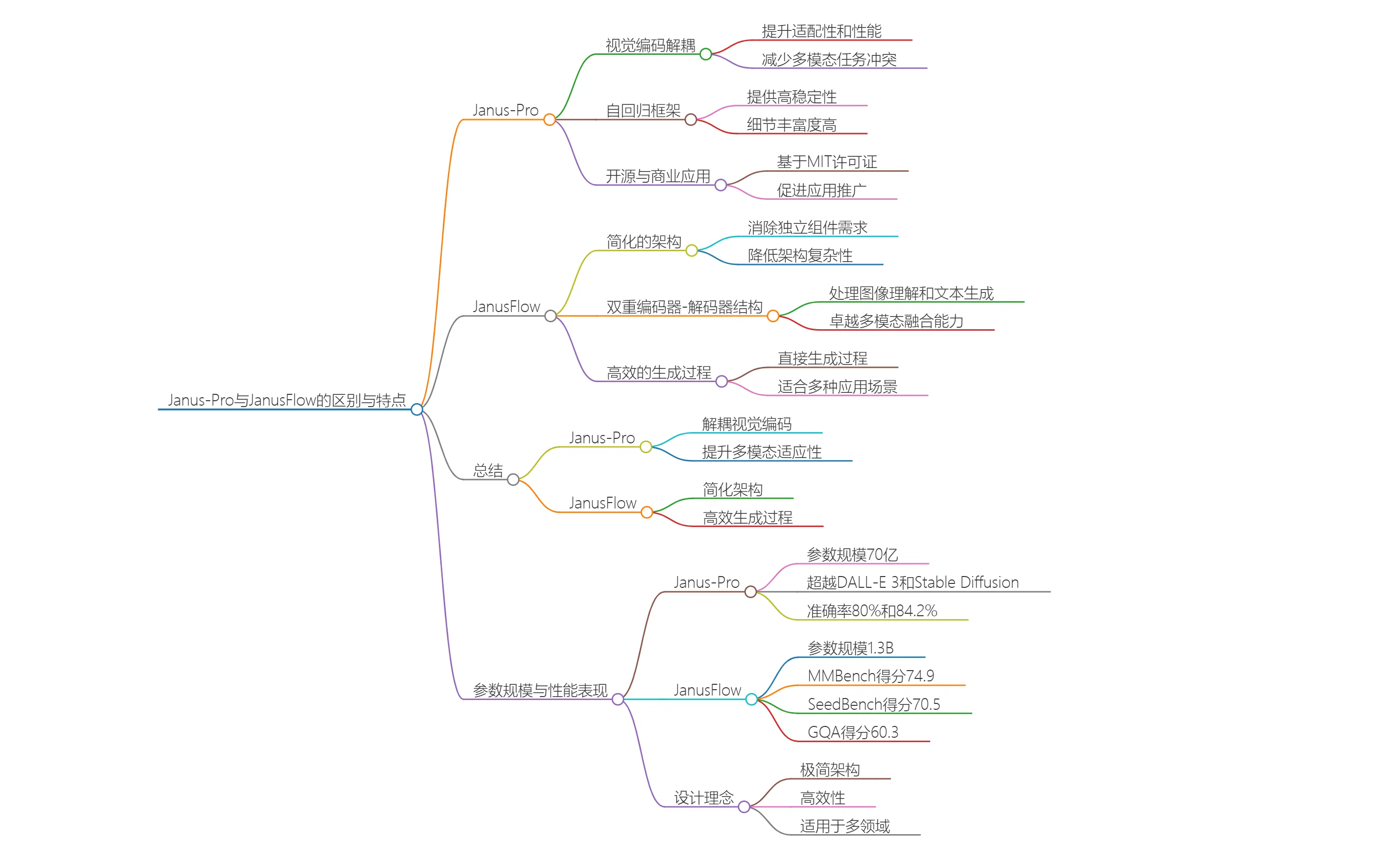
1. Technical Architecture
Janus-Pro:
It adopts decoupled visual encoding technology, splitting the visual encoding process into independent paths to handle multimodal understanding and generation tasks separately, resolving the functional conflicts of the visual encoder in the two tasks found in traditional models.
It is based on a unified Transformer architecture, simplifying the model design and enhancing scalability.
It uses SigLIP-L as the visual encoder, supports image input at 384x384 resolution, and employs LlamaGen Tokenizer for image generation.
JanusFlow:
By integrating rectified flow with an autoregressive language model, it achieves an extremely simple yet powerful multimodal framework capable of generating high-quality images without complex modifications.
It also uses SigLIP-L as the visual encoder and is based on SDXL-VAE for image generation, resulting in higher generation precision.
2. Design Philosophy
Janus-Pro:
It emphasizes flexibility and efficiency. By decoupling visual encoding, it improves the model's adaptability across different tasks, making it suitable for multimodal scenarios such as visual question answering and image captioning.
Its goal is to become a unified multimodal framework that can both efficiently understand image content and generate high-quality images.
JanusFlow:
It focuses on an extremely simple architecture and high scalability. By integrating rectified flow with the language model, it simplifies the multimodal modeling process, making it suitable for large-scale applications.
It aims to provide researchers and developers with an efficient and flexible multimodal solution that supports multi-task extension.
3. Performance
Janus-Pro:
In the GenEval and DPG-Bench benchmarks, Janus-Pro-7B achieves accuracies of 80% and 84.2% respectively, surpassing OpenAI's DALL-E 3 and Stable Diffusion47.
It performs excellently in multimodal understanding tasks, matching or even surpassing task-specific models.
JanusFlow:
It performs outstandingly in image generation tasks, producing high-quality images and supporting 384x384 resolution.
In understanding tasks such as visual question answering and image captioning, its performance is comparable to or even better than that of specialized models.
4. Application Scenarios
Janus-Pro:
It is suitable for scenarios that require high-quality image generation and multimodal understanding, such as advertising design, game development, and artistic creation.
It is ideal for users who need flexible adaptation to multiple tasks, such as researchers and enterprise developers.
JanusFlow:
It is more suitable for large-scale applications and multi-task extensions, such as intelligent assistants and virtual reality, which require efficient generation and understanding.
Thanks to its extremely simple architecture, it is suitable for users with limited resources who still need high-performance models.
5. Open Source and Deployment
Both models are open source under the MIT license, and developers can obtain the code and model weights via GitHub.
Janus-Pro and JanusFlow have their own emphases in technical architecture, design philosophy, and application scenarios:
Janus-Pro achieves efficient multimodal understanding and generation through decoupled visual encoding and a unified Transformer architecture, making it suitable for scenarios that require high-quality image generation and flexible task adaptation.
JanusFlow, on the other hand, provides an extremely simple yet powerful multimodal framework through the integration of rectified flow with the language model, making it suitable for large-scale applications and multi-task extensions.
The release of both models brings new breakthroughs to the multimodal AI field. Users can choose the appropriate model for deployment and application based on their specific needs.









