Script Planner Assistant▸
 AI Apps
 AI News

ClotheDreamer: Text-to-3D Wearable Garments
ClotheDreamer: Text-to-3D Wearable GarmentsIntroduction
ClotheDreamer, a virtual try-on project, can generate wearable 3D garments from text. ClotheDreamer is from Shanghai University, Shanghai Jiao Tong University, Fudan University, and Tencent YouTu Lab.
ClotheDreamer Features:
Supports custom garment templates, enabling diverse and personalized 3D clothing generation
Generated garments can adapt to different body shapes and support automatic fitting
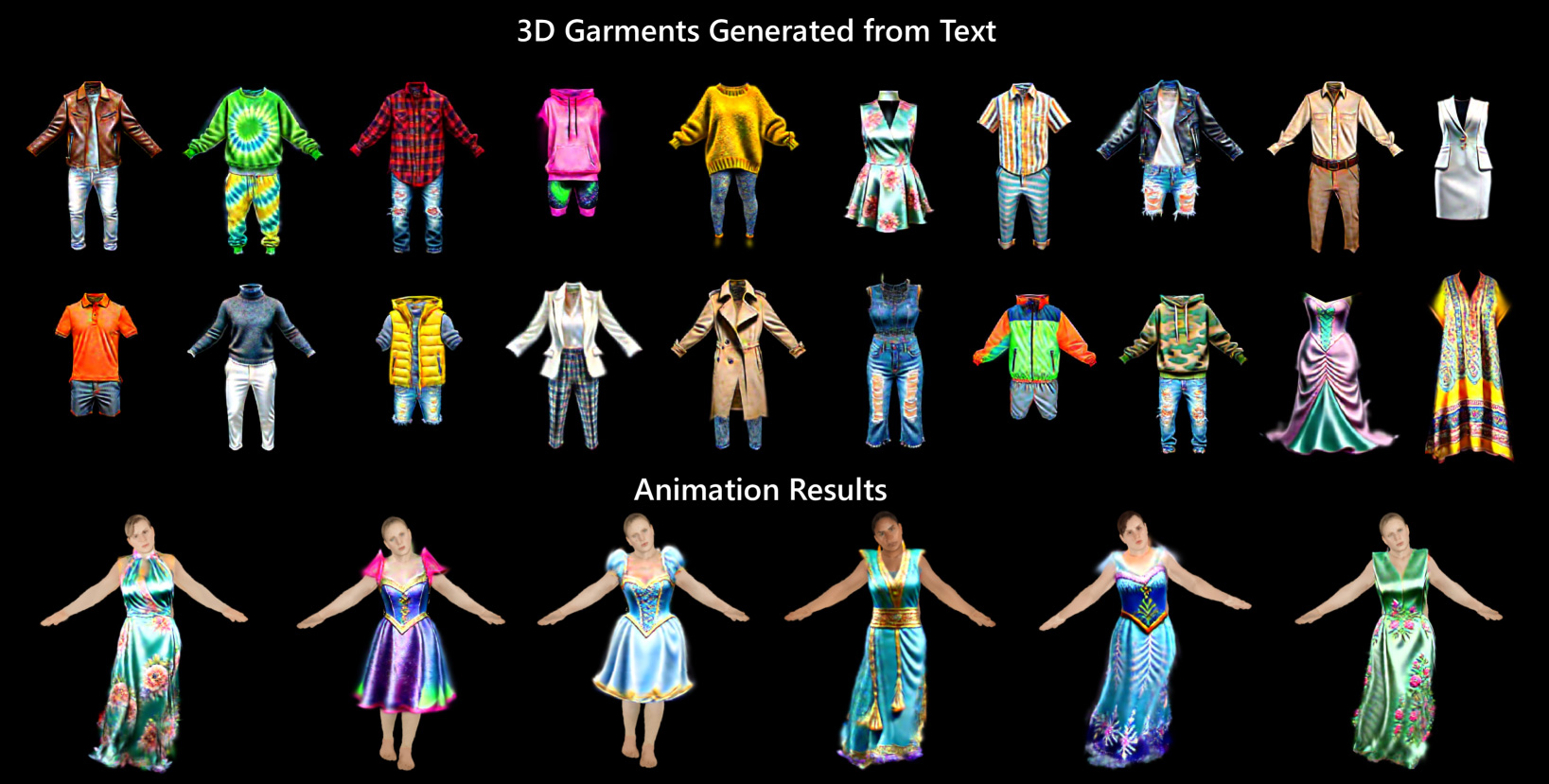
ClotheDreamer, a novel system for text-guided garment generation that uses 3D Gaussian Splatting (3D GS) to model diverse garment geometries.
ClotheDreamer allows users to generate 3D garment models from text descriptions, enabling more intuitive and expressive clothing design.
ClotheDreamer leverages the power of large language models and 3D Gaussian Splatting to generate detailed, high-quality garment meshes that capture complex shapes and folds.
ClotheDreamer is a tool that allows you to create 3D models of clothing through text descriptions. You don't need to use complex 3D modeling software to design garments yourself; simply input a description, and the system will generate 3D garment models for you.
The key innovation of ClotheDreamer is the use of 3D Gaussian Splatting (3D GS) to represent the shape of garments. Gaussian Splatting is a mathematical method for describing 3D shapes that can capture complex details such as folds and drapes on garments. By combining this 3D modeling technique with a powerful language model, ClotheDreamer can transform your text descriptions into highly realistic 3D garment models.
This makes the process of designing clothing more intuitive and accessible, as you don't need specialized 3D modeling skills. You can simply describe the garment you have in mind, and ClotheDreamer will bring it to life in 3D. This is useful for fashion designers, 3D artists, or anyone who wants to create custom clothing designs.
ClotheDreamer Technical Description
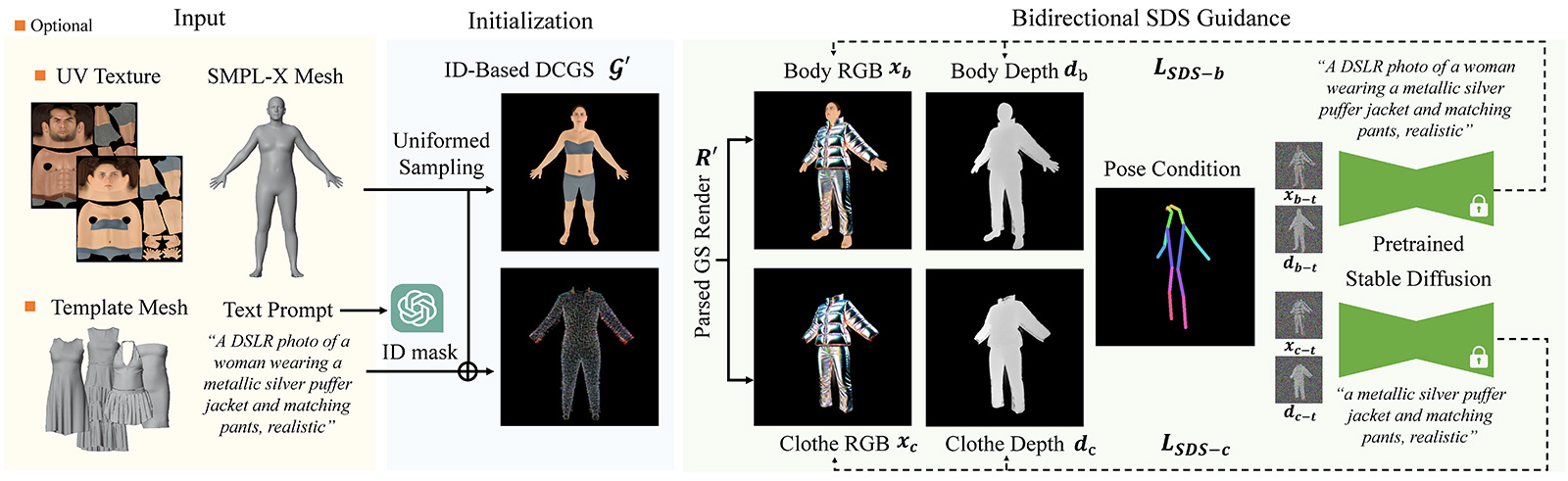
ClotheDreamer uses the GaussianDreamer: Fast Generation from Text to 3D architecture to generate 3D garment models based on text descriptions. It leverages pre-trained language models to encode the input text, which is then used to condition the generation of 3D Gaussian splats representing the garment geometry.
ClotheDreamer is trained on a large dataset of 3D garment models along with their corresponding text descriptions. During inference, the input text is encoded using a language model, and this representation is used to predict the parameters of the 3D Gaussian splats that will form the final garment mesh.
By using 3D Gaussian Splatting, ClotheDreamer is able to capture complex garment geometries, including folds, drapes, and other intricate details. This enables the system to generate highly realistic and diverse garment models that closely match the input text descriptions.
The authors also propose extensions to the base ClotheDreamer model, including LAGA: Layered 3D Avatar Generation and Customization via Text, and Dress Code: Autoregressively Sewing Garments from Text, which further expand the system's garment generation and customization capabilities.
ClotheDreamer Limitations Analysis
The ClotheDreamer system represents an impressive advancement in the field of text-to-3D generation, demonstrating the potential of large language models and 3D Gaussian Splatting for intuitive garment design. The ability to transform natural language descriptions into high-quality 3D garment models could have a significant impact on fashion, 3D art, and other fields.
However, the paper does acknowledge some limitations of the current approach. The system is trained on a relatively small dataset of 3D garment models, which may limit its ability to generalize to more diverse or unconventional garment styles. Additionally, while the 3D Gaussian Splatting representation can effectively capture complex geometries, it may not be suitable for all types of garment features, such as sharp creases or highly asymmetric shapes.
Further research could explore ways to expand the dataset, improve the 3D representation, and enhance the system's ability to handle a wider range of garment types and styles. As suggested in the related work, integrating ClotheDreamer with other 3D modeling tools or avatar generation systems could also unlock new applications and use cases for the technology.
Overall, ClotheDreamer represents an exciting step forward in the quest to make 3D garment design more accessible and intuitive. As the field of text-to-3D generation continues to evolve, systems like ClotheDreamer are likely to become increasingly valuable tools for designers, artists, and anyone who wants to bring their clothing ideas to life in the digital realm.