
 Asistente de guiones▸
 Apps AI
 Noticias AI
2026年AI学习路线:从入门到Agent应用开发,附详细的资源整理
小编 ·
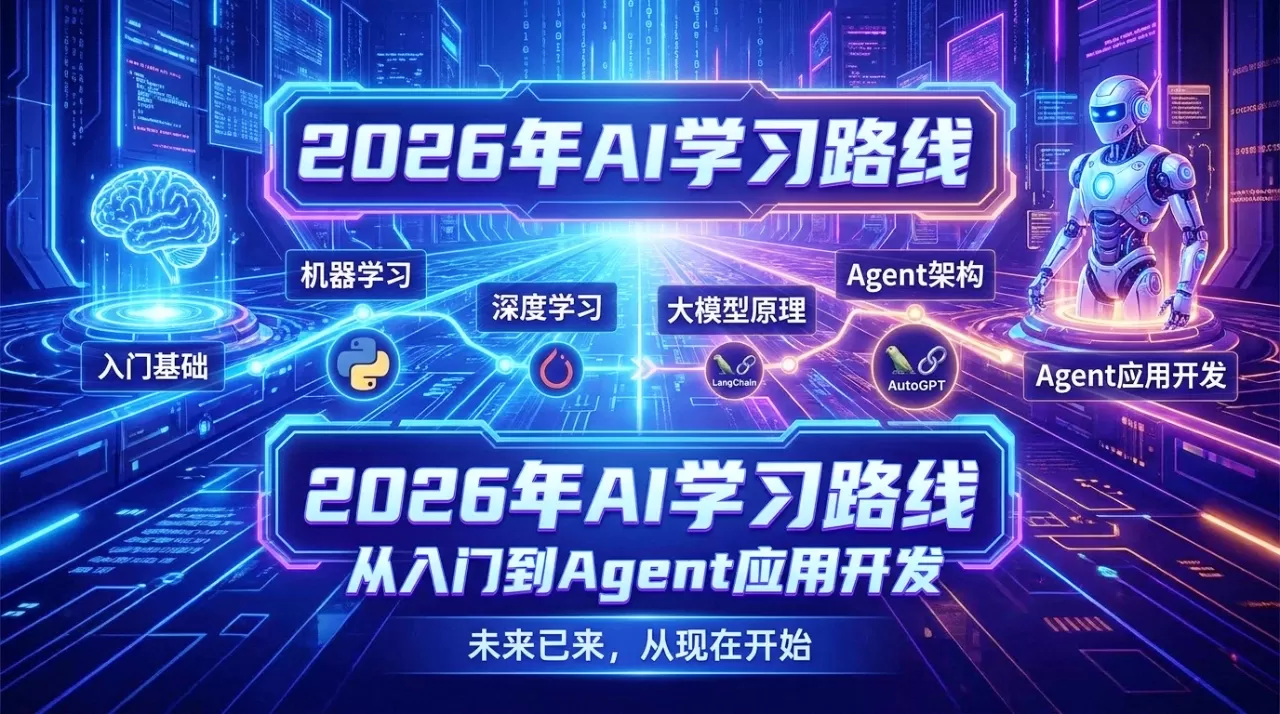
2026年AI学习路线:从入门到Agent应用开发,附详细的资源整理
Frequently people ask me: I want to learn ai development and programming—how should I study? In reality, the hardest part of learning AI is often not “not being able to learn it,” but the lack of a learning roadmap. There are too many tutorials, courses, tools, and papers. Many people work through a considerable amount of material, yet in the end they haven’t even completed a single working project.
Below is the AI learning roadmap I’ve put together for everyone: first learn to use it, then learn to build with it, and finally learn to deploy real solutions. We’ll follow the progression “Introduction—Fundamentals—Machine Learning—Deep Learning—Large Language Models and Agents—Engineering,” and I’ll also include worthwhile courses and books. I recommend checking out 科大讯飞AI大学堂, which offers many free AI courses.
Stage 1: Learn to use AI and develop sound judgment
Starting straight with mathematics and code can make you give up. A steadier starting point is to first understand what AI can and cannot do.
The main focus of this stage is:
AI can generate text, perform translation, organize information, conduct data analysis, generate images, and automate workflows;
Learn to write prompts, for example, by clearly defining the objective, providing examples, specifying the output format, and asking the model to think step by step;
Apply AI to real tasks, such as organizing notes, writing copy, checking code, creating spreadsheets, and generating images.
Become familiar with common tools and don’t stop at chatting with them.
You can start with Andrew Ng’s AI for Everyone, which provides a basic understanding in six hours. Then complement it with Andrew Ng’s courses on machine learning and deep learning; the videos cover Transformers and large language models and are accessible to Chinese speakers.
Stage 2: Build foundations in Python, data, and mathematics
If you want to develop AI applications, you can’t skip the fundamentals. But fundamentals don’t mean studying every mathematical proof from cover to cover; you only need enough to get by.
The main topics are:
Python variables, functions, file input/output, and API calls;
Data processing with NumPy, Pandas, and Matplotlib;
Linear algebra, probability and statistics, and calculus, with a focus on understanding vectors, matrices, probability, and gradient descent.
For videos, you can watch 3Blue1Brown’s Essence of Linear Algebra and Essence of Calculus, which are more intuitive than textbooks. For programming, try Harvard CS50P or Liao Xuefeng’s Python tutorial. As for books, Dive into Deep Learning is suitable for learning while running the code.
Stage 3: Machine learning—understand how models learn
This stage isn’t about memorizing formulas. It’s about understanding how models learn from data and how their performance is evaluated.
Focus on regression, classification, decision trees, random forests, and XGBoost in supervised learning; clustering and dimensionality reduction in unsupervised learning; and accuracy, recall, F1, AUC, and cross-validation in model evaluation.
The top course choice is Andrew Ng’s Machine Learning Specialization. You can pair it with Zhou Zhihua’s Machine Learning and Li Hang’s Statistical Learning Methods. For hands-on practice, use Hands-On Machine Learning with Scikit-Learn, Keras & TensorFlow. Ideally, complete an introductory Kaggle project, such as predicting Titanic survival or house prices.
Stage 4: Deep learning—enter the world of neural networks
Deep learning is the essential path to large language models. You don’t need to chase complex models at first; get the training workflow running first.
You need to learn forward propagation, backpropagation, loss functions, and optimizers; CNNs, RNNs, LSTMs, and Transformers; as well as the basics of using PyTorch.
For videos, try fast.ai’s Practical Deep Learning for Coders, which lets you get results first and fill in the theory later. Mu Li’s Dive into Deep Learning and its accompanying videos are also suitable for Chinese-speaking learners. For more advanced material, study Stanford CS231n and CS224n. As for books, Deep Learning with Python is strong on intuition, while the “flower book” Deep Learning is better used as a reference.
Stage 5: Large language models, RAG, and agents
This is a direction very worth investing in for 2026. Knowing how to call an API doesn’t mean you know how to build applications. The abilities needed to deliver real solutions usually include Embedding, vector databases, retrieval augmentation, tool calling, and agent orchestration.
Main topics include Transformers, pretraining, fine-tuning, and Embedding; Prompt Engineering; RAG retrieval augmentation; vector databases; LangChain, LangGraph, LlamaIndex, Dify, and Coze; as well as agent memory, planning, tool calling, and multi-agent collaboration.
You can take the Hugging Face NLP Course and Agents Course, which are free and offer certifications. The short courses from DeepLearning.AI offer good value for money. Microsoft’s Generative AI for Beginners works well as a main tutorial. During the hands-on stage, read less and consult official documentation more, because large language model tools evolve too quickly.
Stage 6: Engineering and industry deployment
Getting a demo to run is only the beginning. Being able to deploy, maintain, and solve real problems is what completes the loop.
In this stage, learn LoRA fine-tuning; local deployment with Ollama and vLLM; serving with FastAPI and Flask; Docker, CI/CD, and cloud deployment; the fundamentals of MLOps; and multimodal systems, agent systems, security, and compliance.
You can look at Full Stack Deep Learning, Berkeley’s LLM Agents course, and the official documentation for Ollama, vLLM, LangGraph, Dify, CrewAI, and AutoGen. This stage works best with a project-driven approach, such as building a knowledge-base Q&A assistant, a document organization tool, an automated reporting system, or a content generation workflow.
List of the most worthwhile video courses
| Stage | Course | Target audience |
|---|---|---|
| Introduction | Andrew Ng’s AI for Everyone | Building a basic understanding from scratch |
| Fundamentals | Andrew Ng’s machine learning/deep learning series | Comprehensive Chinese-language courses |
| Mathematics | 3Blue1Brown’s linear algebra/calculus | Visualizing and reinforcing the fundamentals |
| ML | Andrew Ng’s Machine Learning Specialization | Main machine learning course pathway |
| DL | fast.ai’s Practical Deep Learning for Coders | Getting started quickly with deep learning |
| Chinese-language hands-on | Mu Li’s Dive into Deep Learning | Learning while running the code |
| Advanced | Stanford CS224n/CS231n | Advanced NLP and computer vision |
| Large language models | Hugging Face NLP/Agents Course | Large language model application development |
| Short courses | DeepLearning.AI short course series | Quickly filling gaps in specific skills |
| Open-source tutorial | Microsoft’s Generative AI for Beginners | Introduction to the entire workflow |
Essential reading list
Introducción y conocimientos básicos
Material complementario de «AI for Everyone»
《浪潮将至》
《智人之上》
Fundamentos y matemáticas
《 lineal algebra esencial》
《Python for Everybody》o materiales de CS50P
《Poder de las matrices》
Aprendizaje automático
《Aprendizaje automático》周志华
《Métodos de aprendizaje estadístico》李航
《Hands-On Machine Learning with Scikit-Learn, Keras & TensorFlow》
Aprendizaje profundo
《Deep Learning》Ian Goodfellow
《Dive into Deep Learning》李沐
《Deep Learning with Python》
《Neural Networks and Deep Learning》邱锡鹏
Modelos grandes y aplicaciones
《Transformers for Machine Learning》
《Desarrollo de aplicaciones con modelos grandes: crea un AI Agent con práctica》
Documentación oficial de LangChain / LangGraph / LlamaIndex / Dify
Nivel avanzado
《Inteligencia artificial: métodos modernos》
《Pattern Recognition and Machine Learning》
《Reinforcement Learning: An Introduction》
《Superinteligencia》
Cómo seguir esta ruta
No abras demasiados cursos a la vez. En cada etapa, basta con elegir un curso principal, un libro y un proyecto pequeño.
Puedes seguir como referencia este calendario:
1—2 meses: Python, tratamiento de datos e ingeniería de prompts; completa varias tareas asistidas por IA.
3—5 meses: aprendizaje automático y métricas de evaluación; completa un proyecto de clasificación o regresión.
6—8 meses: aprendizaje profundo y PyTorch; completa un proyecto pequeño de imágenes o texto.
9—12 meses: modelos grandes, RAG y agentes; crea un sistema de preguntas y respuestas sobre una base de conocimiento o un asistente automatizado.
Después del mes 12: despliegue, optimización y aplicaciones sectoriales; crea un portafolio que puedas mostrar.
Si solo quieres utilizar la IA para mejorar tu productividad, céntrate en la primera y la quinta etapa. Si quieres desarrollar aplicaciones de IA, empieza por reforzar los fundamentos en la segunda etapa. Si quieres crear contenido para un sitio de herramientas de IA, prioriza los modelos grandes, RAG, los agentes y la ingeniería: descompón productos, escribe casos prácticos y realiza comparativas y evaluaciones.
Lo más importante al estudiar IA es empezar a crear cuanto antes. Incluso un asistente que responda preguntas sobre documentos vale más que guardar diez cursos. Ojalá todos aprendáis algo.









