Script Planner Assistant▸
 AI Apps
 AI News

AnimeGANv2_云技派,专注ai人工智能!
AnimeGANv2_云技派,专注ai人工智能!Introduction
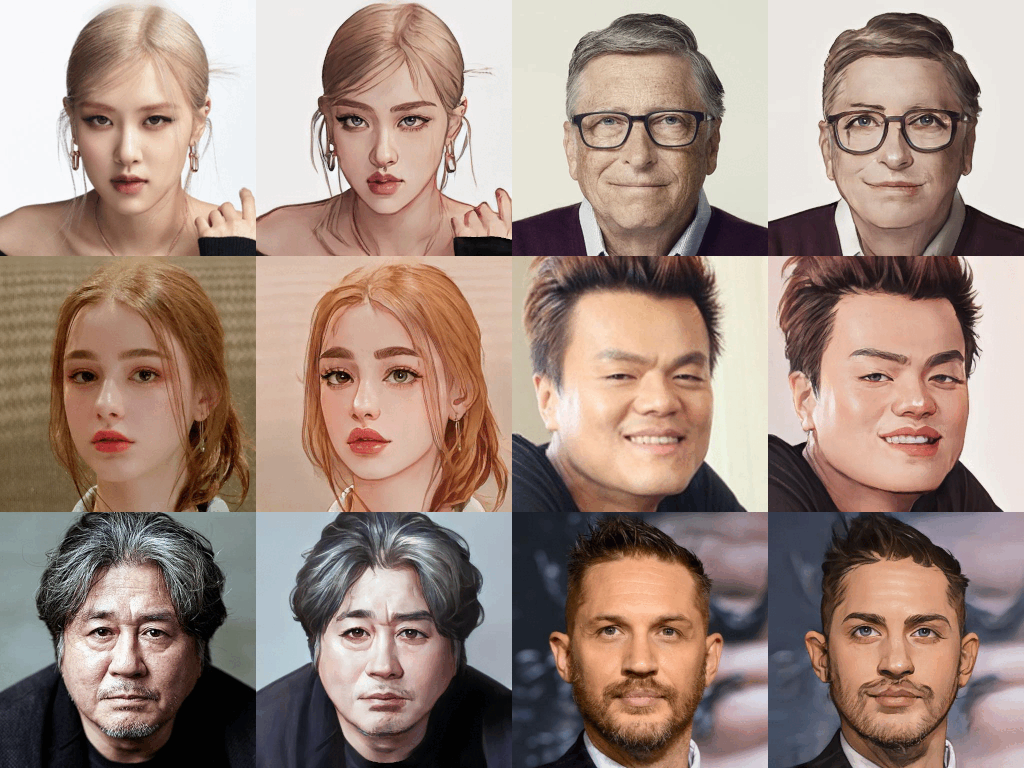
AnimeGAN is a research project from Wuhan University and Hubei University of Technology, employing a combination of neural style transfer and Generative Adversarial Networks (GAN). AnimeGAN was first proposed last year and was built on the TensorFlow framework. The project has now developed a second-generation version that supports the PyTorch framework.
AnimeGAN Features
Solving high-frequency artifacts: Compared with the first generation AnimeGAN, AnimeGANv2 effectively addresses the high-frequency artifact problem in generated images, making the resulting anime-style pictures more natural and aesthetically pleasing.
Model optimization: AnimeGANv2 further reduces the size of the generator network and decreases the number of parameters (the generator is now 8.17Mb), while maintaining high-quality animation style transfer.
Support for multiple styles: AnimeGANv2 supports the styles of renowned animators such as Hayao Miyazaki, Makoto Shinkai, and Satoshi Kon, allowing users to choose different anime styles for conversion according to their preferences.
Technical Background and Improvements:
Image style transfer technology: AnimeGANv2 is based on a Generative Adversarial Network (GAN) framework, specifically designed to convert real-world photos into anime style. It solves the high-frequency artifact problem present in the first generation AnimeGAN by introducing feature layer normalization to reduce such visual noise.
Network structure optimization: It adopts a U-Net-like structure combined with an edge loss function to enhance background color matching and character detail features in the generated images, delivering higher-quality conversion results.
Loss function innovation: It introduces grayscale style loss, adversarial loss, content loss, etc., ensuring that the generated images retain the content of the original photos while featuring clear anime-style textures and lines.
Lightweight and efficient: The model has fewer parameters and is easy to train, with a generator size of only 8.17Mb, supporting fast generation of high-quality anime-style images.
AnimeGANv2 Use Cases
Personal entertainment: Users can convert their own photos into anime style.
Artistic creation: Artists and designers can use this technology to create artworks that blend reality with anime aesthetics.
Social media: Share personalized anime-style images on social media.
Advertising and brand design: Brands can leverage anime-stylized images for creative marketing campaigns.
How to Use AnimeGANv2
Online Experience:
Gradio Demo: AnimeGANv2 provides an online demo on Hugging Face through community contributors. Users do not need to install any software—simply upload a photo, select a style preference, and quickly obtain the conversion result.
Steps:
Visit the online experience page.
Upload a photo by dragging and dropping or clicking the upload button.
Select a style version (e.g., version 1 emphasizes stylization, while version 2 focuses on robustness to the original image).
Click submit and wait for processing to complete.
Local Deployment:
Technical requirements: A Python environment, TensorFlow or PyTorch library, and related dependencies are required.
Steps:
Clone the AnimeGANv2 repository from GitHub.
Install the necessary dependencies.
Prepare or download the pre-trained model.
Run the code and enter the photo path as directed.
Wait for the model to process, and the anime-stylized image will be output.
Project: https://github.com/TachibanaYoshino/AnimeGANv2
Related Information: