Script Planner Assistant▸
 AI Apps
 AI News

Qiewen Academic AI: AI Academic Agent by Fudan NLP Lab
Qiewen Academic AI: AI Academic Agent by Fudan NLP LabIntroduction
What is Qiewen Academic AI
Qiewen Academic AI is an AI academic tool built by the FudanNLP Lab at Fudan University, and it is also the domestic version of WisPaper. It does more than just search for papers—it aims to connect the entire workflow of retrieving, reading, organizing, and even running experiments.
Qiewen Academic AI covers metadata for over 500 million papers and full text for 120 million papers, with around 50,000 new papers added daily, spanning 32 top-level disciplines including computer science, life sciences, mathematics, physics, and chemistry. The team is one of the earliest NLP research labs in China, with a retrieval accuracy of 93.78% and a citation authenticity rate of 99.80%.
You can talk to the paper database in plain language, and manage, read, and run the materials you find.
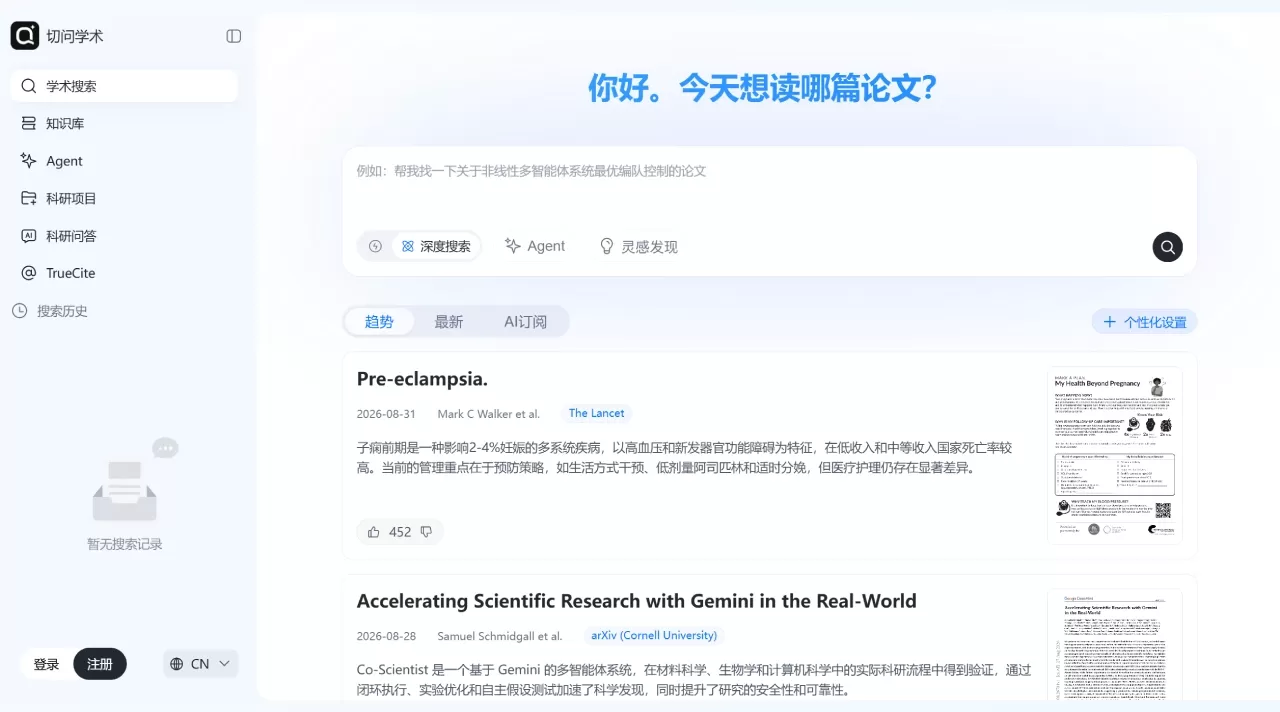
Why Choose Qiewen Academic AI
Better optimization for Chinese scenarios: Built by the Fudan NLP Lab, with a more practical understanding of Chinese academic writing habits and domestic research workflows. The interface is fully in Chinese, and English literature translation has been specifically tuned for academic contexts.
99.80% citation authenticity, no fabricated references: This is the biggest difference between it and general-purpose large models. The biggest risk with ChatGPT and Claude in academic scenarios is "hallucination"—fabricating papers that don't exist. Qiewen Academic answers based on real paper metadata, and every citation can be traced back to a genuine source.
Closed loop from search to experiment: Most academic tools stop at "help you find papers" or "help you understand papers." Qiewen Academic's Agent extends the chain to "help you run papers," which is quite practical for researchers who need to reproduce experiments to validate ideas.
Generous free tier, even better value for campus users: The free version gives 100 credits upon registration (permanent), plus 20 credits for daily login—usually enough for occasional literature searches and reading. Fudan University faculty and students can use the Plus version for free directly with their campus accounts.
Core Features
AI Deep Search: No need to break down keywords. Just type in your research question directly, for example, "What recent real-world applications are there for large language models in healthcare?" The system understands your intent and returns papers; highly relevant ones are marked "Perfect," with a summary explaining exactly how the paper matches your question.
AI Full-Text Translation: Translate foreign-language papers with one click, preserving original formulas, figures, and layout. Bilingual Chinese-English reading is supported, without the LaTeX formula corruption common in traditional machine translation.
Personal Knowledge Base and Conversation: Zotero-like citation management with unlimited folder hierarchy. Upload PDFs and metadata is auto-recognized for archiving. You can ask questions of documents in your library, and the AI answers based on the original text, helping you quickly pinpoint core arguments.
Smart Tracking: After setting research field keywords and filter criteria, the system continuously pushes the latest papers in that direction. New papers are automatically flagged for association with your saved library.
Smart Survey: Automatically generates instant literature reviews and knowledge maps based on search results, with citations to real papers. This addresses the "fabricated citations" problem of large models—content is generated only from real, indexed papers.
Research Agent: After uploading a paper, the AI automatically breaks down the experimental method, assesses compute requirements, applies for GPU servers, configures the PyTorch and CUDA environments, pulls the code, and runs the experiment. When dependency conflicts arise, it tries downgrading, reinstalling, or rewriting scripts on its own until the Pilot Test passes. The official claim is a reproduction success rate above 90%. Researchers without local GPUs or clusters can save a lot of time with this.
Academic Q&A: Source-traceable Q&A based on your literature library, compressing hours of complex investigation into minutes. Every answer can be traced back to a specific paper source.
Use Cases
Graduate students / PhD candidates: literature review before opening a topic, quickly locating core papers when writing a survey, tracking the frontier to avoid topic overlap.
University researchers: quickly building a cognitive framework during cross-disciplinary exploration, and long-term tracking of breakthroughs in a specific direction.
Clinicians / medical researchers: continuously monitoring the latest research in diagnosis and treatment, accumulating literature support for grant applications.
Enterprise R&D teams: investigating industry tech trends and competitor papers, accelerating project evaluation.
Young scholars / undergraduates: using bilingual translation to overcome language barriers and improve efficiency when reading foreign-language papers.
Researchers without GPUs or resources: using the Agent feature to reproduce paper experiments on cloud GPUs, bypassing local compute bottlenecks.
How to Use Qiewen Academic AI
Visit qiewenpaper.com to register and sign in. Individual registration or institutional login is supported (some universities have already enabled institutional trials).
Enter your research question in the search box, and the AI returns a matching paper list. Pay attention to papers marked "Perfect" for high relevance.
Open a foreign-language paper and use the full-text translation feature to read in parallel while preserving formulas and figure layouts.
Add important papers to your personal library and manage them with hierarchical folders; upload your own PDFs and the system will automatically recognize metadata.
Select a specific document or folder and ask the AI directly to get in-depth answers based on the original text.
Set research field keywords, enable smart push, and periodically check for the latest frontier developments.
Use the Survey feature on search results to automatically generate literature reviews and knowledge maps.
Advanced usage: For papers that need to be validated, invoke the Agent to automatically pull code, configure the environment, request GPUs, and execute the code.
Qiewen Academic AI vs. Competitors
| Dimension | Qiewen Academic | Google Scholar | Elicit | Consensus | ResearchRabbit | CNKI / Wanfang |
|---|---|---|---|---|---|---|
| Core positioning | AI academic agent (search + read + reproduce) | Traditional academic search engine | Structured data extraction and literature synthesis | Evidence adjudication and claim aggregation | Citation network visualization and literature discovery | Chinese academic database |
| Search method | Natural language query, AI understands intent | Keyword / Boolean logic search | Natural language + structured field extraction | Natural language, supports yes/no questions | Expand citation network from seed papers | Keyword, author, institution search |
| Literature coverage | 500M+ metadata, 120M+ full text | Extremely broad, covers all disciplines | About 138 million papers | About 200 million papers | Based on Semantic Scholar and other indexes | Mainly Chinese journals, master's and doctoral theses |
| AI synthesis | Smart survey + knowledge map, citations are real | No | Structured table synthesis, supports PRISMA | Consensus Meter evidence aggregation | No synthesis, focuses on discovery | No |
| Literature management | Built-in knowledge base, unlimited folder hierarchy | Requires tools like Zotero | Basic favorites | Basic favorites | Favorites + collaboration | Personal literature management is weak |
| Full-text translation | Supported, preserves formulas, figures, and layout | No | No | No | No | No |
| Experiment reproduction | Agent automatically requests GPU, configures environment, runs code | No | No | No | No | No |
| Chinese optimization | Excellent, fully Chinese interface | Average | Weak | Weak | Weak | Excellent |
| Pricing | Free + Plus (35 RMB/month) + Pro (150 RMB/month) | Free | Free + from $10/month | Free + $9-12/month | Institutional subscription-based, with higher individual fees | |
| Who it's for | Researchers who need end-to-end research assistance, especially those with paper reproduction needs | Quickly finding known literature | Conducting systematic reviews that require structured extraction | Quickly verifying scientific claims and adjudicating evidence | Expanding a literature network from a single seed paper | Chinese-language literature search and deduplication |
Frequently Asked Questions
Q: Is Qiewen Academic AI free?
There is a free version. Registration grants 100 permanent credits, and logging in daily grants another 20 credits. This is basically enough for light daily use. Plus version is 35 yuan/month, Pro version is 150 yuan/month. Fudan University faculty and students can use the Plus version for free with their campus account.
Q: Does it fabricate references?
No. It answers based on real paper metadata, with a citation accuracy of 99.80%, and every citation can be traced back to a specific source. This is a fundamental difference from general-purpose large models in this regard.
Q: Can the Research Agent reproduce any paper?
Currently it mainly targets papers in fields such as computer science and artificial intelligence that have publicly available code. After uploading a PDF, the AI first assesses the experimental difficulty and code availability, before deciding whether to proceed. Officially, the reproduction success rate is over 90%, but complex experiments or papers with unavailable data may still fail.
Q: Which disciplines are supported?
Mainly natural sciences and engineering technology, such as computer science, life sciences, mathematics, physics, chemistry, materials science, etc.; there are also a small amount of humanities and social sciences resources. Fields such as medicine, education, and management are also covered.
Q: Which languages does the translation feature support?
It mainly focuses on translating English literature into Chinese, preserving formulas, figures, and professional formatting. In bilingual reading mode, the original text and translation are displayed side by side.
Q: Can it generate a paper with one click?
No. Its positioning is to handle the repetitive work in research — searching, translating, organizing, reproducing experiments — but the core innovative thinking and academic writing still need to be completed by the researcher themselves.
Q: How do off-campus users register?
Visit the official website qiewenpaper.com. Registration via mobile phone number or WeChat scan is supported. Some universities have enabled institutional login, and you can use it after verification through your school email.
Related News:
60 Must-Have Paper Writing and Academic Research Tools for Researchers