Script Planner Assistant▸
 AI Apps
 AI News

Xiaohe Yinxing: A Phonetic-Shape Hybrid Input Method by the Xiaohe Team
Xiaohe Yinxing: A Phonetic-Shape Hybrid Input Method by the Xiaohe TeamIntroduction
What is Xiaohe Yinxing
Xiaohe Yinxing is a phonetic-shape combined input method developed by the Xiaohe Input Method team. It is an advanced version based on Xiaohe double pinyin. Its defining feature is a fixed four-key length: most common characters are input with just four keystrokes and go directly to the screen, with no need to flip through candidate selections.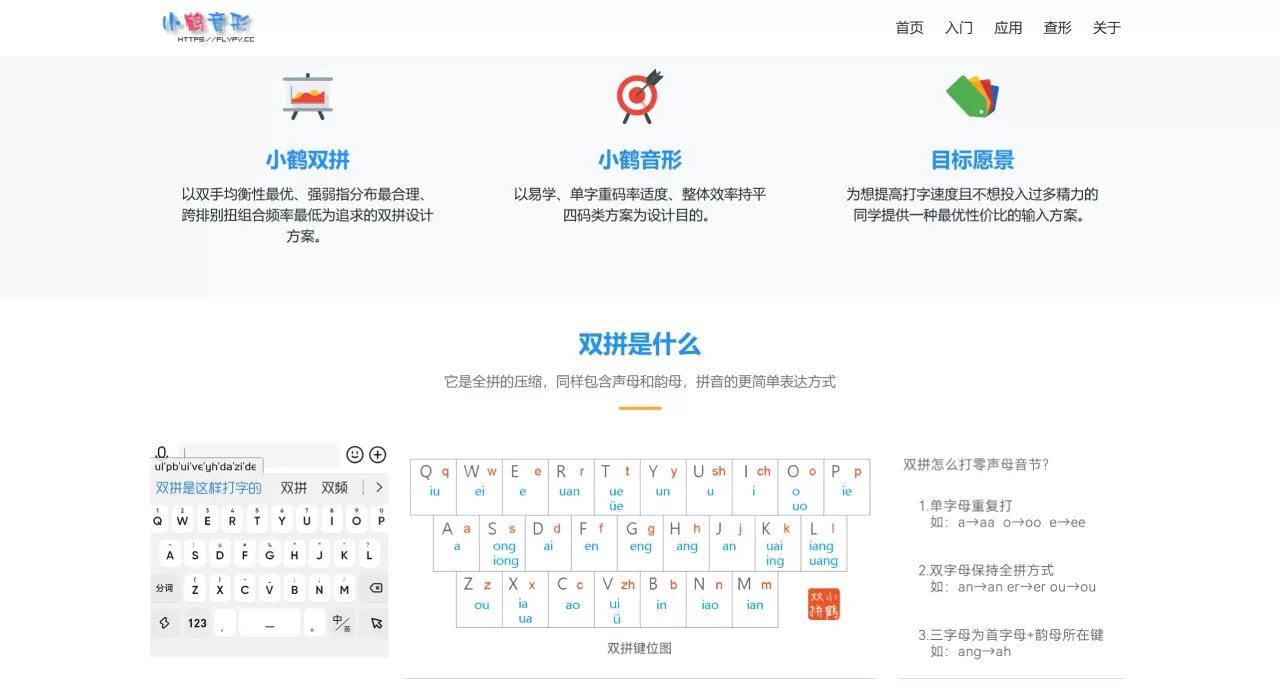
Core Principles
The encoding consists of double pinyin and shape-code components:
The first two characters are double pinyin, with one letter each for the initial and final.
The last two are shape codes, taking the character's first and last forms according to the splitting rules.
Example: after typing herk, the character "鹤" is entered directly.
Main Features
Four-key input: most common characters are completed in four keystrokes, without relying on the candidate box.
Low duplicate-code rate: shape codes distinguish homophones, resulting in few single-character duplicates.
Word rules:
Two-character words: first two codes of the first character + first two codes of the second character (initial-final initial-final)
Three-character words: first code of the first two characters + first two codes of the last character (initial-initial initial-final)
Four-character words: first code of each of the four characters (initial-initial initial-initial)
More than four characters: first code of the first three characters + first code of the last character
Short-code system: short codes are set for level one, two, and three common characters to speed up input.
Wildcard key: supports bidirectional reverse lookup, allowing lookup by sound to get the shape, or by shape to get the sound.
Differences from Double Pinyin
Shape codes are added on top of Xiaohe double pinyin. Structural information reduces duplicates and shortens the input length.
Learning Path
It is recommended to first become familiar with double pinyin, then transition to the phonetic-shape scheme:
Master Xiaohe double pinyin, about one to two weeks.
Learn the Xiaohe shape-splitting rules. Radicals are based on the "sound-as-key" ("音托") principle, mapped to keys according to their pronunciation.
Practice fixed four-key input.
How to Use
Download and install: visit the official website https://flypy.cc/ and download the input method for your platform.
Mainstream input method integration options: if you are already using Rime, Sogou, Shouxin, or other input methods, you can directly load the Xiaohe Yinxing scheme:
| Input Method | Configuration Method |
|---|---|
| Rime (小狼毫/鼠须管/同文) | Download the official schema file and place it in the configuration directory |
| Sogou/Shouxin | Download the Xiaohe Yinxing skin/scheme package and import it |
| iOS/Android | Use apps that support Rime, such as iRime or Tongwen Input Method |
Xiaohe Shape-Splitting Rules Quick Reference
Shape Selection Principles
Take the first shape and the last shape of the character, each corresponding to a key.
Shape-code keys follow the "sound-as-key" principle: the shape-code key matches the first letter of that component's pronunciation.
Components without an independent pronunciation are assigned to the key whose shape or common pronunciation is closest.
Some Common Shape-Code Keys
a: radicals such as 亻, 彳, 丿, 乛
b: 阝 (left ear), 卩, 勹, etc.
c: 艹, 廾, , etc.
d: 丶, 冫, 氵, etc.
e: 阝 (right ear), 卩 (partial)
f: 扌, 攵, 夊, etc.
g: 钅, 刂, 亅, etc.
h: 讠, 亠, 冖, etc.
i: 氵, 丬, etc. (overlapping with d; differentiated by structural position)
j: 纟, 糸, etc.
k: 口, 囗, etc.
l: 耒, 耜, etc. (rare characters, mostly assigned by sound-as-key)
m: 木, 朩, etc.
n: 女, 孑, etc.
o: 日, 曰, etc.
p: 宀, 冖, etc. (overlapping with h; take the main shape)
q: 犭, 犬, etc.
r: 人, 入, 𠆢, etc.
s: 石, 礻, etc.
t: 土, 士, etc.
u: 扌, 攴, etc. (overlapping with f; determined by structure)
v: 见, 贝, etc.
w: 王, 玉, 耂, etc.
x: 纟, 幺, etc. (overlapping with j)
y: 又, 廴, 聿, etc.
z: 辶, 廴, etc.
Order of Shape Selection
First split the character into independently formed components, then take the first and last forms in writing order.
If the remaining part is a single stroke with no phonetic anchor, it is assigned to a nearby visually similar or generic shape code.
Usage Examples
"鹤": double pinyin he, first shape "鸟" (sound key n), last shape "冖" (sound key h) → shape codes nk, full code henk (this is illustrative only; refer to the official table for the actual encoding).
When practicing, compare the character's split and prioritize confirming the sound-key of the first and last components.
Frequently Asked Questions
No character appears after typing four codes?Check whether the "四码上屏" (four-code direct commit) option is enabled, or whether the character's encoding is incorrect.
Cannot type a word?Check whether the word is included in the dictionary, or use the custom-word feature to add it.
Forgot how to split a character's shape?Use the wildcard key ` for reverse lookup, or temporarily switch back to double pinyin mode.
Switching with double pinyin?Most schemes support Shift or a specific shortcut key to switch between pure double pinyin and Yinxing mode.
Related Information: