Script Planner Assistant▸
 AI Apps
 AI News

MiroFish: AI Prediction Engine Powered by Multi-Agent Technology
MiroFish: AI Prediction Engine Powered by Multi-Agent TechnologyIntroduction
MiroFish is a recently popular open-source AI prediction engine that has ranked high on the GitHub global trending list. It was developed by BaiFu (Guo Hangjiang), a 20-year-old senior student at the University of Science and Technology of China, and received a 30 million RMB investment from Chen Tianqiao, founder of Shanda Group.
MiroFish is an AI prediction engine powered by multi-agent technology, positioned as a "simple and universal swarm intelligence engine capable of predicting all kinds of things."
Its core design philosophy is to build a "parallel digital world": it extracts "seed information" from the real world, such as breaking news, policy drafts, financial signals, or novel texts, and then automatically constructs a high-fidelity virtual digital world. In this virtual space, there are thousands of intelligent agents with independent personalities, long-term memory, and behavioral logic. They freely interact with one another and develop social relationships. Users can dynamically add variables from a "god's-eye view," enabling more accurate predictions of future development directions.
This project was officially released in December 2025 under the AGPL-3.0 open-source license, and has already garnered more than 10K Stars on GitHub.
MiroFish Features
Graph Construction: Uses temporal GraphRAG technology to extract key entities and their relationships from seed materials, thereby building a dynamic knowledge graph. For example, in the "Dream of the Red Chamber" case, the system generated 905 entity nodes and 3,822 relationship edges based on 150,000 characters of the original text.
Agent Generation: Based on the constructed knowledge graph, it automatically extracts relationships between entities to generate intelligent agents with independent personalities, stances, and backgrounds, and equips these agents with long-term memory.
Swarm Intelligence Evolution: Launches simultaneous simulations on dual platforms, allowing dozens to hundreds of intelligent agents to discuss, compete, and act on specific topics within their own independent environments, thereby simulating phenomena such as public opinion fermentation and group polarization in real society.
Dynamic Variable Injection: During the simulation, users can add new variables in real time (for example, "what if the policy is released one week earlier") and observe how butterfly-effect-like situations affect the development of the virtual society.
Visualized Reports: A dedicated ReportAgent comprehensively analyzes the actions and evolution results of all intelligent agents, outputting a structured prediction report that includes event development trajectories, key milestones, trend judgments, and risk warnings.
In-Depth Interactive Exploration: After the simulation is complete, users can have one-on-one conversations with any intelligent agent to inquire about their viewpoints and decision-making logic, or communicate with the ReportAgent to flexibly understand the prediction results.
MiroFish Technical Highlights
Adopts the OASIS simulation engine open-sourced by the CAMEL-AI team, capable of supporting millions of intelligent agents interacting simultaneously.
Integrates Zep Cloud technology to manage the long-term memory of intelligent agents.
Supports pause and resume functionality, allowing users to flexibly control the prediction process.
MiroFish Application Scenarios
MiroFish is suitable for a wide range of scenarios, from serious prediction to recreational simulation:
Macro-Level Decision Rehearsal
Public Opinion Crisis Response: Predicts the dissemination paths of hot events in terms of public opinion, changes in public sentiment, KOL reaction trends, and potential risk points, helping relevant personnel formulate response strategies in advance.
Policy Effect Evaluation: In a risk-free environment, simulates the reactions of various social parties after a policy is released, and tests the effects of different release timings and wording.
Corporate Strategic Analysis: Simulates the impact of negative news on a publicly listed company's stock price, or predicts strategic evolution and market effects after a large-scale corporate financing round.
Micro-Level Creative Exploration
Literary Creation: Deduces branch directions and ultimate endings of novel plots. Official demo cases include predicting the lost ending of "Dream of the Red Chamber" based on its first 80 chapters.
Entertainment Simulation: Explores various novel "brain-teaser" scenarios, such as how fictional characters would behave and react in specific situations.
Financial Prediction
Analyzes the impact of financial signals on market sentiment and simulates crowd behavior under different market conditions.
MiroFish Advantages
Extremely Low Barrier to Entry: Uses natural language interaction, so users don't need to know code or understand complex parameters—"as long as you can hold a conversation, you can use this software."
High Simulation Fidelity: Intelligent agents have long-term memory and independent personalities; their behavioral logic is relatively close to that of real humans, and they can exhibit group dynamics similar to those in real society.
Zero-Risk Trial and Error: Provides decision-makers with a safe rehearsal venue, avoiding the high costs of experimenting in the real world.
Healthy Open-Source Ecosystem: The code is open source (under the AGPL-3.0 license), supporting local deployment and secondary development, with an active community.
Flexible Deployment Options: Provides three different deployment methods: online demo, source code deployment, and Docker deployment.
How to Use MiroFish
1. Online Experience
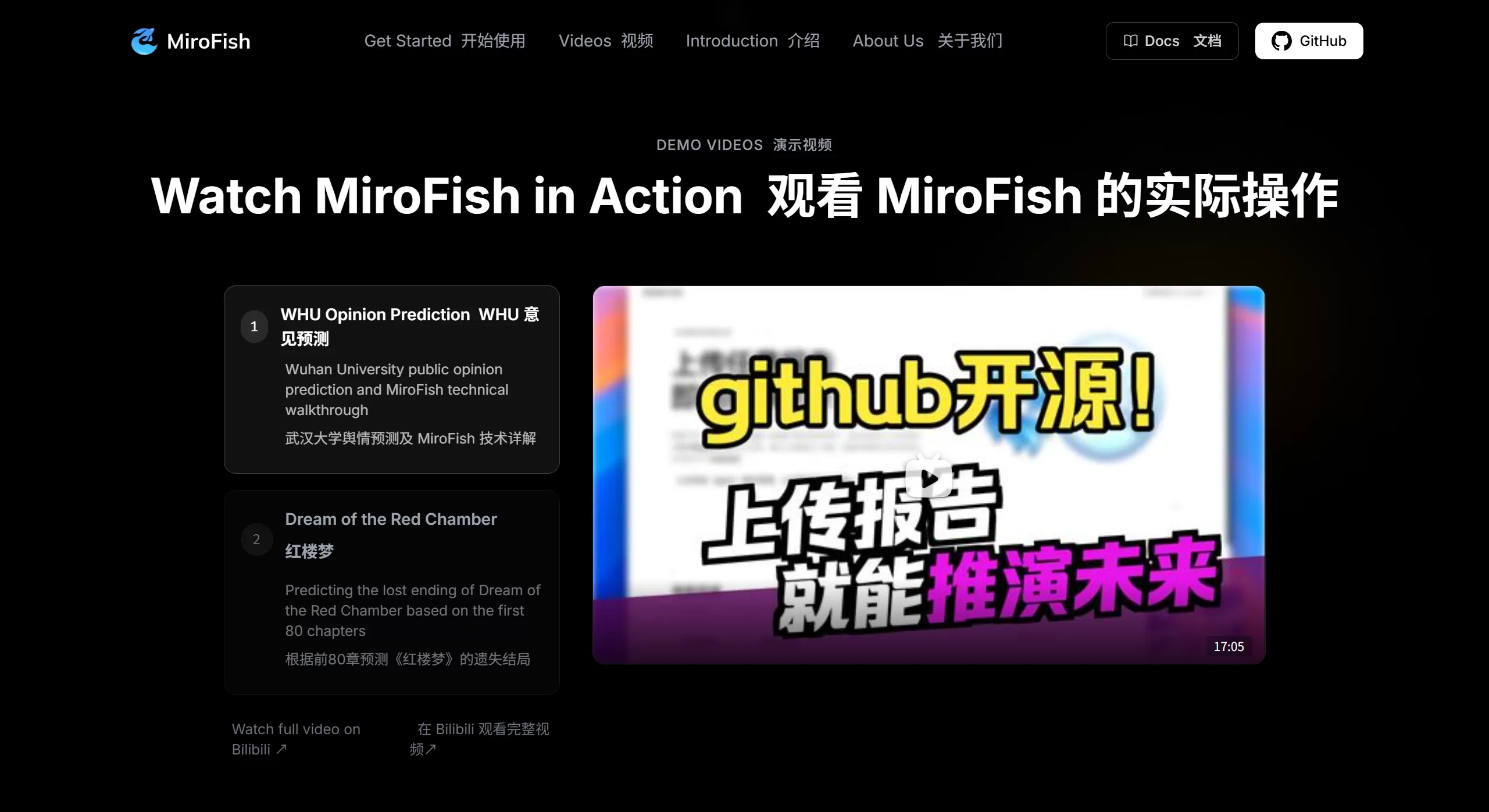
Directly visit the official demo URL to experience preset cases (such as Wuhan University public opinion simulation and "Dream of the Red Chamber" continuation):
https://666ghj.github.io/mirofish-demo/
2. Local Deployment
Environment requirements: Node.js 18+, Python 3.11-3.12, uv package manager
# Clone the repository
git clone https://github.com/666ghj/MiroFish
# Configure keys
cp .env.example .env
# Edit .env and fill in your LLM API Key and Zep API Key
# One-click dependency installation
npm run setup:all
# Start the service
npm run dev
# Frontend at localhost:3000, backend API running at localhost:5001
3. Docker Deployment
After completing the .env file configuration, run:
docker compose up -d
MiroFish Usage Workflow
Upload seed materials: Upload raw materials such as analysis reports, novel texts, or news.
Describe prediction requirements: Use natural language to clearly state the problem you want to simulate (for example, "After this event is released, what will the main public opposition focus on?").
Wait for system construction: The system will automatically complete knowledge graph construction, intelligent agent generation, and environment configuration.
Run the simulation: Set the number of simulation rounds and observe the interactions between intelligent agents and the evolution of society.
View reports and interact: Read prediction reports or have in-depth conversations with specific intelligent agents to explore details further.
Frequently Asked Questions (FAQ)
Q: Is MiroFish free?
A: Yes, MiroFish uses the AGPL-3.0 open-source license, and the code is completely free. However, during use, you need to prepare your own large model API Key (such as Alibaba Cloud Bailian), which may incur API call fees.
Q: What is the relationship between MiroFish and BettaFish?
A: BettaFish (微舆) is the author's previous work, mainly focused on public opinion analysis (i.e., analyzing past events); MiroFish is its upgraded version, focusing on prediction and simulation (i.e., predicting future events). The relationship between the two is likened to a "rearview mirror" and a "telescope."
Q: Do I need programming basics to use it?
A: No. This product is designed with the philosophy of ultimate simplicity—users only need to describe their needs in natural language, and all complex configurations are automatically completed by AI in the background.
Q: Which large models are supported?
A: In theory, all LLM APIs conforming to the OpenAI SDK format are supported. In the official examples, qwen-plus from the Alibaba Bailian platform is the default recommendation.
Q: What content can be predicted?
A: Currently, official examples cover hot public opinion, campus events, and novel ending simulations. Simulation features for more scenarios, such as finance and current affairs, will be updated陆续.
Q: Can the simulation process be interrupted?
A: Yes, MiroFish supports simulation pause and resume functionality, allowing users to flexibly control the prediction process.
h2>MiroFish Project ResourcesGitHub Repository:https://github.com/666ghj/MiroFish
Online Demo:https://666ghj.github.io/mirofish-demo/