
 Script Planner Assistant▸
 AI Apps
 AI News

Story-Iter: A Long-Story Visualization Solution by UCSC-VLAA
Story-Iter: A Long-Story Visualization Solution by UCSC-VLAAIntroduction
What is Story-Iter?
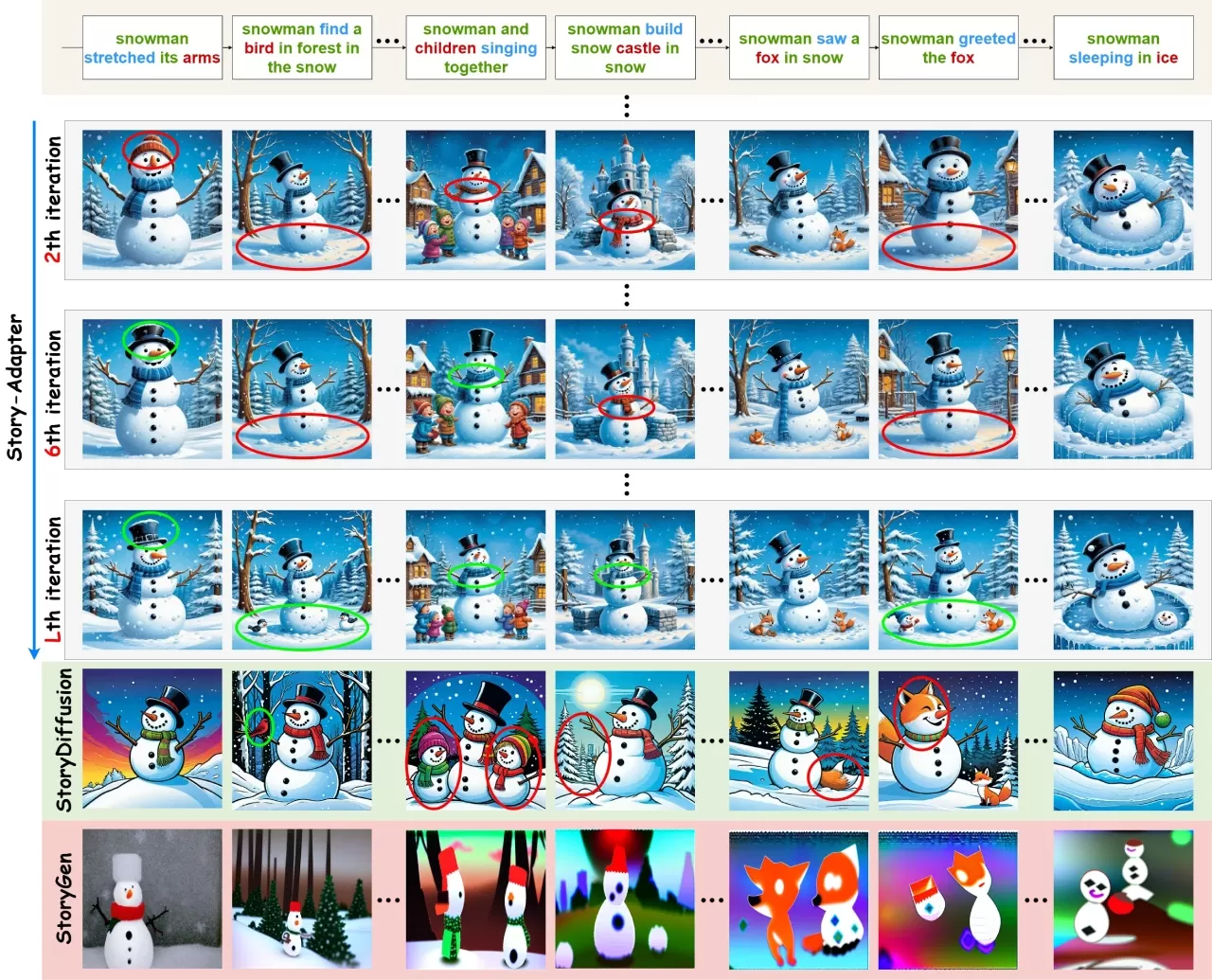
Story-Iter is a long story visualization solution proposed by UCSC-VLAA. This task requires generating coherent image sequences from narrative text, supporting long story scenes of up to 100 frames .
Unlike autoregressive methods, Story-Iter adopts an external iteration mechanism—beyond the internal denoising steps of the diffusion model, it introduces an additional iterative loop that optimizes the quality of each frame by continuously integrating all reference images generated in the previous round .
🔧 Story-Iter Features
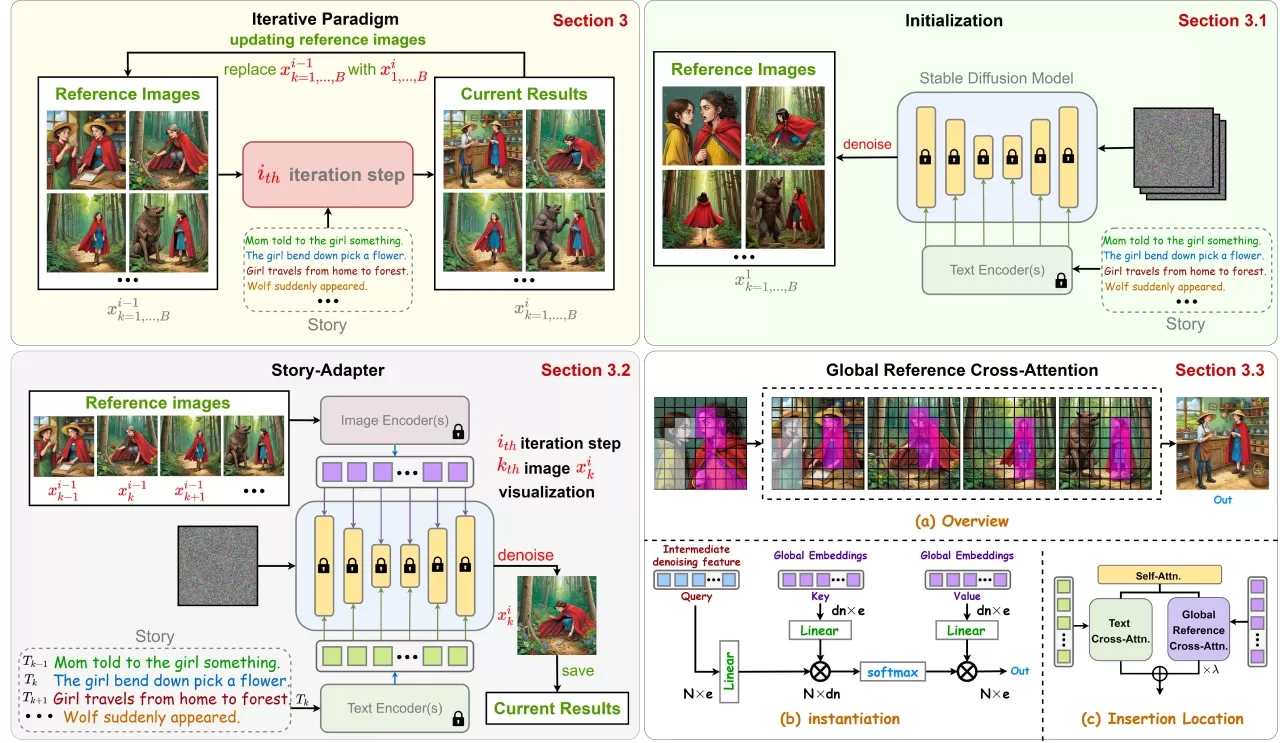
1. Global Reference Cross-Attention Module
Plug-and-play: No training required, directly integrated into existing diffusion models (such as Stable Diffusion)
Global embedding: Uses global embeddings to model all reference frames, ensuring semantic consistency across long sequences
Cross-attention mechanism: Aggregates the information flow from all reference images during the image generation process
2. Iterative Optimization Paradigm
Initialization phase: Generates initial versions of each frame based on the story text prompts
Iterative refinement: Uses all images generated in the previous round as references for the next round, progressively optimizing
Progressive improvement: Achieves precise fine-grained interaction generation by repeatedly integrating overall visual context and text constraints
3. Long Sequence Support
Supports generating long story image sequences of up to 100 frames
Performs excellently in semantic consistency and fine-grained interaction
🎯 Story-Iter Use Cases
Comic/picture book generation: Automatically generates coherent comic pages from long-form story text
Animation pre-visualization: Provides storyboard-level visual previews for animation production
Film storyboarding: Assists directors and cinematographers in quickly generating shot sketches
Children's storybooks: Creates richly illustrated narrative books for educational content
Advertising creativity: Generates long-sequence product promotional visual stories
Game cutscenes: Generates continuous visual narratives for game storylines
✅ Story-Iter Pros and Cons
Pros
Training-free: No additional model training or fine-tuning required, plug-and-play
Computationally efficient: Lower computational cost compared to methods that introduce large multimodal encoders
Consistency guarantee: Effectively maintains character, scene, and style consistency across long sequences through the global reference mechanism
Fine-grained interaction: Capable of generating high-quality scenes with complex character interactions
Scalability: Supports story generation of up to 100 frames, far exceeding traditional methods
Cons
Iteration overhead: Although training-free, the iteration process requires multiple inferences, resulting in higher time costs
Dependent on base model: Performance is limited by the capabilities of the underlying diffusion model (such as SD)
Long story challenge: Despite supporting 100 frames, consistency drift may still occur in extremely long stories
No official code: The GitHub repository may not yet be fully public or may be in an early stage
🛠️ How to Use Story-Iter
Environment Preparation
# Clone the repository (assumed to be public)
git clone https://github.com/UCSC-VLAA/story-iter.git
cd story-iter
# Install dependencies
pip install -r requirements.txt
Basic Usage Workflow
Prepare story text: Break down the story into continuous textual descriptions (each frame corresponds to a segment of description)
Initialization generation: Run the first round of generation to produce the initial image sequence based solely on text prompts
Iterative Optimization:
Use the generated images as references for the next round of generation
Enable the GRCA module to aggregate global reference information
Repeat iterations until convergence or until a preset number of iterations is reached
Output results: Obtain the final optimized coherent story image sequence
Key Parameters
--num_iterations: Number of iterations (typically 3-5 iterations show noticeable improvement)
--use_grca: Enable the global reference cross-attention module
--num_frames: Number of story frames (supports up to 100 frames)
❓ Story-Iter FAQ
Q1: What is the relationship between Story-Iter and Story-Adapter?
According to arXiv, Story-Iter and Story-Adapter are different names for the same project. The paper is cited as Story-Adapter: A Training-free Iterative Framework for Long Story Visualization, but both the project page and the ICLR 2026 submission use the name Story-Iter .
Q2: Do I need to train my own model?
No. Story-Iter is a training-free framework that can be directly applied to pre-trained Stable Diffusion models .
Q3: Which base models are supported?
Primarily based on the Stable Diffusion series of models (such as SD 1.5, SDXL), with functionality extended by inserting the GRCA module .
Q4: How long does it take to generate a 100-frame story?
The exact time depends on hardware configuration and the number of iterations. Due to the iterative optimization mechanism, total time = single-frame generation time × number of frames × number of iterations. Using an A100 GPU can significantly accelerate the process.
Q5: How is character consistency ensured?
Through the global reference mechanism of the GRCA module, information from all generated frames is aggregated in each iteration, ensuring that character appearance, clothing, and scene elements remain consistent throughout the entire story .
📚 Related Resources
Project page: https://jwmao1.github.io/storyiter/
Paper: https://arxiv.org/abs/2410.06244
GitHub repository: https://github.com/UCSC-VLAA/story-iter
Affiliated institution: UCSC-VLAA (Vision Language and Artificial Intelligence Laboratory at University of California, Santa Cruz)














