Script Planner Assistant▸
 AI Apps
 AI News

TinyShip_云技派,专注ai人工智能!
TinyShip_云技派,专注ai人工智能!Introduction
What is TinyShip?
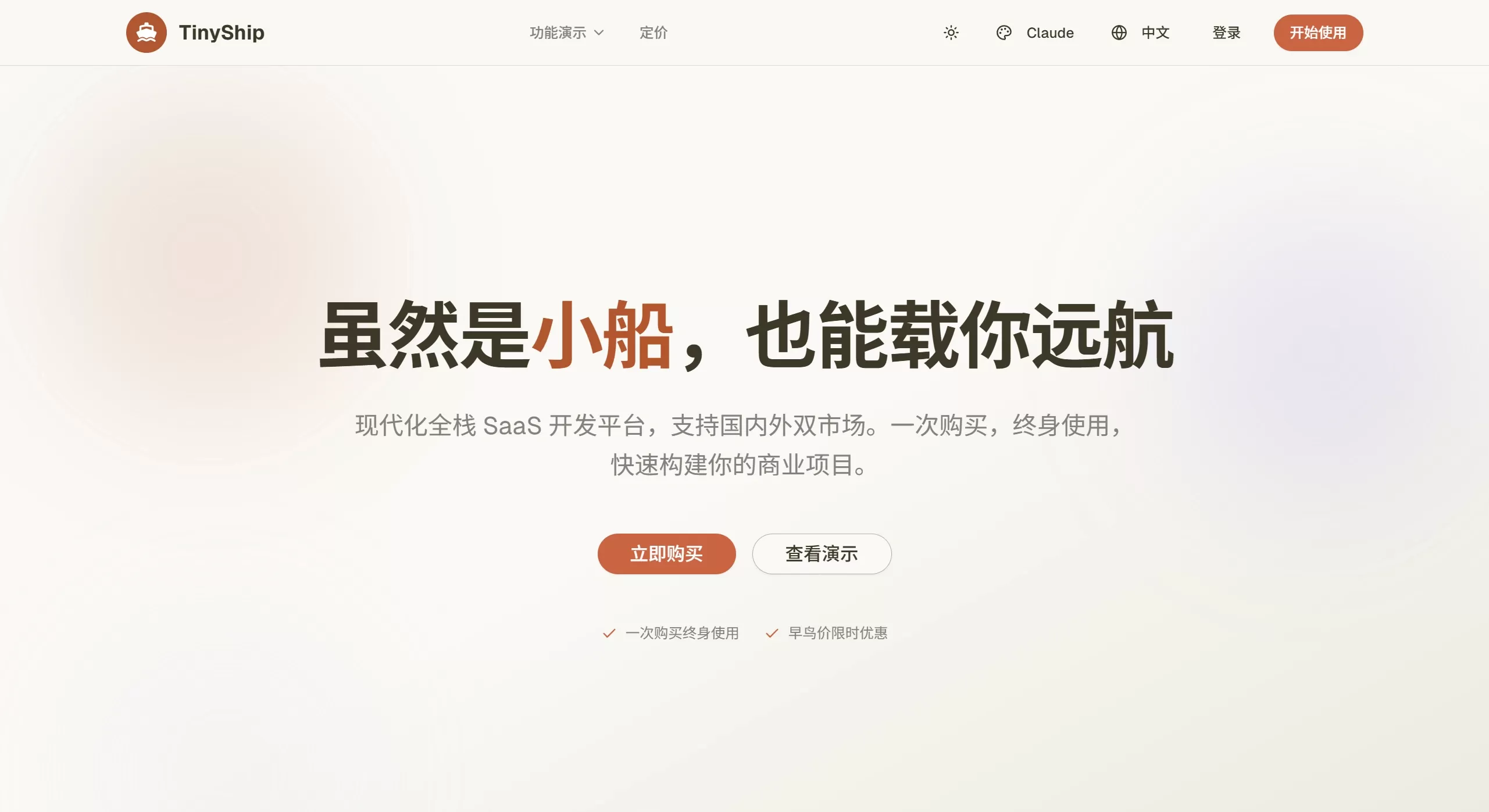
TinyShip is a modern full-stack SaaS development starter that lets developers quickly build commercial-grade SaaS applications. It adopts the dual-framework approach of Next.js plus Nuxt.js, so both React and Vue developers can use it. It comes with ready-made features like authentication, payment, ai integration, and internationalization, living up to the meaning of "although it is a small ship, it can carry you on a long voyage."
TinyShip is not a low-code platform; it is enterprise-grade development infrastructure. The code is written following the best practices for production environments and is of high quality. Buy it once and use it forever. It adapts well to both domestic and international markets, using the WeChat ecosystem domestically and the OAuth and Stripe ecosystem internationally.
TinyShip Features
Dual-framework support: The Next.js version features App Router, SSR/SSG, server components, and TypeScript integration. The Nuxt.js version uses Vue 3 Composition API, Nitro server engine, with auto-imports. Both versions share the same libs core libraries and infrastructure.
Comprehensive authentication: Supports email registration and login, and sends verification emails. Supports OAuth login, such as Google, GitHub, Apple. Domestically, it offers WeChat login and phone number login. It also has 2FA multi-factor authentication and session management.
Payment system: Internationally, it uses Stripe and Creem. Domestically, it uses WeChat Pay, and Alipay is planned to be added. It has a credits system, allowing top-up on demand and using credits, which can be combined with subscriptions. You can set AI model multipliers to assign credit prices to image generation.
AI development ready: It integrates the Vercel AI SDK. It has AI chat, with a simple AI Chat example inside. It supports AI image generation, compatible with Alibaba Cloud Qwen, FAL, and OpenAI's DALL-E. It also plans to add features like image analysis, speech-to-text, text-to-speech, RAG, and tool calling.
Communication services: Email can use Resend, SendGrid (planned), and SMTP (planned). For SMS, it uses Alibaba Cloud domestically and Twilio internationally.
Cloud storage integration: It has a unified interface supporting Alibaba Cloud OSS, AWS S3, and Cloudflare R2. It supports direct upload, CDN usage, signed URL generation, and metadata management.
Other features: It has a theming system, built on shadcn/ui, supports dark mode, and uses TailwindCSS v4. It offers internationalization with built-in multilingual support. It has an Admin panel for managing users, orders, subscriptions, and includes a dashboard. It has a documentation subsite built with Fumadocs, supporting full-text search and dark mode.
TinyShip Use Cases
Building SaaS applications: Quickly create subscription-based software, such as AI tools and productivity software.
Doing AI projects: Use the Vercel AI SDK to build chat bots and image generation applications.
Building e-commerce platforms: Use the payment system and credits mechanism to sell digital goods.
Building corporate websites: Use the built-in Landing Page, documentation site, and blog features.
Building products for both domestic and international markets: Products that need to support both domestic (WeChat, phone number, WeChat Pay) and international (OAuth, Stripe) users.
Quick MVP validation: Entrepreneurs quickly build minimum viable products to test business models.
How to Use TinyShip
Environment preparation: Install Node.js and PNPM; Docker is optional. Configure a PostgreSQL database.
Project initialization: Clone the project and install dependencies using pnpm install. Then configure environment variables by editing the .env file, including database connections, payment keys, and AI API Keys.
Start development: Start the Next.js or Nuxt.js application using pnpm dev. Alternatively, use Turborepo to manage multiple applications simultaneously with pnpm turbo dev.
Core configuration process: First, learn about the project introduction and environment setup, then quickly start the first application. Then configure the authentication system, use Drizzle ORM to operate the database, modify UI components and themes, and configure internationalization. Afterward, learn about advanced topics like payment integration, permission systems, and AI development.
Deployment: Supports containerized deployment with Docker. It can be deployed to cloud platforms such as Vercel, AWS, and Alibaba Cloud.
Frequently Asked Questions
Q1: Is TinyShip a low-code platform?
No. It is a code-level starter for professional developers, providing high-quality, scalable infrastructure code. You need to know the basics of React/Vue, TypeScript, and databases.
Q2: Can I use it for multiple projects after purchasing?
According to the "buy once, use forever" approach, it can be used for multiple commercial projects, but the specific licensing depends on the official user terms.
Q3: How do I switch payment providers?
It uses a vendor-lock-in-free architecture, with a unified API wrapping different payment channels. You can switch by changing the configuration parameters without rewriting business code. For example, use the createPaymentProvider function and change the provider parameter to 'stripe', 'wechat', or 'creem'.
Q4: Does it support Alipay?
Currently (Q1 2026), it mainly supports Stripe, WeChat Pay, and Creem. Alipay QR code payment is planned to be added in Q1 2026.
Q5: Which models are supported by the AI features?
Currently, it supports OpenAI (GPT/DALL-E), Anthropic, Alibaba Cloud Qwen, and FAL. More models can be added using the Vercel AI SDK.
Q6: How do I get technical support?
Check the documentation center at https://docs.tinyship.cn/zh-CN. Complete video tutorials are expected in Q3 2026, or refer to the Cursor development rules in the project for AI-assisted development.
Q7: Does the database have to be PostgreSQL?
It uses Drizzle ORM with PostgreSQL by default, but the architecture can modify the libs/database layer to adapt to other databases.
Q8: Do industry templates need to be purchased separately?
The basic version includes core features. Industry templates (such as SaaS, e-commerce, and AI templates) are extension packs that need to be purchased separately, but basic version users get discounts.
Access the Demo
Product homepage: https://tinyship.cn
Feature demo: https://demo.tinyship.cn
Documentation center: https://docs.tinyship.cn