Script Planner Assistant▸
 AI Apps
 AI News

Verdent AI: AI-Native Multi-Agent Coding Platform
Verdent AI: AI-Native Multi-Agent Coding PlatformIntroduction
Verdent ai was founded in 2025 by Chen Zhijie, former head of TikTok's algorithm team, and Liu Xiaochun, former head of product at Baidu. It is positioned as an "AI-native multi-agent coding platform."
Verdent AI breaks a requirement down into several sub-tasks, then has multiple Agents work on them simultaneously. Once completed, it automatically checks and merges the results, aiming to deliver complete, runnable code. It is more than just a code completion tool—through AI agents, it handles task decomposition, planning, code generation, self-checking, and other steps, enabling the delivery of high-quality code and improved development efficiency.
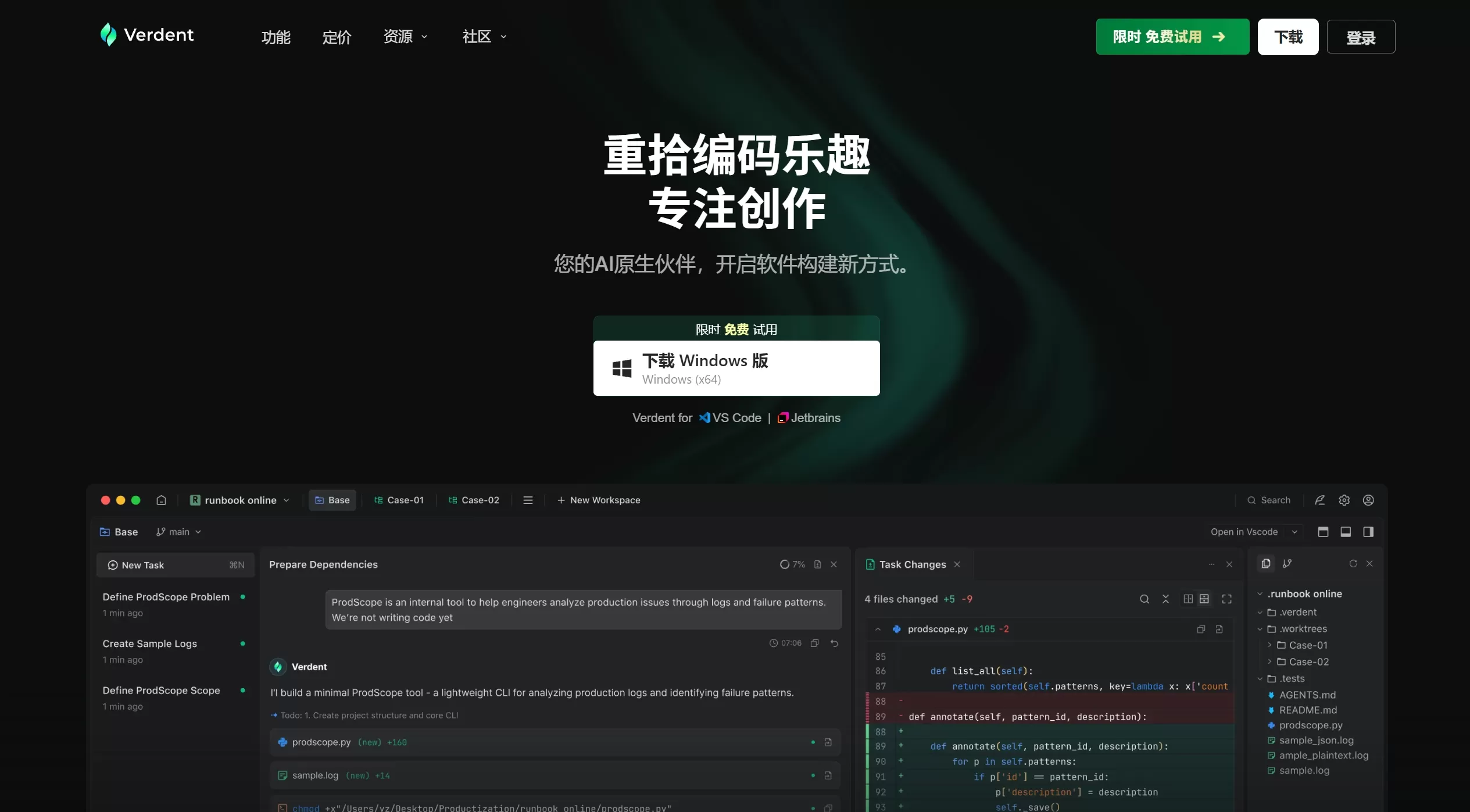
Verdent AI Features
Parallel Multi-Agent: Can simultaneously launch sub-agents for planning, coding, testing, documentation, etc. Each agent has its own independent Git worktree, so they won't interfere with each other.
Plan-First: Before generating code, requirements must be broken down, the tech stack and acceptance criteria must be determined, reducing the need for rework.
DiffLens: Provides instant semantic-level diff comparison, highlighting the scope of impact and potential risks, making code review easier.
Self-Verification: After code is generated, it automatically runs linter, unit tests, and browser verification. If they fail, it automatically fixes the issues and iterates until they pass.
Custom Sub-Agents: Enterprises can write their own small agents (such as a "Spring Security Checker") and integrate them into the main workflow.
Unified Standards: Place an AGENTS.md file in the project root directory, and all agents must follow the same coding and commit standards.
Verdent AI Application Scenarios
Large Project Development and Refactoring: Faced with massive legacy systems or complex cross-repository projects, Verdent AI can quickly understand the context.
Multi-Task Parallel Processing: When a team needs to advance the development of multiple modules simultaneously, its multi-agent capabilities can be leverageded.
Urgent Bug Fixes: Quickly generate patches in an isolated worktree, then merge after verification.
Personal Projects and Prototype Validation: Helps independent developers quickly turn ideas into runnable code prototypes.
How to Use VerVerdent AI
Register and Install: Register on the Verdent AI official website to receive 100 credits. Search for "Verdent" in the VS Code extension marketplace for one-click installation; for desktop, download Verdent Deck (supports macOS 11+ and Win10+).
Initialize the Project: After opening the project, an AGENTS.md file is automatically generated (rules can be manually modified). Select a model, such as Claude-sonnet-4-5, GPT-5, Kimi-K2, etc.
Submit Requirements: Enter a one-sentence requirement, such as "migrate the user module to microservices and add caching." Enter ThinkTogether mode, where the AI will ask about the tech stack, caching choices, acceptance metrics, and other information. After confirmation, a Task Board is generated.
Parallel Development: Click "Start," and each sub-agent automatically pulls independent worktrees to develop in parallel; progress and logs are shown in real time on the interface. You can pause at any time, adjust sub-tasks, or insert new requirements.
Result Verification: DiffLens highlights all changes for one-click review, then tests can be run locally. Once passed, it automatically commits and pushes. If tests fail, the Agent continues to iterate until passing or until human intervention is required.
Verdent AI FAQ
What languages and frameworks does Verdent AI support? Currently, it has the best support for Python, JavaScript/TypeScript, Java, Go, and Ruby on Rails. C++ and Rust are continuously being optimized…
Will Verdent AI really mess up my code? All changes are made in isolated worktrees, and full tests are run before formal merging; by default, it blocks merges that have compilation errors or failing unit tests.
Can it be used offline? Core model invocations require an internet connection; local cache allows offline viewing of already generated code, but cannot continue to generate new code.
How are credits calculated? A single complete task (including planning, coding, testing) consumes approximately 8–15 credits; the 100 credits given upon registration can complete 6–10 standard requests, and subscriptions can be made subsequently as needed.
What is the difference between Verdent AI and Cursor/Copilot? Cursor and Copilot mainly focus on "code completion"; Verdent, on the other hand, focuses on "delivery of entire tasks," featuring a built-in closed loop of planning, testing, and merging, and can run multiple agents in parallel.