Script Planner Assistant▸
 AI Apps
 AI News

Xiaobaogong: Legal AI – AI-Powered Legal Service Platform
Xiaobaogong: Legal AI – AI-Powered Legal Service PlatformIntroduction
"Xiaobaogong Legal AI" was launched in 2016 by Professor Wang Yanling's team at the School of Law, South China Normal University. It is one of the earlier industry-academia-research platforms in China dedicated to combining "law + artificial intelligence," and is currently one of the few legal vertical large models that have completed the filing with the Cyberspace Administration of China.
It runs on two engines—an "advanced general-purpose large model" and a "self-developed legal professional large model." Its knowledge graph is built on more than 200 million judgment documents and over 4.2 million laws and regulations. It also incorporates Retrieval-Augmented Generation (RAG) technology to minimize AI hallucinations, so that legal Q&A can cite sources and be verified.
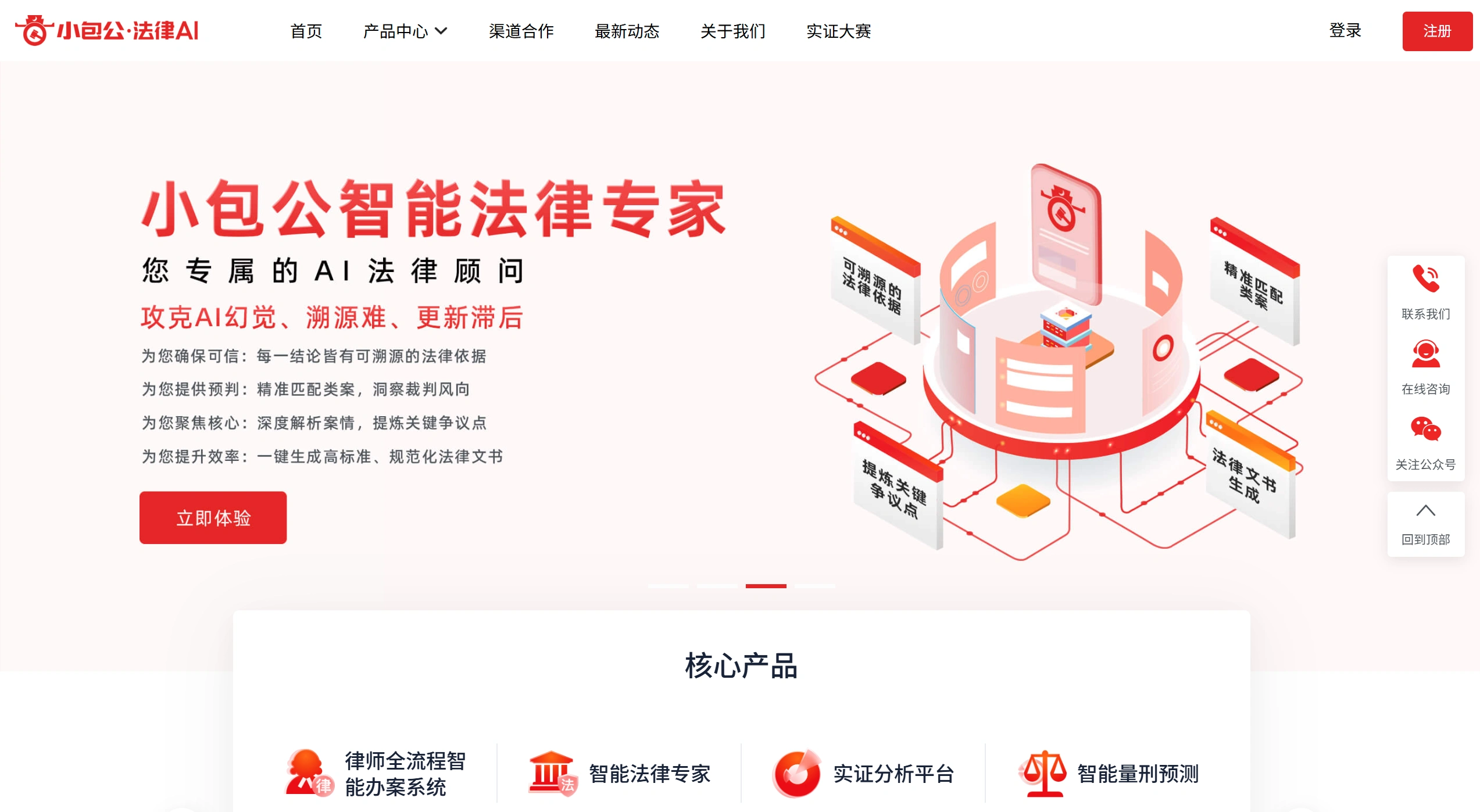
Main Features of Xiaobaogong
Intelligent Legal Consultation: Available around the clock, covering common matters such as labor disputes, marriage and family affairs, contract disputes, and criminal defense. It immediately provides legal basis, risk alerts, and action suggestions.
Similar Case Search and Sentencing Prediction: Enter the case facts and it automatically finds similar cases while ranking similarity. It covers 26 common criminal offense categories, with sentencing predictions that differ from actual court rulings by no more than 5%.
Smart Mediation and Administrative Reconsideration: It can analyze case files with a single click, organize claims and evidence, identify points of dispute, and generate mediation plans or reconsideration decision documents. Ten counties and districts in Zhanjiang have already adopted it for end-to-end AI assistance across the three steps of "acceptance, legality review, and discretion."
Enterprise Compliance and Contract Risk Control: It can quickly draft contracts, scan clauses for risks, automatically compile evidence lists, and produce compliance reports covering corporate governance, labor and personnel, intellectual property, and more. To date, it has served more than 10,000 government agencies and companies.
Legal Education and Public Services: "Digital human + AI" windows have been deployed in universities, communities, and comprehensive governance centers to provide smart guidance and automatically answer common questions, helping to ease the shortage of grassroots legal resources.
Technical Features of Xiaobaogong
Dual Engines: The general-purpose large model ensures smooth conversational ability, while the vertical legal large model is responsible for accurately identifying laws, cases, and key points. The two work together through a knowledge graph and RAG for joint reasoning, reducing AI hallucinations.
Traceability: Every answer is accompanied by direct links to the original text of statutes, cases, or key judgment points. With one click, users can view the specific clause or document passage for further verification.
Multi-Scenario Tools: More than ten tools have been developed, including "automatic generation of complaints/answers," "intelligent analysis of first-instance judgments," and "AI drafting of lawyer's letters." Courts, procuratorates, arbitration commissions, and law firms can all access these directly via API or mini-programs.
Application Results of Xiaobaogong
Judicial Administration: After adopting the platform for administrative reconsideration cases across Zhanjiang, the accuracy of identifying points of dispute reached 100%, the evidence recognition rate hit 95%, and the average case handling time was reduced by 40%.
Grassroots Governance: The comprehensive governance center of Huangpu District in Guangzhou adopted a "human + AI" collaborative model, cutting legal consultation response times from several hours to instant replies and increasing mediation success rates by 18%.
Media Rights Protection: In partnership with Niumei Data, the "Meijian AI" was developed to analyze legal relationships for tipsters, assess the sufficiency of evidence, and provide action suggestions. It has already helped hundreds of users successfully defend their rights through the media.
How to Use Xiaobaogong
Desktop: Search for "Xiaobaogong Intelligent Legal Platform" to access the official website and register. Individuals can try out basic Q&A, similar case search, and document generation for free.
Mini-Program: Search for "Xiaobaogong Legal AI" on WeChat to ask questions via voice or text, and export the results directly to Word or PDF.
Institutional Use: Localized all-in-one machines, private cloud, and API interfaces are available, and can be integrated with OA systems, case-handling platforms, or the 12348 legal hotline as needed.
Company Profile
Xiaobaogong Legal AI (Guangdong Bowei Chuangyuan Technology Co., Ltd.) was founded on June 6, 2016, by Professor Wang Yanling, a professor at the School of Law, South China Normal University. The company serves as the industry-academia-research base for the Guangdong Provincial Key Laboratory of AI Legal Applications. Its R&D team includes law professors, computer science professors, AI experts, and case-handling specialists, all focused on the integration of law and artificial intelligence.
In the legal technology space, Xiaobaogong is driving legal services toward digitalization with its distinctive dual-track model and solid technology. It not only leverages advanced general AI capabilities but also integrates a dedicated legal model, aiming to provide efficient and accurate intelligent solutions for the legal industry.
In summary, "Xiaobaogong" is not an ordinary legal Q&A bot. It covers the entire workflow of "consultation—retrieval—mediation—compliance—legal education," and has proven effective in numerous political and legal agencies. If you need to quickly obtain reliable, source-verifiable legal answers, or need to batch-generate legal paperwork and contract risk control reports, it's well worth a try.
Related Information: