Script Planner Assistant▸
 AI Apps
 AI News

Marble: A Multimodal 3D World Model by Fei-Fei Li's World Labs
Marble: A Multimodal 3D World Model by Fei-Fei Li's World LabsIntroduction
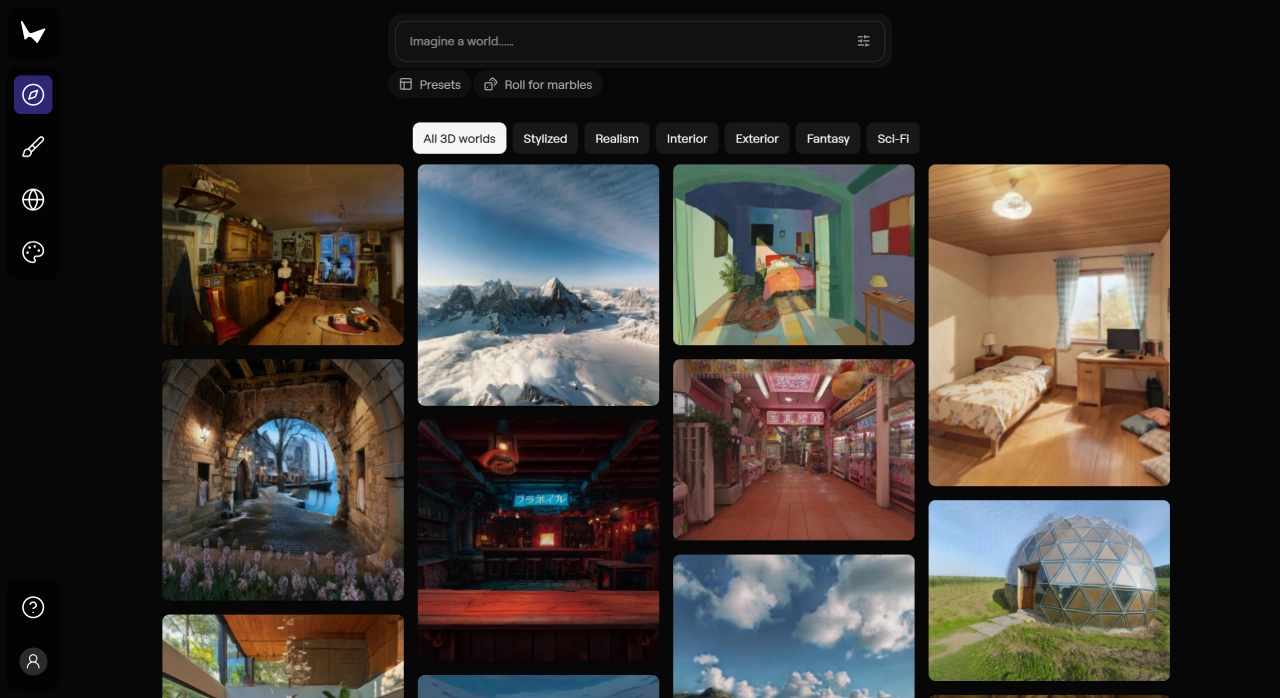
Marble is a multimodal 3D world model launched by Fei-Fei Li's World Labs, designed for creators. It can use text, one or more images, short videos, or simple 3D layouts to create 3D environments that can be explored, modified, and downloaded, with camera control and interactive editing down to every pixel. It is mainly used in game development, film and TV special effects, and virtual reality, and is characterized by producing 3D worlds that remain consistent in appearance and don't randomly change.
Marble Main Features
Multimodal 3D Generation: Accepts inputs including text, a single image, photos from different angles, short videos, and more. For example, typing "Hobbit kitchen" creates a full 3D scene with wooden furniture and copper items; uploading a regular room picture produces a 360-degree panoramic 3D environment in about 6 minutes. Multiple images or videos make digital twin scenes more realistic. Additionally, users can first build a 3D framework with simple geometry, and the ai will automatically add details like lighting and materials.
Flexible Editing and Extension: This is the first model with built-in AI editing tools. You can modify just part of it or adjust the structure — for example, removing a trash can from the scene with one sentence, and the lighting changes accordingly. Using its editor Chisel, you can place geometry to define the spatial structure, then set the style with text — the same structure can become different styled scenes just by changing the prompt. You can also add details at the edges of scenes, or use "Compositor Mode" to seamlessly stitch several independent scenes together.
Multi-Format Export Adaptation: Results can be exported in Gaussian splatting, triangle meshes, and other formats. Triangle meshes are further divided into low-precision collision meshes and high-precision render meshes, which can be directly imported into professional software like Unity and Unreal Engine. It can also export video with AI-added dynamic effects like smoke and flowing water. It also supports VR headsets like Apple Vision Pro and Meta Quest 3, for directly building VR experiences.
Chisel Experimental 3D Editor: First build the spatial "skeleton" with basic geometry, then define the overall "style" with text, allowing structure and style to be handled separately and reused.
World Extension and Composition: One-click detail enhancement on selected areas, or use Composition Mode to merge multiple independent worlds into larger spaces.
Marble Typical Workflow
Choose input method first: Use text or a single image for quick concepts; multiple images or videos give more accuracy and control. Complex scenes are best done with multiple images or videos.
Generate world: Once you have an explorable 3D environment, first check in 2D or 3D view whether perspective, scale, and style are consistent.
Fine editing: Use AI tools to modify local areas or fill in gaps, or use Chisel to rebuild the structure and change the style, letting structure and appearance be adjusted independently.
Scale up: Add details to edges or weak areas, or use Composition Mode to merge several small worlds into a large space for more depth.
Export and deliver: Use Gaussian splatting for high-definition display; use meshes for assets in games or film engines; use video rendering with effects for promos or test shots; web sharing can use the open-source Spark renderer that works with THREE.js.
Marble Subscription Pricing
Four tiers. The free plan gives 7,000 points per month, allows up to 4 worlds, and only basic inputs like text and images; the Standard plan is $20 per month with 20,000 points, allowing 12 worlds and supporting multiple images and video inputs.
The free plan gives 7,000 points per month, allows up to 4 worlds, and only basic inputs like text and images; the Standard plan is $20 per month with 20,000 points, allowing 12 worlds and supporting multiple images and video inputs; the Pro plan is $35 per month ($1 for the first month) with 40,000 points, allowing 25 worlds and commercial use; the Flagship plan is $95 per month with 120,000 points, allowing 75 worlds and full access to all features.
Marble Use Cases
Game Development: Quickly produce walkable level prototypes and atmospheric spaces, with assets importable into common engines.
Film and TV VFX: Provide well-controlled 3D assets and accurate camera paths for test shots and background environments.
Virtual Reality / Immersive Exhibits: Create explorable immersive experiences and interactive displays.
Robotics Simulation: Build diverse simulation training environments, reducing the difficulty of data collection.
Marble Strengths and Limitations
Strengths: Much faster than traditional modeling — simple scenes can be done in just minutes. Hollywood teams have used it to shrink movie previsualization time from 3 months to 2 days. For small-scale static scenes like rooms, the structure and style are relatively stable, and textures are sufficient. Export formats connect to mainstream development tools and VR devices, linking creation to deployment.
Limitations: When scenes are larger than a room, distant areas tend to blur or distort. Multi-image composition may stall, and success rates for complex scenes still need improvement. Currently only static scenes are supported — no dynamic elements or physical effects — and fidelity for some complex requirements isn't accurate enough yet.
Marble lowers the difficulty of writing prompts — ordinary users can get an explorable, editable, downloadable 3D world in just minutes. It is currently the only publicly available "generative spatial intelligence" production tool.
Related Information: