Script Planner Assistant▸
 AI Apps
 AI News

AI Ping: All-in-One LLM Benchmarking & API Platform
AI Ping: All-in-One LLM Benchmarking & API PlatformIntroduction
ai What is Ping?
AI Ping is a platform focused on large model API services. Built around developer needs, it offers two core services. First, it continuously evaluates and aggregates hundreds of models from dozens of providers, publishing performance leaderboards with critical metrics like latency and throughput—such as the "2025 Large Model Service Performance Rankings"—and supports queries of core model parameters. Second, it provides a unified API interface paired with intelligent routing that automatically matches the optimal provider, along with a personal data center that breaks down call costs, helping developers make decisions faster, develop more efficiently, and integrate at lower cost.
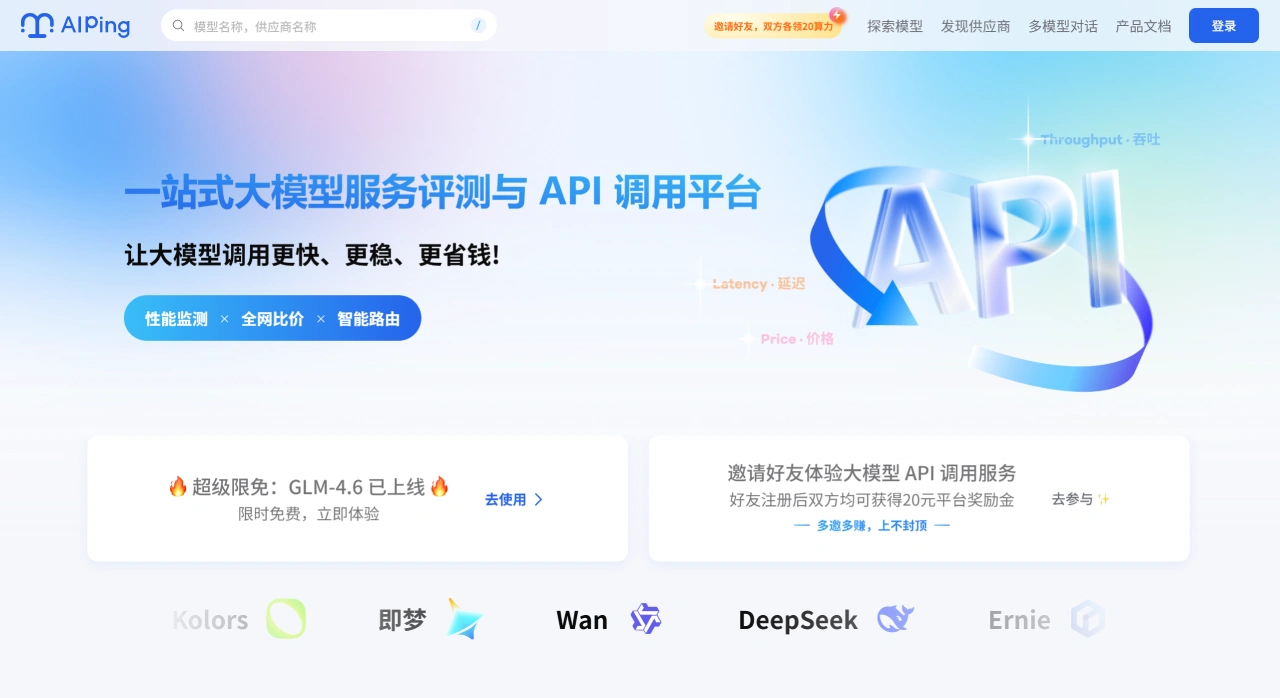
AI Ping Core Services
Shorten the time developers spend selecting models and evaluating providers
Reduce the complexity and cost of multi-platform integration, improving development efficiency
Provide objective, verifiable performance data to support informed decision-making
AI Ping Core Features
Intelligent Routing
Automatic selection: Based on real-time monitored data such as price, P90 latency, and throughput, each request is automatically routed to the currently optimal provider.
High-availability guarantee: Continuously monitors provider node status. If the preferred provider experiences service degradation, high latency, or downtime, traffic is automatically and seamlessly switched to other high-quality providers, ensuring stable and efficient calls.
Unified API Interface
Simplifies multi-model access and integration, allowing direct calls to dozens of AI models and services from multiple providers.
Supporting Features
Performance monitoring: View provider service performance in real time.
Cross-platform price comparison: Compare pricing advantages across different providers.
Transparent costs: Provide detailed call data to help balance cost and performance.
How to Get Started with AI Ping
Register and log in: Click "Log In" at the top-right corner of the AI Ping website. You can log in instantly via mobile phone verification code without registering, or use an account and password.
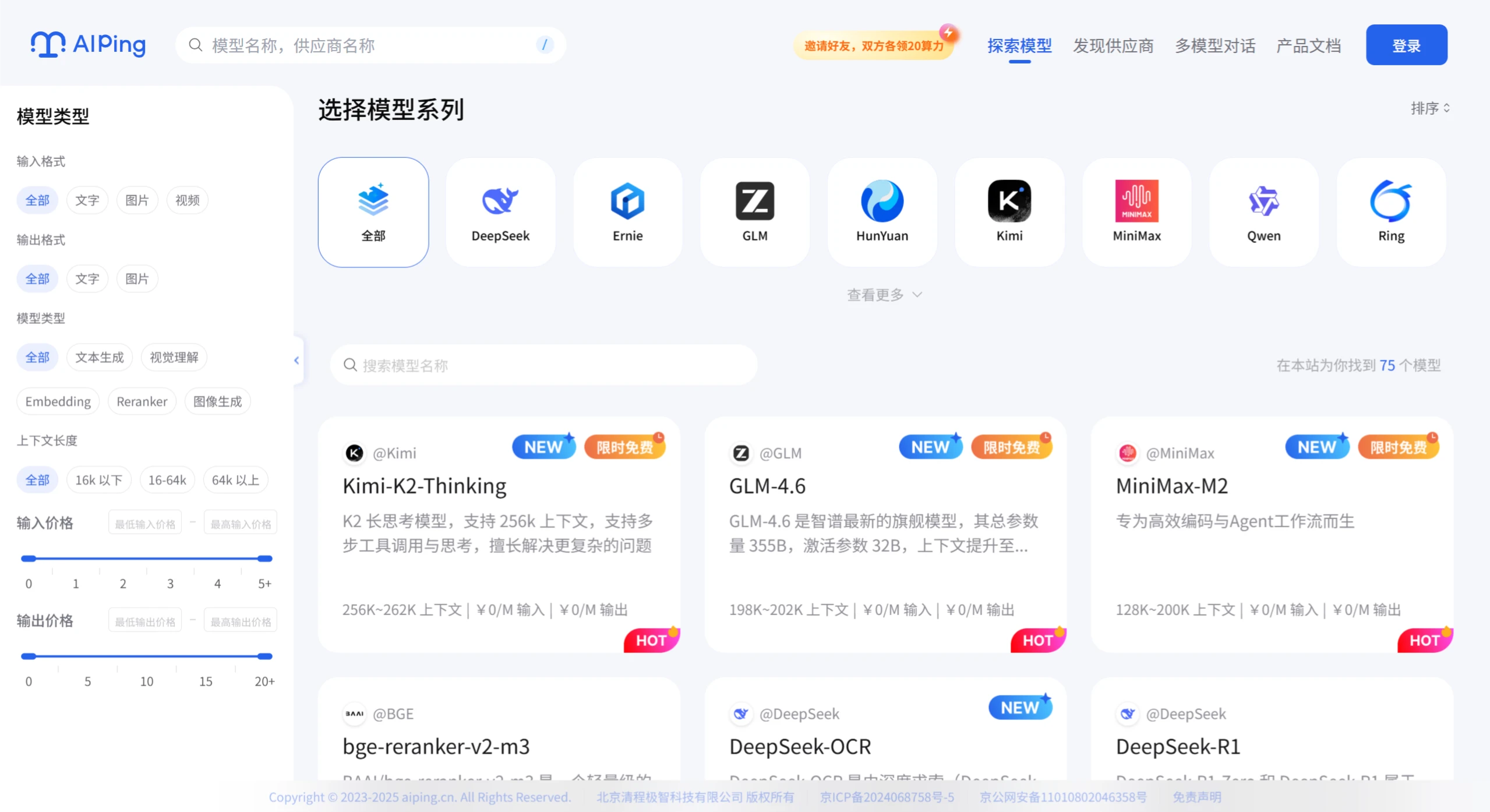
Choose a model: Click "Explore Models" in the navigation bar. Use the search bar and model family filters to find the model you need; click a model card to view its detail page.
Call the API: The top of the model detail page displays model information, a summary of provider services, and evaluation data; the bottom provides sample call code (such as OpenAI Python SDK, Requests, Curl, etc.) that can be copied and used directly. AI Ping forwards requests to the most cost-effective provider via intelligent routing, with a default strategy that balances cost and performance and automatically switches providers upon failure. See the related documentation for more routing strategies. No separate API key is required for your first call—sample code is pre-filled with the default API key.
Frequently Asked Questions
Q1: What developer pain points does AI Ping primarily address?
A1: It addresses three major pain points: ① Difficult selection—lack of objective, comprehensive performance data for reference; ② Complex integration—inconsistent interfaces across providers and cumbersome multi-platform switching; ③ Opaque costs—unclear token consumption and fee breakdowns make precise cost control difficult.
Q2: How does intelligent routing balance speed and cost?
A2: Through "requirement matching + data support + algorithmic scheduling": first clarify user needs (e.g., prioritizing speed or cost), then leverage real-time multi-dimensional data (price, P90 latency, throughput, etc.) combined with load balancing and cost optimization algorithms to dynamically match providers—prioritizing low-latency, high-throughput providers to ensure smooth performance during peak hours, and switching to cost-effective options during off-peak hours to save costs.
Q3: What key information can developers access to assist with model selection?
A3: Two categories of core information: ① Performance data—24/7 evaluation results for hundreds of models from dozens of providers (including latency, throughput, reliability, and other metrics) plus authoritative leaderboards; ② Parameter configuration—query parameters such as context length, service price, and maximum output length on the model detail page, and compare differences across providers.
Which large model services does AI Ping evaluate and aggregate information for?
AI Ping provides evaluations of mainstream large language model services, primarily from major model vendors and MaaS providers. The complete model list is available on the AI Ping website. In the future, AI Ping will offer evaluations and aggregated information for additional modalities, such as image, voice, and video model services.