Script Planner Assistant▸
 AI Apps
 AI News

FreeSewing: Open-Source Project for Custom Sewing Patterns
FreeSewing: Open-Source Project for Custom Sewing PatternsIntroduction
FreeSewing is an open-source platform that generates fully tailored sewing patterns using the user's body measurements. It is not a company, does not sell any products, has no ads, no tracking, and does not collect or sell personal data. The platform was initiated and maintained by Joost De Cock, targeting home sewing enthusiasts and fashion entrepreneurs, emphasizing that "fit matters more than size" and the slow fashion philosophy.
FreeSewing Core Features and Highlights
Tailored customization: Enter personal body measurements to automatically generate exclusive patterns, suitable for non-standard sizes.
Variety of designs: Offers multiple clothing styles such as shirts, jackets, and pants for selection and customization.
Open-source platform: All code is public, and users are free to use, modify, or contribute.
No ads, no tracking: The website has no ads, does not track user behavior, and does not collect or sell data.
Account management: After registering, users can save multiple measurement sets and patterns for convenient reuse.
Community interaction: Users can upload their works, share experiences, and get inspiration.
FreeSewing Use Cases
Home sewing enthusiasts: Can create well-fitting, personalized garments, free from the limitations of standard sizing.
Small-scale apparel entrepreneurs: Used for pattern making, sample fitting, or small batch production, saving pattern development costs.
Teaching and training: Can serve as a teaching tool for fashion design and pattern making.
DIY projects: Used to make personalized garments such as gifts, performance outfits, and cosplay costumes.
How to Use FreeSewing
Register an account: Visit the official website https://freesewing.eu/ to register and create an account.
Enter body measurements: Go to the "Measurements" page and input measurements for various body parts as prompted, such as bust, waist, shoulder width, etc. You can save multiple measurement sets, such as for yourself, family members, or clients.
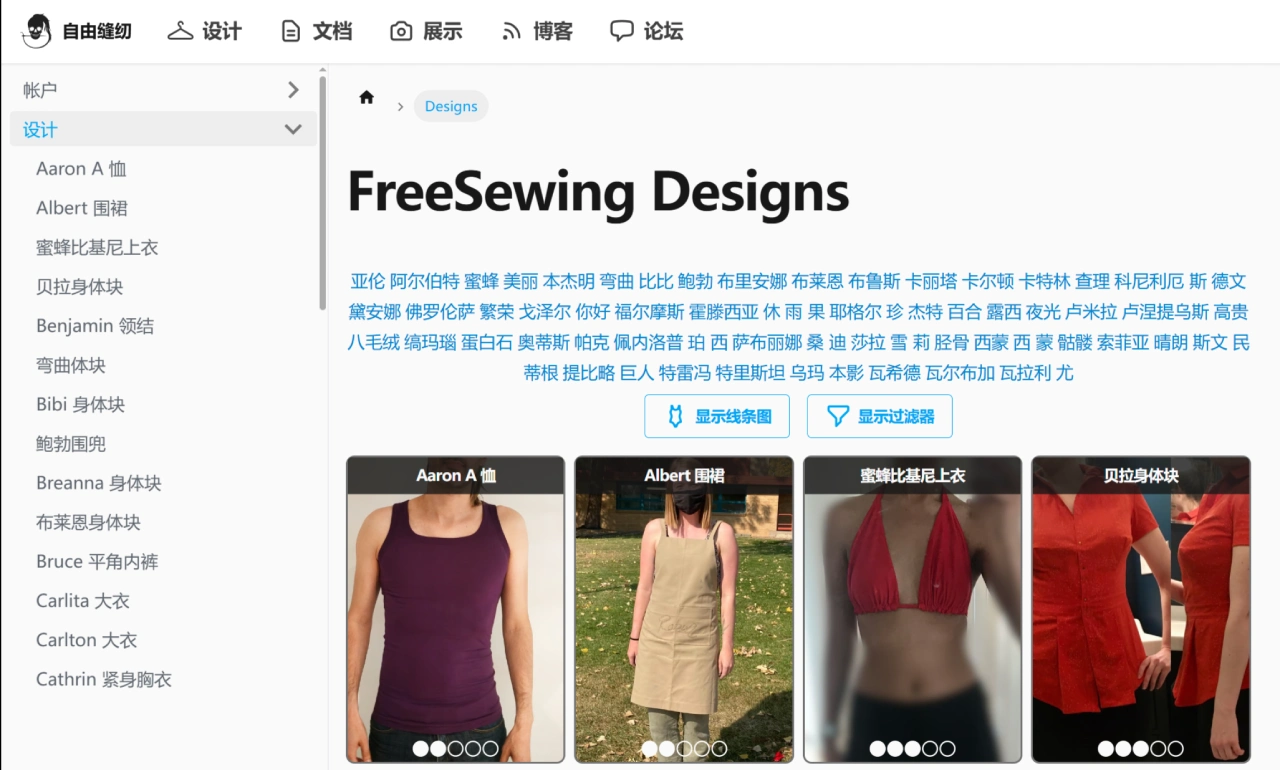
Choose a design: Browse the clothing styles provided by the platform, such as the Aaron T-shirt, Bella top, etc. Each design comes with a detailed description, finished garment image, and a difficulty rating.
Customize pattern parameters: Select measurement set, fabric type, seam allowance, and style details. The system will generate a personalized pattern in real time.
Download and print: Patterns are provided in PDF format, supporting A4/US Letter tiled printing or A0 large format printing. Includes cutting diagrams, sewing instructions, and fabric recommendations.
Sew and share: Cut the fabric according to the pattern and sew. Once completed, you can upload your work to the community and share experiences with other users.
Tips:
Beginners are advised to start with simple styles, such as scarves or T-shirts, to gradually become familiar with the platform.
Accurate measurements are crucial; it is recommended to have someone else assist with measuring to ensure accurate data.
Browse community works more often to gain inspiration and practical tips.
Local Setup and Development for FreeSewing
Preparation: Go to https://github.com/freesewing/freesewing and install Node.js (LTS), npm, and Git.
Clone the repository: Clone the repository via link 1.
Install dependencies: Run "npm install".
Build the project: Run "npm run build".
Start the development server: Run "npm start", which usually opens at http://localhost:3000.
Tech stack: Includes JavaScript, Node.js, npm, Monorepo, ESLint, Prettier, Git.
License and ecosystem: The core library adopts the MIT license, and the ecosystem includes Core, Plugins, Sites, etc., facilitating secondary development and integration.
Key Questions
Q: What is FreeSewing's biggest differentiating advantage compared to traditional sewing patterns or commercial sewing platforms?
A: FreeSewing's core differentiating advantages lie in two aspects. First is customization and precision: it generates "tailor-made" sewing patterns based on the user's personal measurement data, breaking through the imprecise sizing of the traditional industry and solving the pain point of ill-fitting garments. Second is non-commercial and privacy protection: it is not a corporate entity, with no sales or employees, so the platform has no ads, does not track user behavior, does not sell personal data, and does not use it for ai training. In contrast, most commercial sewing platforms have ad push, data collection, etc. FreeSewing provides users with a clean and safe environment to use.
Q: For a user who wants to obtain a personalized set of sewing patterns through FreeSewing, what specific operations need to be completed? What are the key differences in functionality between registered and non-registered users?
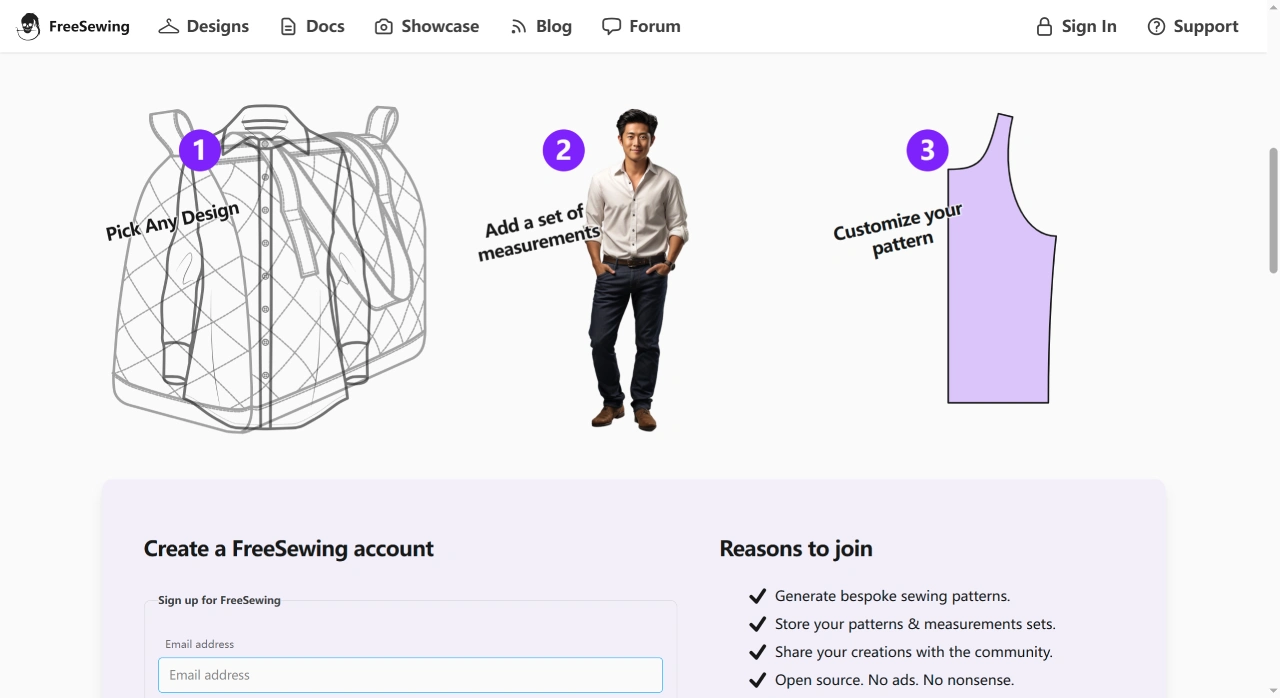
A: Users need to complete 3 steps to obtain a personalized sewing pattern. First, choose any design from the platform; second, add a set of personal measurement data; third, perform personalized customization on the pattern. The key functional difference between registered and non-registered users is that non-registered users may only be able to complete basic pattern generation (subject to the platform's actual restrictions), while registered users can additionally enjoy storage functions, i.e., storing personal patterns and measurement datasets, avoiding repeated upload of measurement data, and enjoying community sharing features to share personal sewing creations with the community, thus managing personal design results more conveniently and participating in community interaction.
Q: As an open-source project, what is FreeSewing's current version update status? What support does the platform's operation and maintenance rely on, and in what ways can users participate in or contribute to the platform's development?
A: FreeSewing has currently been updated to version 4.3, which added the Percy design; the previous version 4.2 added 4 designs, including the Devon jacket, Jett jacket, Sarah skirt, and Sunny skirt, continuously enriching the platform's design resources. The platform's operation and maintenance mainly rely on two kinds of support: first, a volunteer team that provides help services to users to ensure user experience; second, user financial support. Founder Joost De Cock calls on users who are able to provide a small amount of financial support each month. Users can contribute to the platform's development in two ways: first, by actually using and sharing — use the platform to generate patterns and share creations in the community, enriching community content and attracting more users to participate; second, where finances permit, provide financial support to provide economic assurance for platform operation and version updates.