Script Planner Assistant▸
 AI Apps
 AI News

Compumuseum – Online Computer Museum & Web Emulator Platform
Compumuseum – Online Computer Museum & Web Emulator PlatformIntroduction
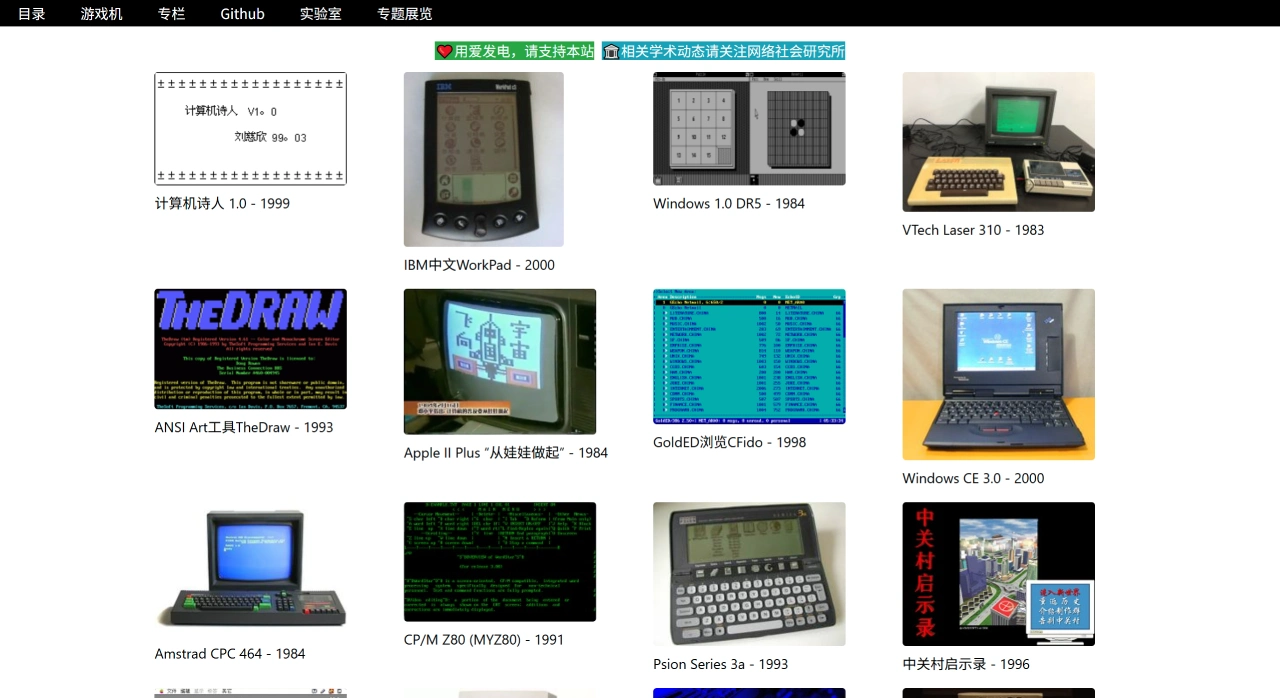
Compumuseum is an online computer museum and web emulator platform oriented toward Chinese-speaking readers. Through modern web emulators, users can run historically significant computer systems and software directly in their browser, emphasizing a "ready-to-use" interactive experience. The site features classic operating systems, Chinese-language platforms, and retro games, such as the Apple IIe, UCDOS, Wenhua (Wenquxing), the China Educational Computer (CEC-I), and classic DOS games including "The Legend of Sword and Fairy" (Xianjian Qixia Zhuan).
Within the exhibitions of the Compumuseum, visitors can explore the development of various digital devices ranging from early mainframes to modern smartphones. Through rich illustrative and textual materials, historical data, and technical analysis, the museum demonstrates how digital media is built upon digital electronic computers processing numerical data, covering forms of expression such as hypertext, audio, video, 3D models, and interactive games.
Computer Devices
Early Computers
1973: Xerox Alto, one of the earlier computers to feature the concept of a graphical user interface.
1975: Digital PDP-11/70, a well-known computer of its time.
1977: Apple I, Apple II—important early personal computers from Apple; the Apple II helped popularize personal computing.
1980: TRS-80 Model III, a computer released by Radio Shack.
1981: IBM PC 5150 (available with MDA monochrome or CGA color display), which had a profound impact on the personal computer market; ZX Spectrum, a popular home computer in the United Kingdom.
1982: Atari 800XL, Commodore 64—popular home computers; the Commodore 64 performed particularly well in gaming and home applications.
1983: BBC Micro, Acorn Electron—the BBC Micro was widely used in British education and other fields, while the Acorn Electron targeted home users.
1984: VTech Laser 310, NEC PC-9801VX (bundled with Ichitaro software), Apple II Plus, IBM PC XT (running Xenix 2.1.3), SHARP X1 Turbo, Amstrad CPC 464—each of these computers had its own features and user base in different regions.
1985: MSX2, Amiga (with the game Apidya), Atari ST (available with color or monochrome display, plus the unofficial system EmuTOS)—MSX2 was a standardized home computer, the Amiga offered powerful multimedia capabilities, and the Atari ST had advantages in music production.
1986: Macintosh Plus (with a Chinese system), Macintosh II—these advanced Apple's computer lineup, and the Macintosh Plus's Chinese language support helped promote the platform in markets such as China.
1987: Acorn Archimedes 310, China Educational Computer CEC-I (with a game floppy disk version)—the Acorn Archimedes 310 was relatively powerful, while the CEC-I targeted the Chinese market.
1991: CP/M Z80 (MYZ80)—CP/M was an early operating system, and MYZ80 was a related product based on the Z80 chip.
1993: Psion Series 3a, Macintosh II (with the Chinese 7.1 system)—the Psion Series 3a was a handheld computer, and the Chinese system version of the Macintosh II supported its use in Chinese-language environments.
1996: Apple II Plus.
1998: GoldED browsing CFido—CFido was an early online community, and GoldED was used to browse its content.
2000: IBM Chinese WorkPad, Windows CE 3.0—the IBM Chinese WorkPad was a mobile office device, and Windows CE 3.0 was Microsoft's operating system for mobile and embedded devices.
2001: Atari ST unofficial system EmuTOS.
2002: Wenhua (Wenquxing) NC1020—a Chinese electronic dictionary and learning device with computing and entertainment functions.
Other Devices
1981: SHARP PC-1500, a portable computer.
Operating Systems
Early Operating Systems
1973: The Xerox Alto likely ran an early prototype operating system related to graphical interfaces.
1981: Xenix 2.1.3, which ran on the IBM PC 5150, was a variant of Unix suited to personal computers.
1983: Xenix 2.1.3, which ran on the IBM PC XT.
1984: The NEC PC-9801VX likely ran a related Japanese operating system (Ichitaro is a word-processing software).
1987: The systems run on the Macintosh II and Macintosh Plus (the Macintosh Plus had a Chinese system version)—these were Apple's own operating systems, featuring a distinctive graphical interface and user experience.
1990: PC/GEOS, a graphical operating system for personal computers.
1991: The CP/M operating system, which ran on CP/M Z80 (MYZ80), was an early popular disk operating system.
1993: The Macintosh II (Chinese 7.1 system) was a version of Apple's operating system tailored for Chinese-language environments.
1997: Chinese Windows 3.2 and WPS97—Windows 3.2 was Microsoft's Chinese edition of the Windows 3.x series released for the Chinese market, and WPS97 was office software from Kingsoft designed to work alongside Windows 3.2.
1998: Windows CE 3.0, an operating system developed by Microsoft for mobile and embedded devices.
2000: Windows CE 3.0, Windows CE.NET 4.0—Windows CE.NET 4.0 was a further development of the Windows CE series.
Other Operating System-Related Items
DOS systems: Although the text does not specify a particular version of DOS, there are multiple DOS-based software and games—such as the DOS software UCDOS 7.0, an input method and related software under the Chinese DOS operating system; DOS games such as "The Legend of Sword and Fairy" (Xianjian Qixia Zhuan), "Heroes of the Jin Yong Swords" (Jin Yong Qunxia Zhuan), DOOM, "Duke Nukem," and "Prince of Persia," all running in a DOS environment.
Software
Office and Word Processing Software
1997: WPS97, office software developed by Kingsoft, held an important position in the Chinese office software field.
1998: GoldED, which could be used to browse content from the CFido online community, and also had certain text processing features.
Other Software
1993: TheDraw, an ANSI Art tool used to create and edit ANSI artwork.
1998: Jingwei Virus Encyclopedia, possibly an encyclopedic software about computer viruses.
1990: The DOS version of the Mac emulator Executor, which could emulate Macintosh computers in a DOS environment.
Games
Early Games
1977: Possible early simple games related to the Apple I and Apple II (no specific games are mentioned in the text, but these two computers were important platforms for the early development of games).
1980–1982: Early games based on computers such as the TRS-80 Model III, Atari 800XL, and Commodore 64 (no specific games are mentioned, but these computers were platforms where early games became popular).
1982: Early games based on the Apple IIe (no specific games are mentioned).
1983: Early games based on the BBC Micro, Acorn Electron, ZX Spectrum, and others (no specific games are mentioned).
1984: Early games based on computers such as the NEC PC-9801VX (no specific games are mentioned).
1985: Games based on the MSX2, Amiga (the game Apidya), Atari ST (with related games), and others; Apidya was a game on the Amiga platform.
1986: Early games based on computers such as the Macintosh Plus (no specific games are mentioned).
1987: Early games based on the China Educational Computer CEC-I, Zhongguancun Apocalypse (possibly a game or related software on a specific platform), SHARP X1 Turbo, and others (no specific games are mentioned).
1990: Early games based on the Atari ST (color and monochrome displays), Macintosh Plus (Chinese system), and others (no specific games are mentioned).
1992: Amiga game Crazy Sue.
1995: DOS game "The Legend of Sword and Fairy" (Xianjian Qixia Zhuan), a renowned Chinese role-playing game.
1996: DOS game "Heroes of the Jin Yong Swords" (Jin Yong Qunxia Zhuan), a role-playing game set in the world of Jin Yong's martial arts novels.
1993: DOS game DOOM, a renowned first-person shooter.
1991: DOS game "Duke Nukem," an action shooter game.
1990: DOS game "Prince of Persia," an action-adventure game.
1990: Amiga game Crazy Sue, a game on the Amiga platform.
1997: "Touhou Fuumaroku" (The Eastern Demon Sealing Record), based on the NEC PC-9821, a role-playing game.
DOS games for platforms (such as Apple II, IBM PC, etc.), as well as NES and indie games (not tied to a specific title, though the NES is a famous gaming console with many classic games).
Features and Value of Compumuseum
Chinese-friendly: Fully Chinese interface and content, lowering the barrier for Chinese-speaking users to enter the field of retro computing.
Ready to use: No software installation required; open the webpage to experience a variety of platforms and software.
Broad content: Covers both international classic platforms and hardware/software unique to the Chinese market, such as UCDOS, Wenquxing (文曲星), and Zhonghua Learning Machine (中华学习机).
Education and research: Provides learners and researchers with a "media archaeology lab" that can be used for teaching demonstrations and digital heritage research.
Cultural significance: Focuses on China's digital heritage, drawing attention to and helping preserve the early history of computer development.
Accessing and Using Compumuseum
Open the official Compumuseum website, select a machine or system of interest from the homepage, and after entering the corresponding page, click "Run / Full Screen" to begin the experience. Some emulators support "Load Disk / Image" (Choose file), allowing you to upload floppy disk images for further exploration. During use, you can pause or reset at any time and adjust basic settings through the page options.