Script Planner Assistant▸
 AI Apps
 AI News

Lightyear.fm: Simulating How Radio Waves Travel Through Space at the Speed of Light
Lightyear.fm: Simulating How Radio Waves Travel Through Space at the Speed of LightIntroduction
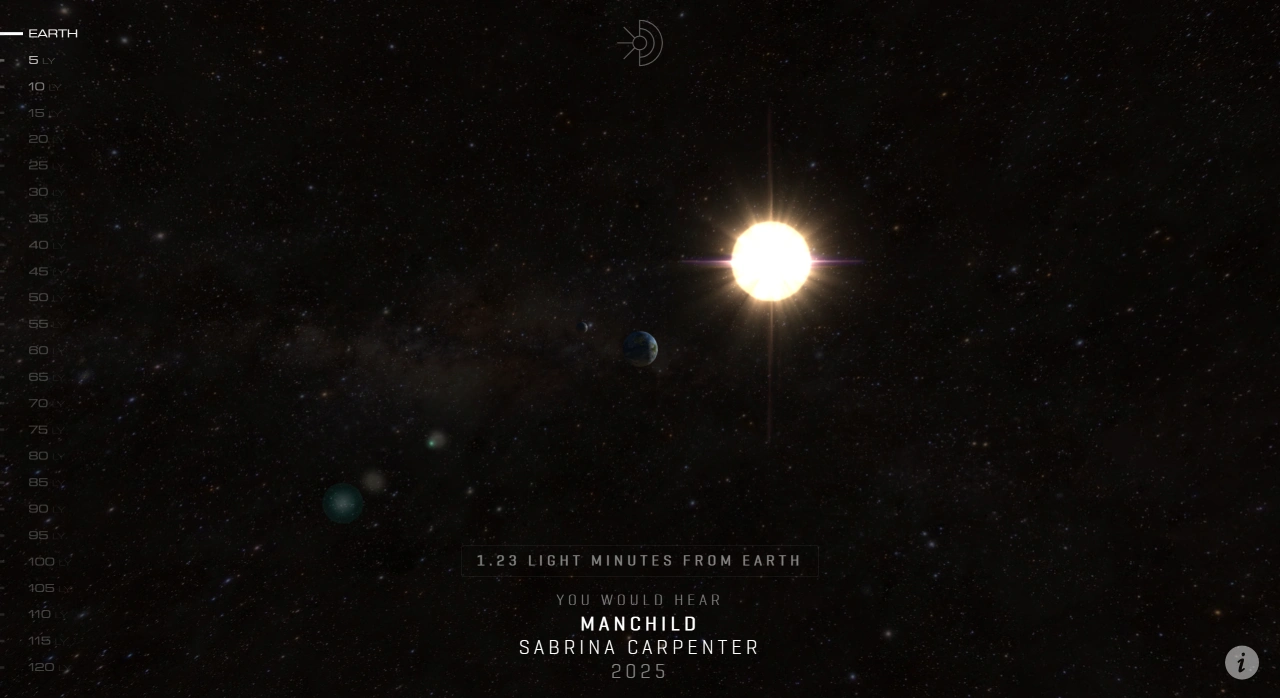
Lightyear.fm is a website that's both fun and educational. It simulates the process of radio waves traveling outward at the speed of light, letting you intuitively see how far the broadcasts and music humans have sent out over the past hundred-plus years have traveled. On this site you can listen to a simulated "broadcast from Earth," and as you scroll outward, away from Earth, you'll see which eras and celestial objects correspond to different distances—giving you a feel for just how vast the universe is, and how faint humanity's signals really are.
Lightyear.fm Main Features
Interactive audio player: This player simulates broadcasts sent from Earth. As you scroll farther outward, it automatically plays earlier programming. The page also notes that, although radio waves have already traveled more than a hundred light-years away, thanks to the inverse square law, terrestrial broadcasts fade into background noise within just a few light-years of Earth.
Distance-to-era mapping: The farther you scroll, the earlier the programs you'll hear. For example, the page notes that around 20 light-years out you can hear Madonna's 1995 "Take A Bow," and around 40 light-years out you can hear Fifth Harmony's 2015 "Worth It."
Interstellar landmarks and visual cues: A 1-pixel white dot on the page represents roughly 300 light-years—the size of our local region of the galaxy—helping you see that humanity's signals cover only a tiny fraction of the Milky Way.
Data and sources: The site's song list is compiled from over 120 years of Billboard data, much of it sourced from the Whitburn project.
How to Use Lightyear.fm
Open the site: Visit Lightyear.fm.
Start the experience: Click the Play button on the page, and the site will begin playing the simulated "broadcast from Earth."
Explore outward: You can hold and scroll your mouse wheel downward, or use a touchpad or wheel to "move away from Earth." You'll see the distance increase, while the music gradually shifts back to earlier eras.
Return to Earth: Click "Go back to Earth" on the deep-space interface to return to the starting point and begin again.
Core Mechanism and Highlights
Distance-to-era mapping: The farther you are from Earth, the older the music you hear. For every additional light-year of distance, the broadcast "rolls back" by 1 year.
Scientific note: Although the page is an artistic visualization showing radio waves traveling out to hundreds of light-years, in reality, due to the inverse square law, terrestrial broadcasts become virtually undetectable just a few light-years from Earth.
Interstellar landmarks: The 1-pixel white dot on the page represents roughly 300 light-years—the size of our local galactic region—helping you intuitively grasp that humanity's signals occupy only a very small part of the Milky Way.
Tips for Using Lightyear.fm
Recommended setup: For the best, most stable experience, use the Chrome browser and put on headphones.
Tech stack: The page is built with HTML5 and Three.js for the 3D visualization.
Fun Facts
The speed of light and a light-year: Light travels in a vacuum at roughly 300,000 km/s (about 186,000 miles/s). One light-year is the distance light covers in a year—approximately 9.46 trillion km (about 5.88 trillion miles).
Inverse square law: The intensity of radio waves decreases rapidly with the square of the distance, so even though they propagate at the speed of light, just a few light-years from Earth the signal is drowned out by cosmic background noise.
Sense of scale: Even though humanity's broadcasts have "traveled" more than a hundred light-years, that's a tiny fraction compared with the Milky Way's diameter of roughly 100,000 light-years.