Script Planner Assistant▸
 AI Apps
 AI News

xPander ai: Backend Platform for AI Agents with Full Dev-to-Deploy Tooling
xPander ai: Backend Platform for AI Agents with Full Dev-to-Deploy ToolingIntroduction
xpander.ai is a backend service platform designed for AI agents, providing end-to-end tools from development to deployment, including core features such as agent memory, more than 2,000 tools and MCP connectors, multi-agent orchestration, runtime environments, and CI/CD pipelines. xPander ai supports mainstream runtimes such as OpenAI, Agno, and Anthropic, and can be quickly integrated with communication tools like Slack and Teams. Developers can build, deploy, test, and release new versions of agents within 1 hour, while meeting enterprise-level requirements, including private VPC deployment, multi-tenant management, and full-chain governance.
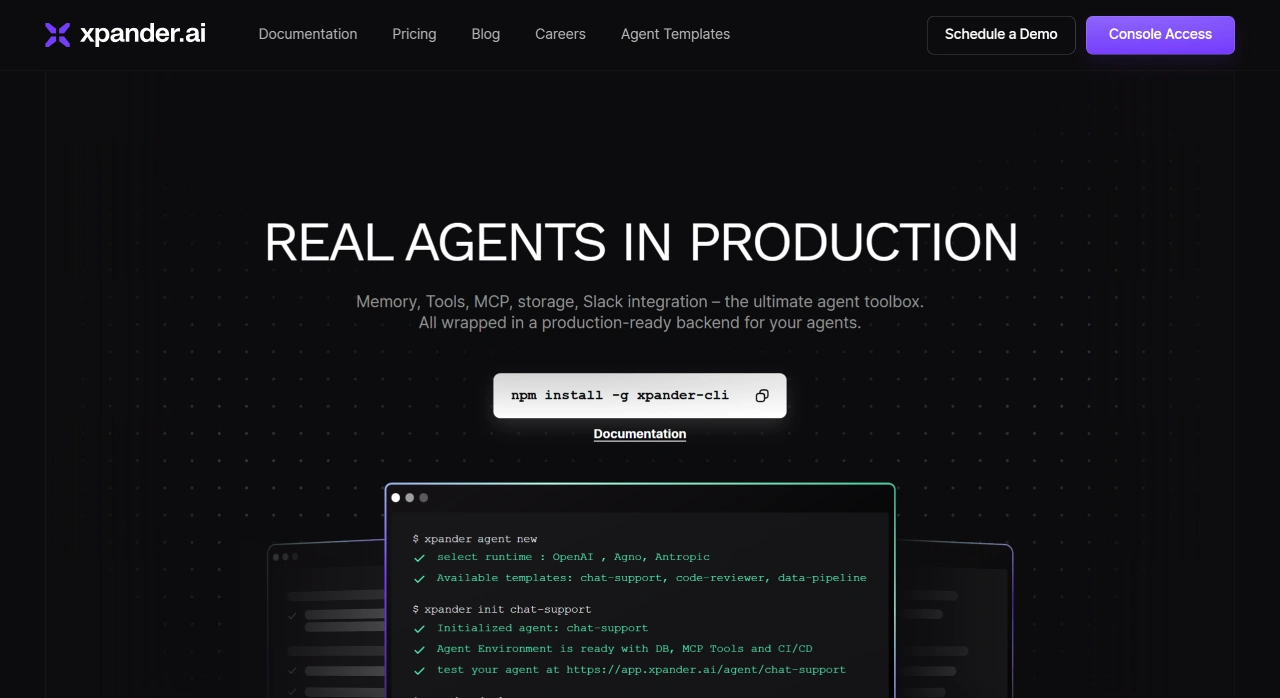
Core Features of xPander ai
Flexible frameworks: Supports common frameworks such as OpenAI ADK, Agno, CrewAI, and LangChain, and developers can also interact directly with native LLM APIs.
Tool integration: Provides an MCP-compatible tool library and pre-built integrations, allowing developers to quickly invoke the features they need.
Multi-user state management: Supports framework-specific local state, as well as distributed state management systems.
Real-time event processing: Uses event streaming technology to support Slackbots, ChatUIs, Agent2Agent communication, and Webhook integration.
API guardrails: Leverages the Agent-Graph-System to define and manage API operation dependencies, enhancing security.
Agent graph system: Ensures reliable execution of multi-step agents.
Agent connectors: Enable agents to connect with various third-party systems and application programming interfaces.
Advantages
No-code solution: Provides a visual environment, allowing enterprise developers to efficiently build, test, and deploy AI agents without writing code.
Open-source SDK: Comes with an open-source SDK that can be used to programmatically build and run AI agents.
Integration and extensibility: Can be integrated with enterprise systems, and agent behavior can be simulated and tested before launch.
Cost optimization: Helps save LLM costs. For example, deploying AI agents on Slack can save 80% of LLM costs.
Rapid deployment: Deploying AI agents on Slack takes only two minutes, with no need to worry about infrastructure or scaling.
Memory capability: AI agents have autonomous memory, allowing them to remember previous conversations and provide more personalized service.
Use Cases for xPander ai
Team collaboration: Turn AI agents into Slack teammates that automatically reply to messages and assign tasks.
Customer service: Automatically respond to customer inquiries and reduce the workload of human support agents.
Task automation: Automatically handle daily tasks such as reminders and scheduling.
Enterprise internal task automation: Build AI agents to execute complex enterprise tasks, such as data processing and file management.
Pricing and Permissions
Free plan: Provides basic features and limited resources, suitable for getting started and experimentation.
Pay-as-you-go plan: Charges based on usage, suitable for users who require flexible resources.
Team plan: Designed for production use, offering higher limits and governance features.
Custom plan: Targets large-scale or enterprise-level deployments, providing customized solutions.
Frequently Asked Questions about xPander ai
Q: Does xpander.ai support custom AI frameworks?
A: Yes. The platform is not bound to a specific framework, so developers can use their preferred tools. The platform only complements missing pieces such as MCP tools and runtime environments, ensuring compatibility.
Q: How do I add custom private API tools?
A: xPander ai offers a tool generation feature. By configuring private API parameters (such as request endpoints and authentication methods) through the interface or SDK, you can generate tools that AI can invoke, with no need for additional adaptation logic.
Q: How can enterprises ensure data security?
A: xPander ai supports deployment within a private enterprise VPC, so all data stays within the enterprise's security perimeter. It also provides multi-tenant isolation, tool permission verification, and access log auditing, meeting data compliance requirements.
Q: What is the difference between self-hosted and platform-hosted deployments?
A: Self-hosting requires the enterprise to provide infrastructure (servers, networks, etc.), making it suitable for scenarios with high requirements for data control. Platform hosting eliminates the need to manage underlying resources, making it suitable for quick launch and lightweight usage scenarios. Both support the same agent capabilities.
Q: How are permissions managed when multiple teams collaborate on agent development?
A: xPander ai supports organization-level access control, allowing you to assign view, edit, and deployment permissions for agents by team and role, avoiding permission混乱.
Q: How do I troubleshoot issues when an agent fails to run?
A: Use the platform's built-in full-chain monitoring feature to view task execution logs, tool invocation records, and error messages. It also supports session recovery, allowing execution to resume from the breakpoint after a failure, reducing data loss.
Q: Can agents be integrated with Slack and Teams simultaneously?
A: Yes. xPander ai supports parallel multi-channel deployment. Simply select the target channels during deployment, and the system will automatically complete the integration, allowing agents to receive user requests from multiple channels simultaneously.
Q: Does it support integration with existing enterprise systems (such as CRM and ERP)?
A: Yes. By configuring existing system APIs through the custom tool feature, agents can invoke CRM/ERP data to automate business processes (for example, an agent reading customer information from CRM and generating follow-up reminders).