Script Planner Assistant▸
 AI Apps
 AI News

NUKEMAP: An Online Nuclear Explosion Simulator
NUKEMAP: An Online Nuclear Explosion SimulatorIntroduction
NUKEMAP is an online nuclear explosion simulation tool created in 2012 by Alex Wellerstein, a science historian at Stevens Institute of Technology. NUKEMAP uses the Mapbox API and declassified nuclear weapons effects data, allowing users to simulate the consequences of detonating various types and yields of nuclear weapons at any location around the world and at any altitude.
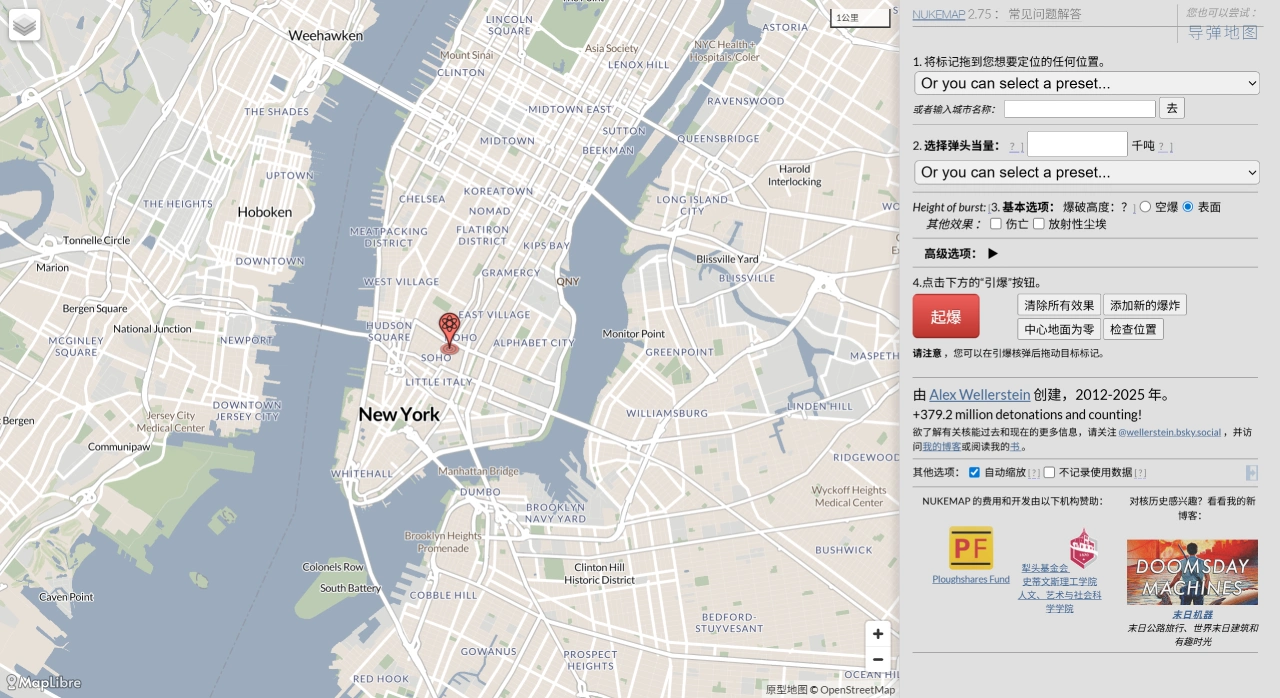
NUKEMAP primarily uses Google Maps as its base map. Users can select the detonation location themselves (such as a city, landmark, or custom coordinates), and can also set the weapon's yield (ranging from a 10-tonne small nuclear device to a 1-gigaton massive-yield nuclear bomb, including historical weapons like "Little Boy" and "Fat Man," modern warheads like the W88, as well as theoretical weapons like the "Tsar Bomba"), and the detonation method (airburst or ground burst). The simulation results are displayed as colored zones overlaid on the map.
The specific zones include:
Fireball zone: The area covered by the high-temperature fireball generated instantly by the nuclear explosion; everything within this zone will be vaporized directly;
Blast damage zone: The area where overpressure causes building collapse and personnel injuries, divided into different severity levels such as heavy (e.g., concrete buildings destroyed), moderate (residential buildings collapse), and light (windows shatter);
Thermal radiation zone: The area where intense thermal radiation from the explosion can cause burns, potentially resulting in third-degree burns (painless but destroying nerves, requiring amputation);
Direct radiation zone: The range affected by ionizing radiation (such as gamma rays and neutron radiation), which may cause acute radiation syndrome (hair loss, bleeding, death) or long-term cancer;
Radioactive fallout zone: The range of radioactive contamination formed when dust kicked up by the explosion is carried by the wind, affecting the ecological environment and human health over a wider area.
In terms of features, NUKEMAP has the following characteristics:
Simulates various explosions: From nuclear weapons historically used in reality to imagined massive-yield nuclear bombs, all can be selected, with different detonation methods such as airburst and ground burst available;
Clear display of ranges: NUKEMAP clearly indicates the fireball radius, thermal radiation range, blast damage area, and the spread path of radioactive fallout;
Estimates casualties: Calculates potential casualties from the explosion based on global population density data;
Shows multiple effects: Including the impact ranges of blast waves, thermal radiation, acute radiation, and radioactive fallout;
Optional historical and modern weapons: Provides multiple preset options ranging from WWII atomic bombs to modern nuclear weapons;
Exportable results: Simulation results can be saved as KMZ files and viewed in other map software.
How to use NUKEMAP:
First open the webpage and enter NUKEMAP's official URL in the browser address bar;
Then select the detonation location, which can be done manually, by selecting a preset location, or by entering coordinates yourself;
Next, set the explosion yield, either by directly entering a value in kilotons (kt) or selecting from preset yields;
Then determine the explosion type, choosing "Airburst" or "Surface burst";
There are also advanced settings (optional), such as airburst settings and display options for explosion effect ranges;
Finally, click the "Detonate" button to see the explosion effects, including blast waves, thermal radiation, radiation ranges, and casualty estimates.
NUKEMAP was made by Alex Wellerstein, a professor at Stevens Institute of Technology in Hoboken, New Jersey, USA, who has long studied the history of nuclear weapons and public perception of them. He created this tool to break misconceptions about nuclear weapons (such as the belief that "nuclear bombs can blow up the whole world" or "nuclear bombs are no different from ordinary bombs"), helping people more clearly understand just how dangerous nuclear weapons are.