Script Planner Assistant▸
 AI Apps
 AI News

WeKnora: Tencent's Open-Source LLM-Based Document Understanding & Retrieval Framework
WeKnora: Tencent's Open-Source LLM-Based Document Understanding & Retrieval FrameworkIntroduction
WeKnora is Tencent's open-source document understanding and retrieval framework, built on large language models and designed specifically for scenarios with complex structures and diverse content. It adopts a modular architecture that integrates multimodal preprocessing, semantic vector indexing, intelligent recall, and LLM-based generation and inference, enabling the construction of efficient and controllable document Q&A workflows. The core retrieval process is based on the RAG (Retrieval-Augmented Generation) mechanism, which combines contextually relevant passages with language models to deliver higher-quality semantic answers.
Key Features
Supports parsing multiple document formats such as PDF, Word, and images, and extracts semantics from them.
Employs the RAG mechanism, combining contextual passages with language models to generate high-quality answers.
Flexible modular architecture that decouples and extends the entire pipeline, including parsing, embedding, retrieval, and generation.
Supports multiple retrieval strategies such as keyword, vector, and knowledge graph search, and provides both a Web interface and API.
Supports on-premises and private cloud deployment, ensuring data security and controllability.
Technical Highlights
Powerful Multimodal Cognition Engine: WeKnora accurately parses mixed text-and-image content in PDFs, Word documents, and images, extracting semantic information from text, tables, and images. By combining OCR with cross-modal modeling, it builds a unified structured knowledge hub.
Modular RAG Pipeline Design: Retrieval strategies such as BM25, vector search, and knowledge graph can be freely combined and paired with large language models like Qwen and DeepSeek, along with vector databases, to flexibly meet enterprise customization needs.
Precise Inference and Trustworthy Decision Support: Combined with private deployment, deep multi-turn contextual understanding, and end-to-end visual evaluation, it provides secure and controllable knowledge support for highly sensitive scenarios.
Flexible Adaptation to Various Production Environments: WeKnora supports on-premises deployment, Docker images, and private cloud environments, and comes with a built-in monitoring and logging system to meet offline scenario requirements.
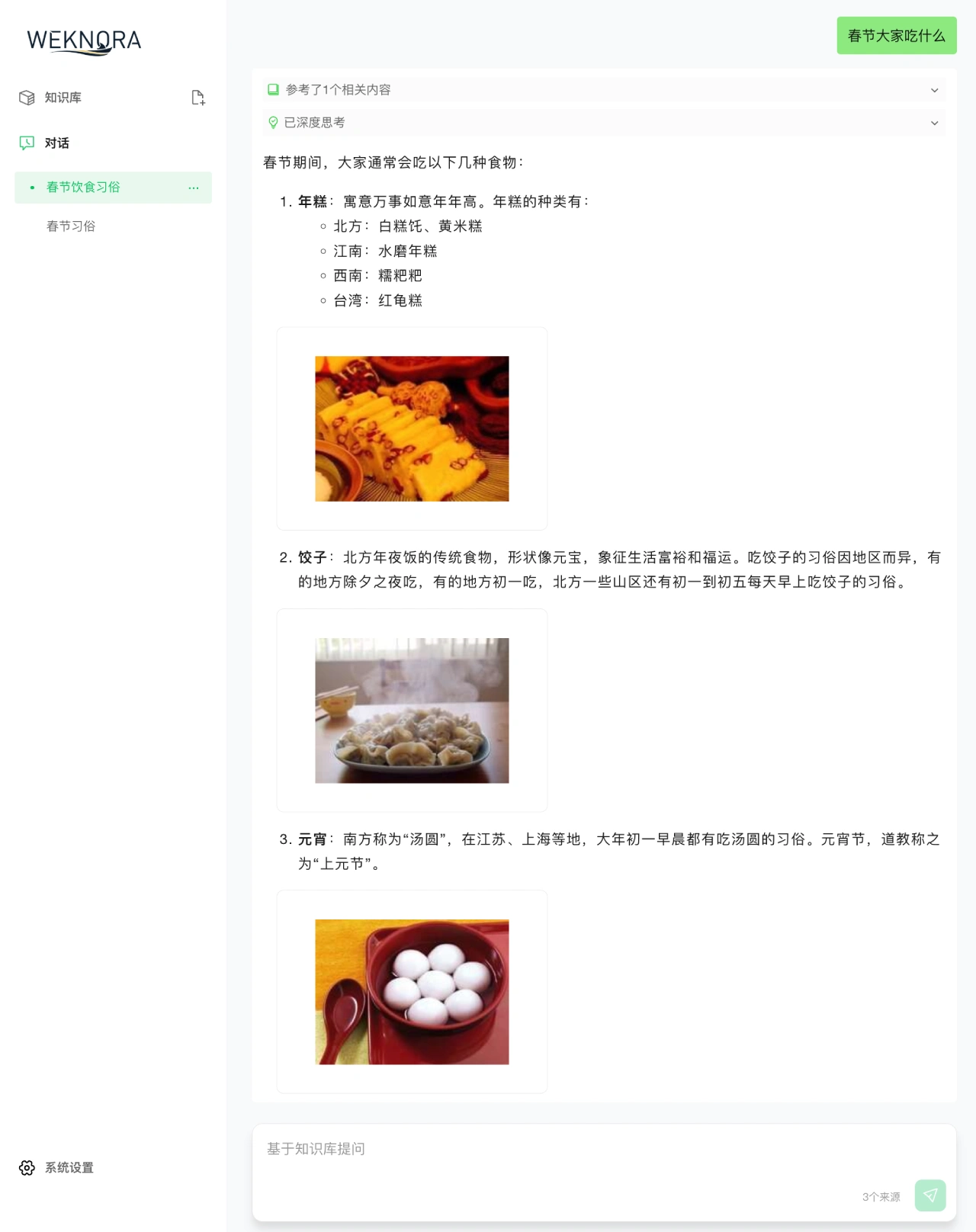
Out-of-the-Box Interactive Experience: WeKnora provides an intuitive Web interface and standard API, supporting drag-and-drop document upload, multi-turn Q&A, and knowledge graph visualization, allowing non-technical users to get started quickly.
Applicable Scenarios
Enterprise Knowledge Management: Used for internal document retrieval, policy Q&A, and operations manual queries.
Scientific Literature Analysis: Enables paper retrieval, research report analysis, and academic material organization.
Product Technical Support: Includes product manual Q&A, technical document retrieval, and troubleshooting.
Legal and Compliance Review: Such as contract clause retrieval, regulatory policy queries, and case analysis.
Medical Knowledge Assistance: Used for medical literature retrieval, clinical guideline queries, and case analysis.
How to Use WeKnora
Deploying WeKnora: You can deploy it via Docker images and get the service up and running in just a few steps. Alternatively, you can deploy it locally from the source code by following the official documentation instructions.
Clone the code repository.
Configure environment variables.
Start the service.
Document Upload: After logging into the WeKnora platform, upload the documents you want to process via drag-and-drop or file selection. The system will automatically parse them and build an index.
Knowledge Retrieval: Enter keywords in the WeKnora search box to quickly retrieve relevant content. It supports multiple methods including full-text search and fuzzy search, and also allows precise retrieval with conditions.
Result Viewing and Analysis: Retrieval results are displayed in a list, and clicking on an item shows the details. For complex documents, features like the knowledge graph can be leveraged for in-depth analysis and understanding.
WeKnora project address:https://github.com/Tencent/WeKnora