Script Planner Assistant▸
 AI Apps
 AI News

Teamo: The World's First Super Agent with A2A Dual-Protocol
Teamo: The World's First Super Agent with A2A Dual-ProtocolIntroduction
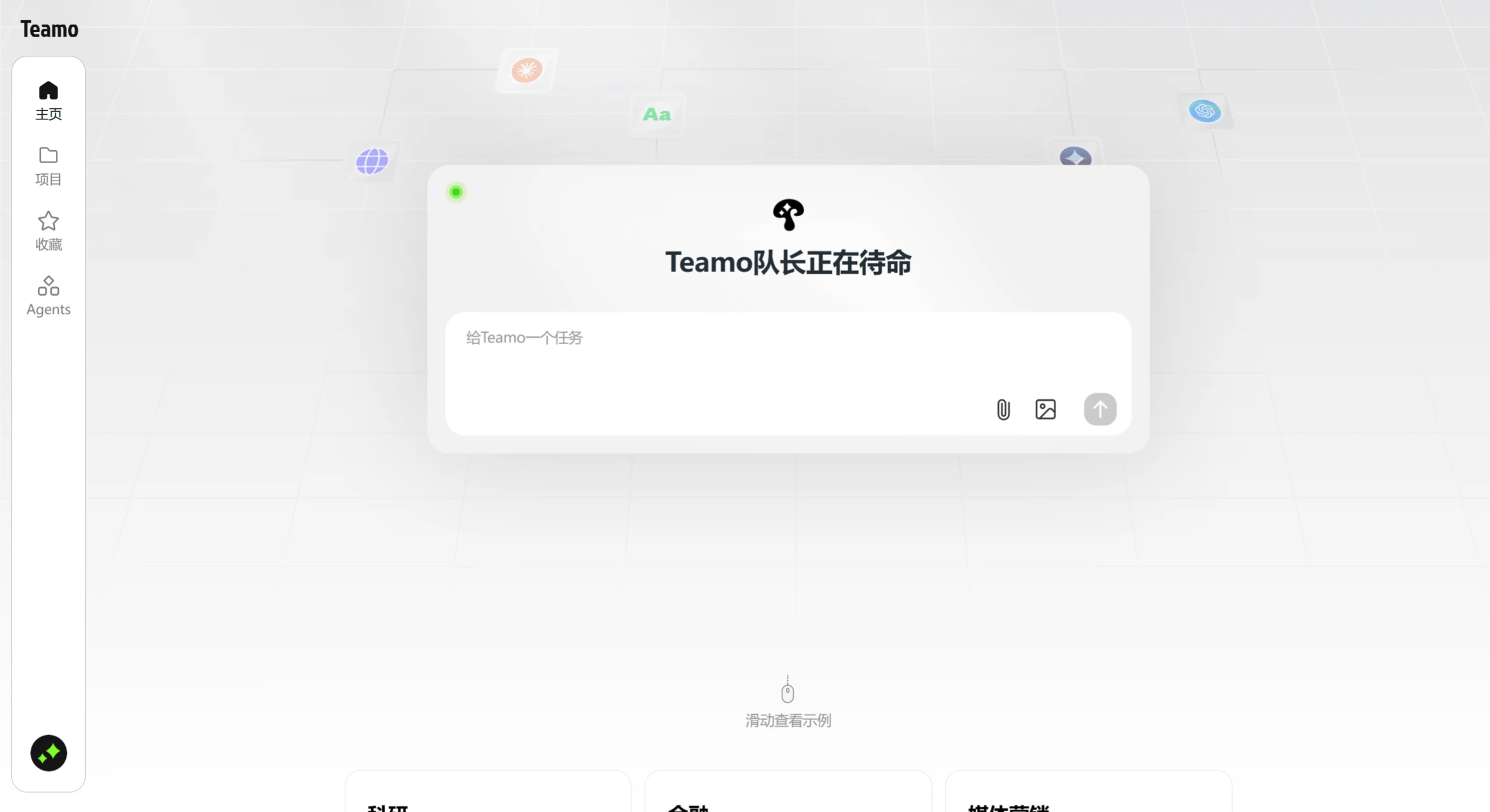
Teamo is a multi-Agent collaborative AI productivity platform developed by the team of Zhihu answerer Xi Xiaoyao. It is the world's first super-intelligent agent based on the dual-protocol paradigm of A2A (Agent-to-Agent) + MCP (Multi-Channel Protocol). Its core value lies in leveraging a "virtual colleague" team to collaborate on specialized needs, including searchers (scraping materials from the web), analysts (screening credible content), writing specialists (synthesizing reports), etc. Tasks are executed in a "specialized division of labor + cross-verification" approach, with a transparent process and traceable sources for conclusions, making up for the "hallucination" problem of traditional AI.
Core Features
Super Search & Write: Executing the super search & write function is the core feature of Teamo. It can quickly understand complex user needs, perform massive in-depth information retrieval, screening, and analysis across the entire web, and organize the analyzed insights into professionally written drafts that are logically rigorous and flow smoothly.
Multi-Agent Collaboration Architecture: Built with the A2A and MCP dual protocols, it is internally formed by Agents with different functions, such as search groups, consulting groups, writing groups, etc. They can collaborate with each other efficiently to complete complex task flows together.
Role-Based Interactive Interface: By interacting with Agents of different functions, it is equivalent to fine-tuning instructions or personalized directions, getting closer to the interaction model of real team management.
Structured Output Templates: Provides a variety of built-in report templates, such as SWOT, industry reports, business plans, academic papers, etc., ensuring that the output content is not only informationally accurate but also meets professional format requirements.
Iterative Collaboration: Users can enter the execution state of any Agent field to make directional adjustments, supplement information, or correct results, significantly reducing risks and achieving efficient collaboration with the AI team.
Technical Principles
A2A Protocol: Enables collaboration between intelligent agents from different platforms and vendors, allowing for secure collaboration between Agents, task state management, user experience negotiation, and function discovery.
MCP Protocol: Emphasizes a hybrid collaboration flow of "model + tools + multi-Agent", supporting intent declaration, task scheduling, plugin encapsulation, and state transfer, further enhancing the Agent's autonomous understanding and collaboration capabilities.
Application Scenarios
Teamo is suitable for scientific research, finance, media, marketing, biomedical and other fields, quickly producing complex content such as review papers, business plans, market research reports, etc., for example:
Scientific Research: Teamo can automatically scrape thousands of papers and generate complete review reports.
Finance: Teamo can quickly generate industry trend analysis reports, saving manual time.
Media: Teamo can assist reporters in writing high-quality press releases and in-depth reports in real time.
Tutorial
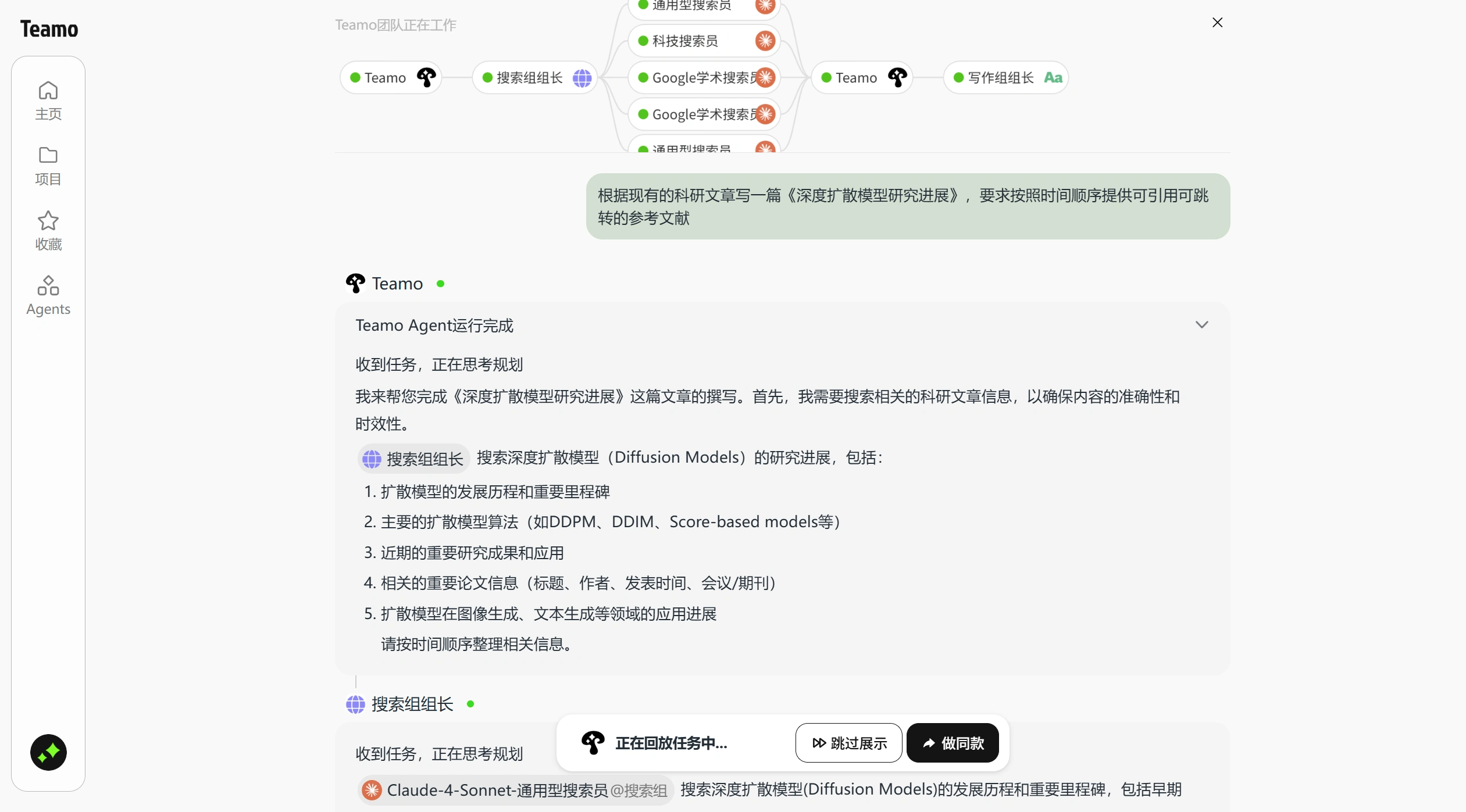
User Access: Users can visit the Teamo official website (https://teamo.floatmiracle.com/).
Describe the Task: Enter input such as "Write a scientific research review" or "Research an industry report".
Task Decomposition and Execution: The CEO Agent automatically breaks down the task and assigns it to different specialized Agents for parallel execution.
Result Output: Multiple versions are compared with each other to generate the optimal one, and a final version is confirmed by the user.
Teamo simulates a real team, breaking through the traditional single AI model, enhancing efficiency and quality, and providing a reliable knowledge work assistant for knowledge workers.
Frequently Asked Questions
1. How does Teamo solve the "hallucination" problem of traditional AI?
Answer: Teamo uses a "multi-Agent collaboration + transparent process" mechanism to avoid single AI fabricating information, achieving "cross-verification" and "traceable process". AI with different functions (such as searchers, analysts, writers) collaborate in a division of labor and provide tools to execute tasks. For example, the search group captures authoritative materials, and the writing group writes reports based on credible sources. You can click to view the data sources and references.
2. What are the key links in Teamo's core collaboration process?
Answer: It includes task decomposition: For example, when analyzing the new energy market, it is automatically broken down into sub-tasks such as Model A capturing financial reports and Model B comparing trends; multi-Agent parallelism: roles such as search group, writing group, evaluation group, etc. For example, multiple searchers in the search group are respectively responsible for different time periods or domain members; result integration and evaluation: after generating multiple reports, the evaluation group rates them (e.g., out of 100) from different levels such as style, length, references, etc., for users to choose different grade results such as S-level (97 points).
If you often come into contact with industry reports, academic articles, or are tired of the "hallucination" problem in traditional AI tools, you can keep an eye on its future development. After all, it is rare to be able to see both the AI's "thinking process" and "sources" at the same time.