Script Planner Assistant▸
 AI Apps
 AI News

ChatEDU
ChatEDUIntroduction
ChatEDU is a multimodal educational tool developed by four undergraduate computer science students at Vanderbilt University. By leveraging generative ai, it serves as a "second brain" for students. It offers three core features: knowledge graphs, dynamic knowledge profiles, and task-based learning agents. It supports uploading various learning materials including text, images, and videos, and analyzes the content using Azure and OpenAI technologies to generate tailored interactive learning workflows.
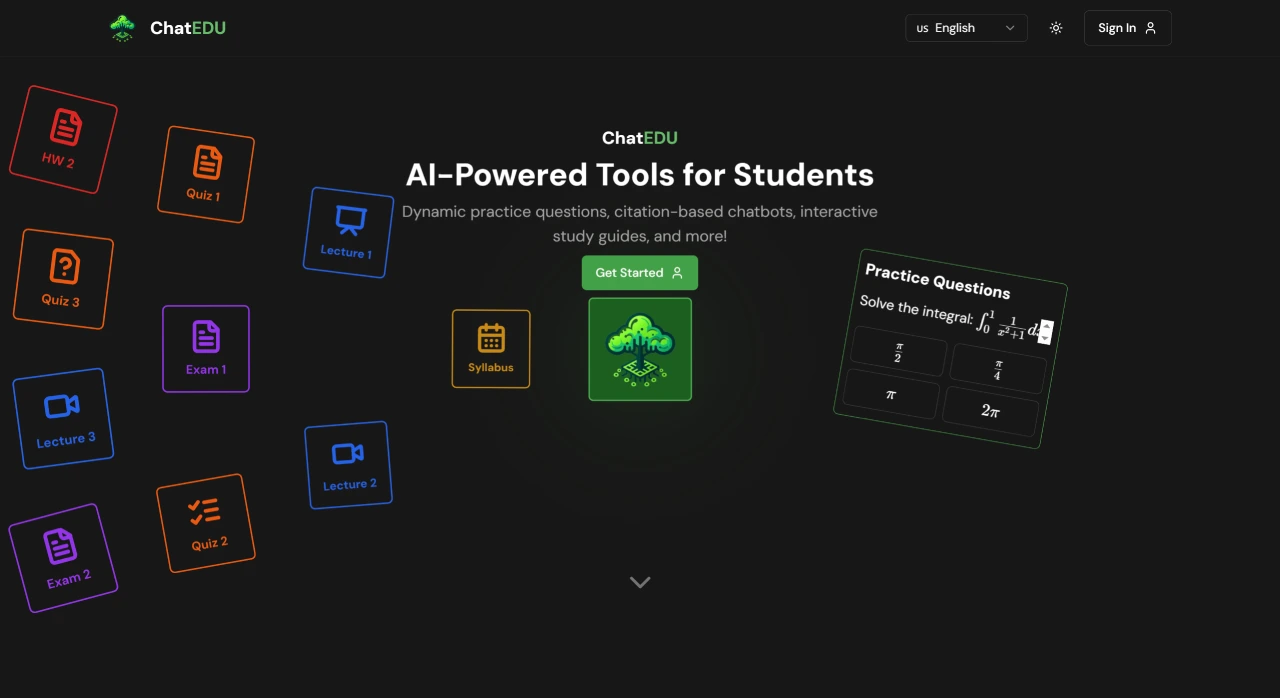
ChatEDU Main Features
Personalized Learning Paths: Students can upload learning materials such as notes, assignments, and courseware. ChatEDU generates personalized learning paths based on these materials.
Intelligent Learning Management: ChatEDU V2 provides teachers with an intelligent learning management system that can generate lesson plans and assignments, and provide instructive feedback.
Multimodal Learning Experience: ChatEDU V3 integrates the features of the previous two versions, acting as a multimodal learning assistant for students. Through technologies such as knowledge graphs and dynamic comprehension analysis, it provides more comprehensive learning support.
ChatEDU Features
Knowledge Graphs: ChatEDU transforms academic topics into structured models, helping students intuitively explore the connections between topics.
Dynamic Knowledge Profiles: The system updates knowledge profiles in real time based on students' learning progress and level of understanding, so as to more precisely match learning needs.
Interactive Learning Paths: The learning agent generates interactive learning paths in various forms, including text, audio, and images, based on the student's knowledge profile.
Advantages
Improved Learning Efficiency: The system dynamically adjusts content and difficulty based on students' learning situations, enabling more efficient studying.
Enhanced Learning Experience: Through knowledge graphs and interactive design, it creates a more engaging learning experience.
Personalized Learning: Personalized learning paths and dynamic knowledge profiles meet the requirements of different students, providing precise learning support.
ChatEDU Application Scenarios
Higher Education: Pilot enterprise version services, providing universities with insights into students' learning needs, assisting classroom teaching, and enhancing interactivity and personalization (citing IDC research: 99.4% of U.S. higher education institutions consider AI to be the key to competitiveness over the next 3 years).
AI Education Innovation: Transforming unstructured learning materials into structured knowledge graphs, promoting the practical application of "knowledge graphs + education," and bridging the gap between academic research and practice.
Career Bridging: Knowledge profiles can be converted into professional skill assessment reports, assisting corporate onboarding training, and guiding students to apply theoretical knowledge to practical scenarios such as social network analysis and transportation system optimization.
FAQ
Q: What is the essential difference between ChatEDU and traditional AI learning tools?
A: Traditional tools focus on automating task completion (such as writing assignments on behalf of students), while ChatEDU builds a personalized knowledge network for students through knowledge graphs and dynamic profiles. It positions AI as a "learning partner" that guides exploration rather than doing the work, with an emphasis on cultivating active learning abilities and building knowledge systems.
Q: What is the technical implementation path for knowledge graphs in ChatEDU?
A: Students upload multimodal learning materials such as text, videos, and PDFs → Azure tools extract content topics and relationships → GPT-4 Vision generates nodes and edges for the knowledge graph → Stored in Azure Cosmos PostgreSQL for real-time access by the learning agent.
Q: How is the improvement in learning outcomes from ChatEDU verified?
A: Short-term plans involve partnering with universities to conduct classroom pilots, evaluating through metrics such as student answer accuracy and knowledge gap closure speed; long-term goals include collaborating with educational research institutions to compare academic performance differences before and after use, validating the effectiveness of personalized learning paths.