Script Planner Assistant▸
 AI Apps
 AI News

SurveyGO (Juanji): AI Paper Writing Tool by ModelBest (Tsinghua)
SurveyGO (Juanji): AI Paper Writing Tool by ModelBest (Tsinghua)Introduction
What is Juanji?
SurveyGO (Juanji) is an AI paper writing tool launched by the Tsinghua Modelbest Intelligence team. It adopts the LLMxMapReduce-V2 technology to achieve intelligent literature aggregation, and can quickly generate well-structured, reliably cited academic reviews based on user-input topics.
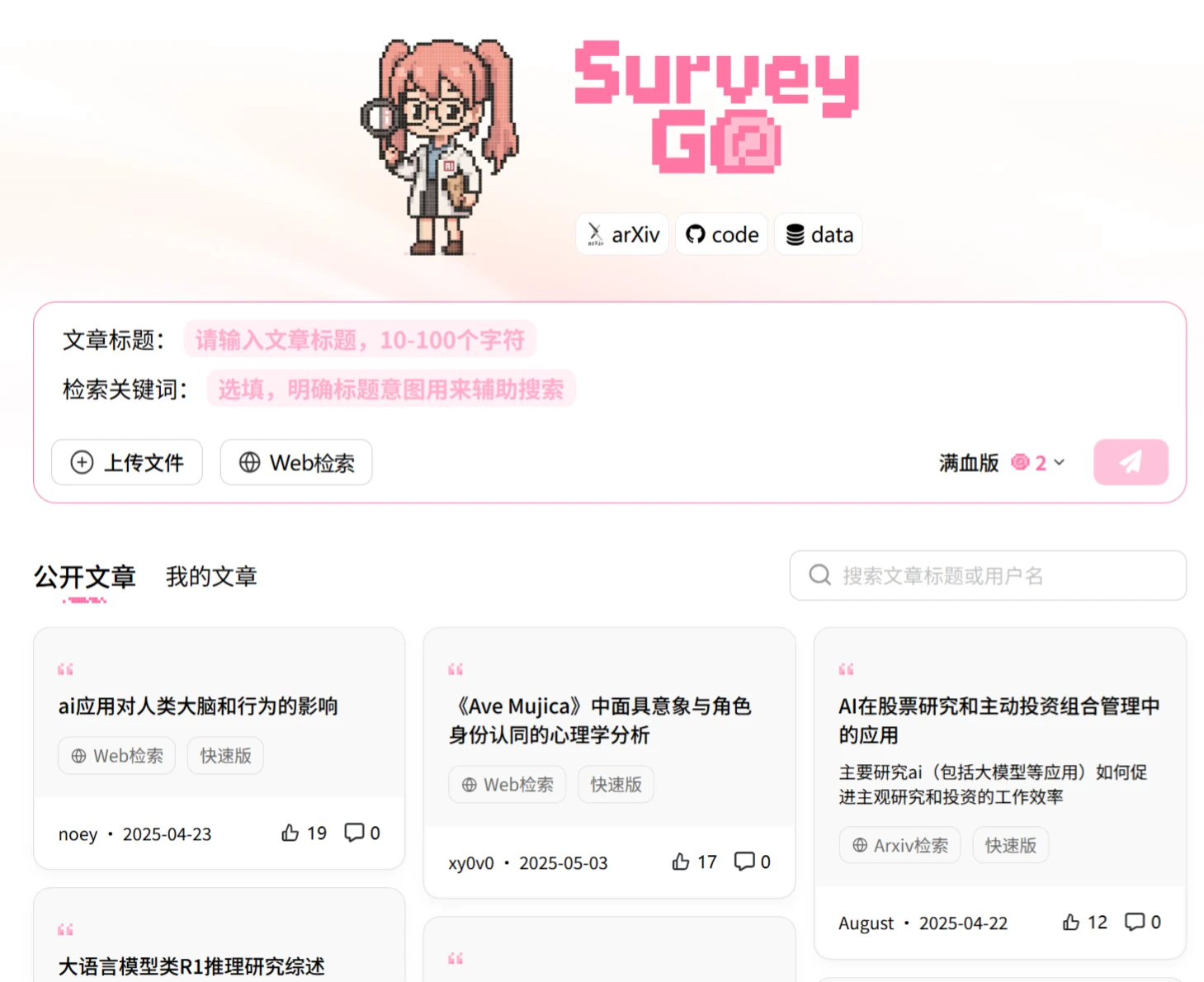
Why is it called Juanji?
Because SurveyGO performs exceptionally well in writing literature reviews, capable of rapidly processing large volumes of literature like "rolling up" the academic rat race, and the name "Juanji" sounds cute, it has been given this affectionate nickname by users.
Core Technology of Juanji
It adopts the self-developed LLMxMapReduce-V2 technology, leveraging text convolution algorithms to aggregate multiple references, replacing the commonly used retrieval in existing methods, thereby fully leveraging all reference chapters. The technology works through the following three stages:
Initialization Stage: Building a knowledge skeleton through framework initialization, adopting a "raw material preprocessing" strategy to generate structured summaries.
Framework Optimization Stage: Using a 7-layer convolutional neural network combined with information entropy evaluation, simulating a "culinary competition"-style iterative optimization, selecting the optimal knowledge framework through 3 rounds of self-optimization.
Review Construction Stage: Adopting a hierarchical content generation mechanism to ensure logical self-consistency between parent chapters and sub-modules.
Technical Principles of Juanji
LLMxMapReduce-V2 Technology: Uses text convolution algorithms to aggregate multiple references, similar to the application of Convolutional Neural Networks (CNN) in image processing, progressively abstracting local information into high-level global representations. The model first focuses on partial cited articles (local information), and through multi-layer convolution operations, integrates local information into more comprehensive structured information, such as the paragraph structure and themes of the article. An information entropy estimation module is introduced to guide the convolution process, ensuring that the scaling process continuously enhances the information content of the results during testing.
Solving Context Length Limitations: Traditional Retrieval-Augmented Generation (RAG) methods generate content based on retrieving text fragments most relevant to the query, easily overlooking important content that is topically related but cannot directly match semantic similarity. Based on aggregating multiple documents rather than simple retrieval, it fully utilizes information from all references, avoiding information loss.
High-Quality Content Generation: Based on multi-layer convolution operations, it extracts key information from the literature and integrates it into structured output, ensuring the logical coherence of the generated article. It automatically cites relevant literature and materials, ensuring the credibility and professionalism of the generated content.
Evaluation Benchmark: To scientifically evaluate the quality of generated articles, a high-quality survey writing benchmark SurveyEval was created, the first scalable evaluation benchmark in the field of computer science that combines surveys with complete references.
How to Use Juanji: Steps
Usage Methods
Normal Mode: Suitable for quickly generating framework-based reviews. Users only need to input the paper title and keyword descriptions (supports Chinese and English), and the system automatically retrieves and integrates relevant literature online. For example, entering "Treatment Progress of Elderly IPF Patients", SurveyGO automatically breaks it down into subtopics such as "elderly" and "IPF", generating a logically rigorous 25,000-word report.
Professional Mode: Supports custom material sources, allowing upload of local literature (PDF/Word) or specifying databases (such as CNKI, arXiv), suitable for projects requiring deep control over references. Additionally, content generated from uploaded files can be set as "non-public" to avoid leakage of sensitive data.
Operating Steps
Mode Selection: Choose Normal Mode or Professional Mode according to your needs, and complete the corresponding information.
Submission and Wait: After completing the topic submission, users can close the page without any operation. The system processes literature in parallel through a distributed computing framework, with generation taking approximately 1 hour (may be extended during peak periods). During the period, users can log in at any time to check progress, or browse and like other users' topics in the "Writing Requirements Table".
Result Retrieval: After generation is complete, click the title to jump directly to the Feishu document, which includes a complete table of contents, body, references (in-text citations + end-of-article list), and the format can be directly copied into a paper.
Advantages and Disadvantages of Juanji
Advantages
Technical Breakthrough: Adopts self-developed LLMxMapReduce-V2 technology, aggregating multiple documents through text convolution algorithms, improving literature utilization and avoiding the information fragmentation problem of traditional RAG technology.
High Content Quality: Produces long reviews of more than 25,000 words with clear structural hierarchy (phenomenon → cause → countermeasure, macro → micro), rigorous logic, and professional charts.
Multilingual Support: Supports generation in Chinese and English, with Chinese reports automatically organizing knowledge context maps.
High Usability: No complex operations required, Normal/Professional modes available, ready to use upon registration.
Disadvantages
Customization Limitations: Lacks fine-grained settings (such as limiting citation literature language, excluding specific sources), unable to meet the personalized needs of advanced researchers.
Privacy Risks: Articles generated through online retrieval are publicly available by default, making sensitive topics easy to browse.
Uneven Language Support: Chinese mode includes logic diagrams, while English mode does not have this feature.
Citation Reliability: Citation sources cover platforms such as Zhihu, 36Kr, and university forums, with high timeliness and relevance and low hallucination rate, but there exist a small number of non-authoritative citations (such as anonymous Zhihu content).
Processing Efficiency Fluctuations: Queuing required during peak periods, dependent on user likes to increase priority.
Juanji Project Address
Project Official Website: https://surveygo.thunlp.org/
GitHub Repository: https://github.com/thunlp/LLMxMapReduce
HuggingFace Model Library: https://huggingface.co/datasets/R0k1e/SurveyEval
arXiv Technical Paper: https://arxiv.org/pdf/2504.05732
Related News:
60 Essential and Useful Academic Research Tools for Researchers