Script Planner Assistant▸
 AI Apps
 AI News

Praison AI: A Free, Open-Source Low-Code Multi-Agent Framework
Praison AI: A Free, Open-Source Low-Code Multi-Agent FrameworkIntroduction
What is Praison AI?
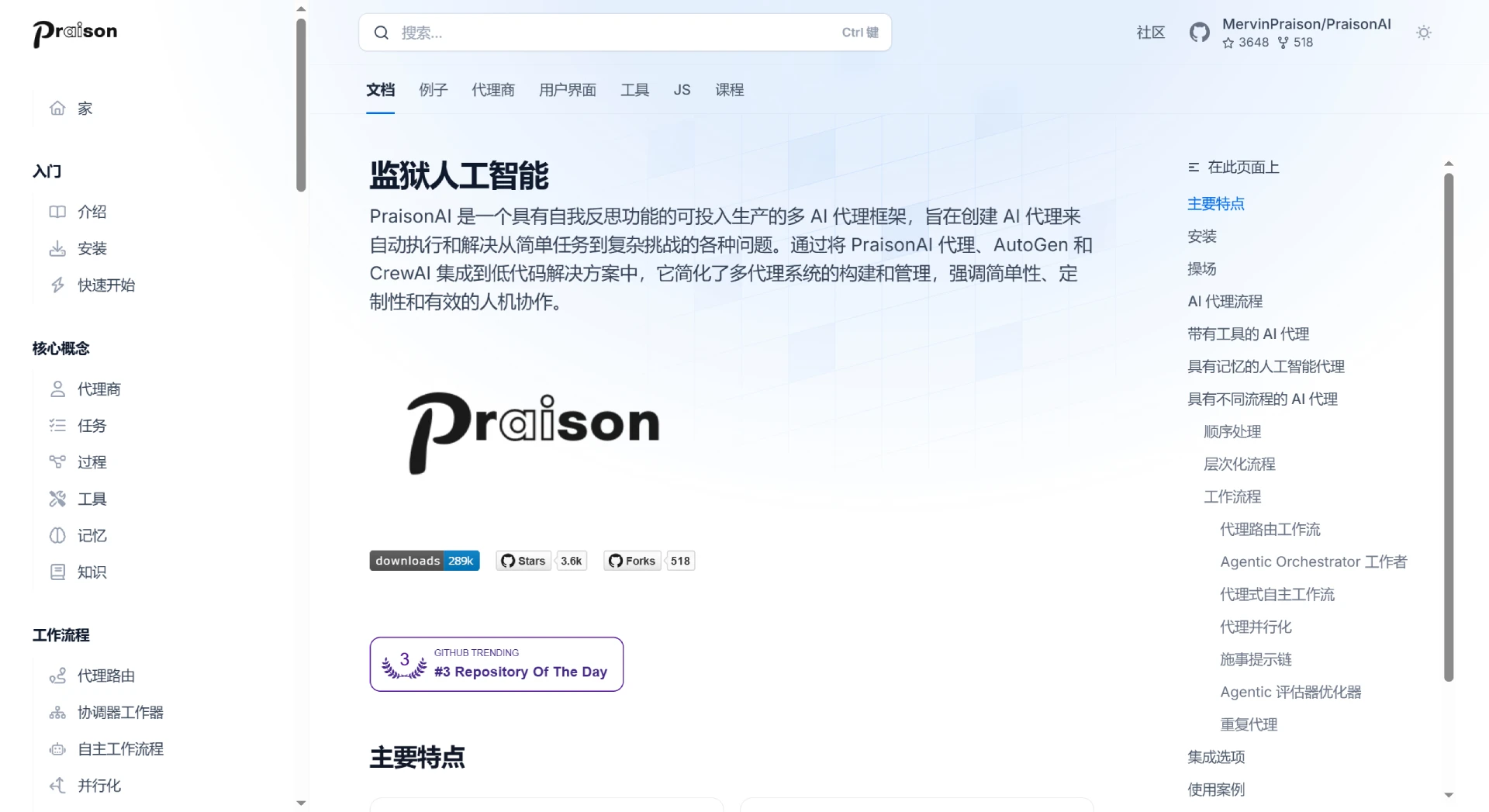
Praison AI is an open-source low-code multi-agent framework that helps users quickly create, manage, and deploy AI agents by simplifying the application development of large language models (LLMs).
Core Concepts
Multi-Agent System (MAS): Praison AI is based on multi-agent system theory, allowing users to create multiple agents with autonomy and collaboration capabilities. These agents can communicate with each other, share knowledge, and work together to complete complex tasks.
Low-Code Development: Praison AI provides a low-code environment where users can quickly define agent behaviors and task workflows through simple YAML configuration files. This low-code approach makes the development process more efficient and lowers the technical barrier.
Features of Praison AI
1. AI Agent Creation and Management
Create AI agents with tool interaction capabilities: agents can use tools to interact with external systems and perform actions.
Create AI agents with memory functions: agents can maintain context and information across tasks, ensuring task continuity.
Create AI agents with multiple process types:
Sequential process: tasks are executed in order one after another.
Hierarchical process: coordinates task execution and agent assignment through a manager agent.
Workflow process: supports complex task relationships and conditional execution.
2. Agent Workflow Types
Dynamic task routing: agents can dynamically route tasks to specialized LLM instances.
Task orchestration and assignment: agents can coordinate and assign tasks to specialized workers.
Autonomous workflows: agents can autonomously monitor, act, and adapt based on environmental feedback.
Parallel execution: agents can execute tasks in parallel to improve performance.
Prompt chaining: agents can handle complex workflows through sequential prompt chains.
Iterative optimization: agents can generate and optimize solutions through iterative feedback.
Repetitive task handling: agents can efficiently handle repetitive tasks through automated loops.
3. Multimodal Interaction
Text interaction: supports text-based interaction methods.
Voice interaction: supports real-time voice interaction, suitable for hands-free applications.
Visual interaction: supports visual input and output, such as image recognition and generation.
4. Memory and Context Management
Agents can save and restore contextual information, ensuring task continuity and consistency.
5. Integration Options
Real-time internet search: access real-time information through tools such as Crawl4AI and Tavily.
Custom tool integration: supports user-defined tools to extend agent capabilities.
Multi-platform integration: supports integration with various existing systems and platforms.
6. User Interface and Interaction
Low-code development interface: quickly create and manage agents through YAML configuration files.
Real-time voice interface: supports voice input and output, enhancing the interaction experience.
Code interface: supports direct interaction with agents through code.
Chat interface: supports interaction methods similar to chatbots.
7. Other Features
Self-reflective agents: agents can evaluate their own performance and optimize it.
Reasoning data generation agents: agents can generate reasoning data to support complex tasks.
Asynchronous agents: support asynchronous task execution, improving efficiency.
Use Cases of Praison AI
Enterprise Automation: Praison AI can be used to automate various internal enterprise processes, such as order processing and document approval. Through agent collaboration, enterprises can improve work efficiency and reduce manual errors.
Intelligent Customer Service: Agents can quickly respond to user inquiries and provide personalized customer service. They can generate accurate answers based on users' history and real-time questions.
Data Analysis: Praison AI can efficiently process and analyze data to generate real-time reports. Agents can automatically adjust analysis strategies based on data changes.
Content Creation: Agents can generate, edit, and optimize content in various formats, such as articles and scripts. Through multi-agent collaboration, more efficient content creation can be achieved.
Advantages of Praison AI
Developer-Friendly: Praison AI provides an intuitive SDK and comprehensive documentation, enabling developers to quickly get started and integrate it into existing technology stacks.
Production-Ready: The framework is designed for enterprise-level applications, offering high scalability and reliability. It can support large-scale agent deployment and the handling of complex tasks.
Open Source: Praison AI is an open-source project that users can customize and extend according to their own needs. The open-source community also provides users with rich resources and exchange platforms.
How to Use
Single Agent: Users can quickly launch an agent through a simple Python script. For example, define an agent and specify its task to start running.
Multiple Agents: Users can define multiple agents and specify the collaboration relationships between them through configuration files. Agents can share information and coordinate tasks with each other.
No-Code Mode: Praison AI provides command-line tools that allow users to quickly create tasks through simple commands. This approach is suitable for non-technical users to get started quickly.
Related Links
GitHub Repository: https://github.com/MervinPraison/PraisonAI。
Documentation: https://docs.praison.ai/。
PyPI Package: https://pypi.org/project/praisonai/。
Related News:
Recommended 10 Excellent Free, Open-Source AI Agent Frameworks