Script Planner Assistant▸
 AI Apps
 AI News

MetaGPT – Open-Source Multi-Agent Framework by DeepWisdom
MetaGPT – Open-Source Multi-Agent Framework by DeepWisdomIntroduction
What is MetaGPT?
MetaGPT is an open-source multi-agent framework developed by the DeepWisdom team, officially open-sourced in June 2023. It leverages large language models (LLMs) to enable multiple agents to collaborate, providing automated solutions for complex tasks. It mimics human workflows by transforming Standard Operating Procedures (SOPs) into prompt sequences, allowing for efficient task decomposition and collaboration.
Core Features of MetaGPT
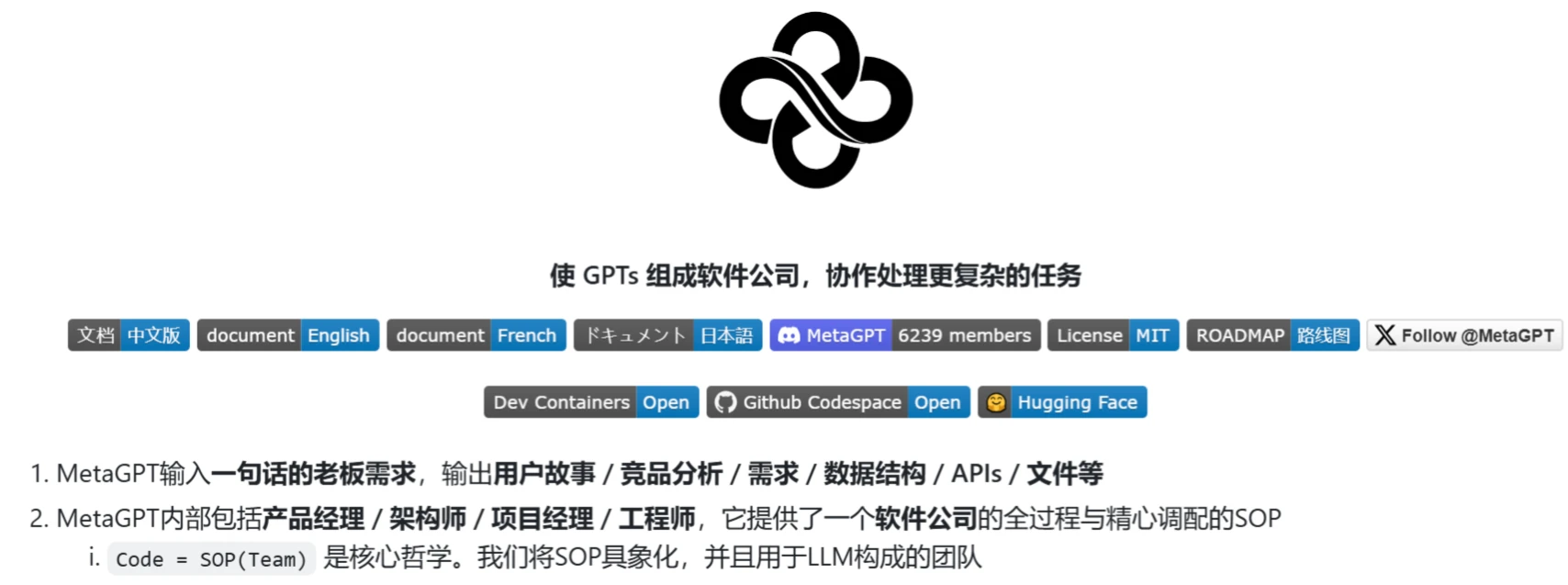
Multi-Agent Collaboration: MetaGPT works like a small software company, with different roles such as product manager, architect, and engineer. Each role corresponds to an agent responsible for specific tasks, such as requirements analysis, system design, code generation, and debugging.
Meta-Programming Framework: By transforming human workflows into prompt sequences, MetaGPT enables multiple agents to collaborate efficiently, reducing errors caused by poor communication.
Task Decomposition and Execution: This framework adopts an "assembly line"-like approach, breaking complex tasks down into multiple subtasks and assigning them to different agents, resulting in more coherent and accurate task execution.
Natural Language Programming: MetaGPT supports the entire process from describing requirements in natural language to automatically generating code, making programming less difficult.
High Performance and Robustness: In code generation benchmark tests, MetaGPT's Pass@1 success rate can reach up to 85.9% and 87.7%, with a 100% task completion rate.
MetaGPT Technical Architecture
Multi-Agent System: MetaGPT assigns roles such as product manager, architect, project manager, and engineer to GPT models, allowing these roles to work together to complete complex tasks.
Agent Communication Mechanism: A complete set of communication rules ensures that agents can effectively transmit information to each other.
Workflow Engine: Uses a Directed Acyclic Graph (DAG) to manage task workflows and ensure smooth task execution.
How to Use MetaGPT
1. Environment Configuration
Make sure the system has Python 3.9+ installed. You can check the Python version with the following command:
python3 --version
If the version is lower than 3.9, please upgrade Python
2. Install MetaGPT
Clone the MetaGPT repository:
git clone https://github.com/geekan/MetaGPT.git
cd MetaGPT
Install in development mode:
pip install -e .
3. Configure MetaGPT
Create the configuration file
Run the following command to initialize the configuration file:
metagpt --init-config
This will create a default configuration file at ~/.metagpt/config2.yaml
Modify the configuration file
Edit the configuration file to set the LLM API key and other parameters. For example:
llm:
  api_type: "openai"  # or other supported API types
  model: "gpt-3.5-turbo"
  api_key: "YOUR_API_KEY"
The priority order of configuration files is: config/key.yaml > config/config.yaml > environment variable.
4. Use MetaGPT
Run via the command line
Run MetaGPT directly from the command line:
metagpt "Create a 2048 game"
Run via a Python script
Import MetaGPT and run the project:
from metagpt.software_company import generate_repo, ProjectRepo
repo: ProjectRepo = generate_repo("Create a 2048 game")
print(repo)
MetaGPT Application Scenarios
Software Development: From requirements analysis to code generation and debugging, MetaGPT can automate the entire software development process.
Complex Task Decomposition: It can break complex tasks down into multiple subtasks and arrange different agents to work together to complete them.
Data Analysis: Quickly process and analyze large amounts of data to provide a basis for business decision-making.
Natural Language Programming: Code can be generated directly from natural language input, lowering the difficulty of programming.
MetaGPT Advantages
Multi-Agent Architecture: Capable of handling more complex tasks and providing more comprehensive solutions.
Team Collaboration and Standardized Operations: Ensures tasks are handled accurately and steadily, reducing the possibility of errors.
Flexibility and Extensibility: Can be adjusted and optimized according to the needs of different fields.
GitHub Repository:https://github.com/geekan/MetaGPT
Related News:
OpenManus: Open-source version of Manus, no invite code required