Script Planner Assistant▸
 AI Apps
 AI News

CineMaster: Kuaishou's 3D-Aware and Controllable Text-to-Video Generation Framework
CineMaster: Kuaishou's 3D-Aware and Controllable Text-to-Video Generation FrameworkIntroduction
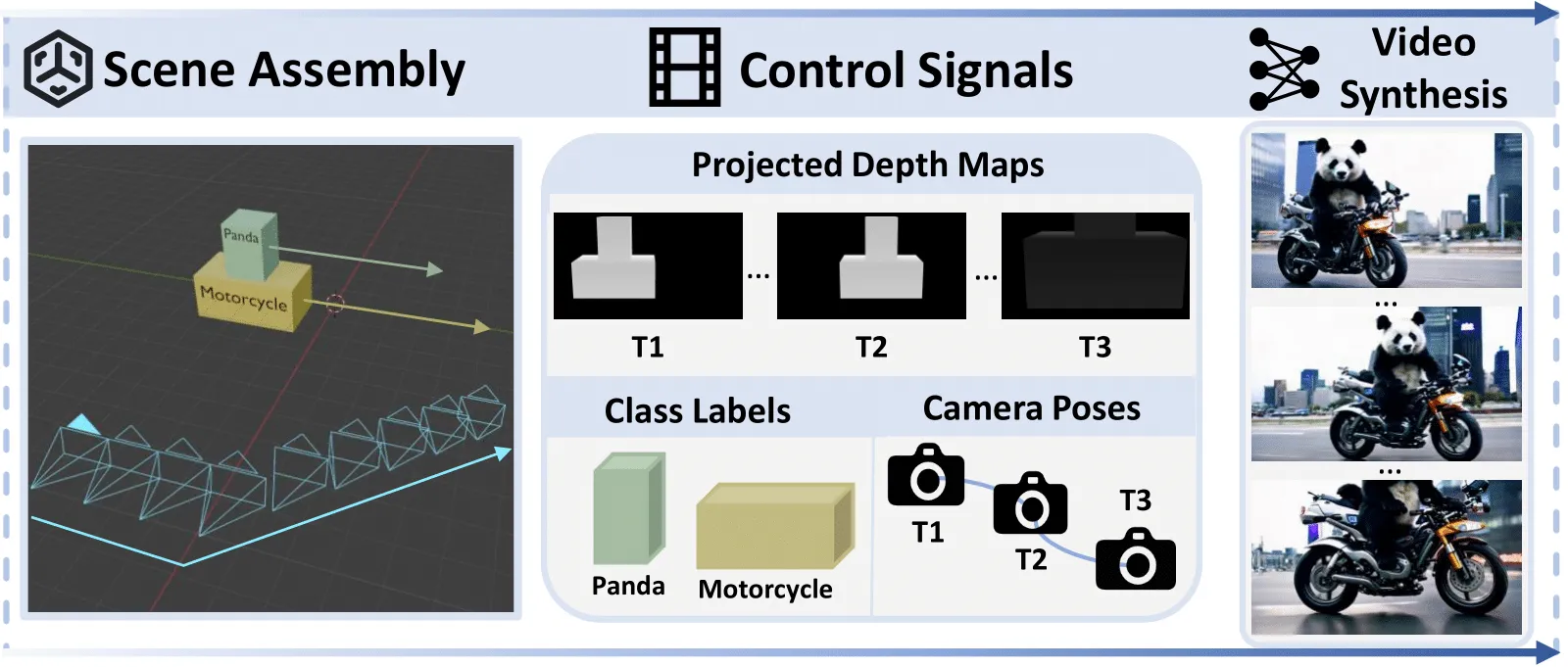
CineMaster is a newly released text-to-video generation framework recently unveiled by Kuaishou. It is a brand-new 3D-aware and controllable text-to-video generation framework jointly released by Dalian University of Technology, the Chinese University of Hong Kong, and Kuaishou Technology. CineMaster empowers users with creative capabilities comparable to those of professional film directors, allowing them to precisely place objects in scenes, freely manipulate objects and cameras in 3D space, and intuitively design the layout of every frame. It is hailed as the ControlNet for video.
CineMaster enables users to precisely control object positions and camera movements through multiple control signals, optimizing the flexibility and accuracy of video generation.
In other words, CineMaster allows users to input control signals including depth maps, camera trajectories, and object labels, enabling them to better realize their creative ideas when generating videos. It can be applied to fields such as animation production, video game development, and other areas requiring precise control of visual elements.
Main Features of CineMaster:
Precise Object Placement in Scenes: Users can freely adjust object positions and camera movements in 3D space, achieving highly controllable video generation.
Intuitive Frame-by-Frame Layout Design: Through an interactive interface, users can preview rendering effects in real time and progressively optimize each frame of the video.
Conditional Signal-Based Video Generation: Leveraging depth maps, camera trajectories, and object category labels to guide the diffusion model in generating video content that aligns with the user's design intent.
Introduction of a Semantic Layout Injection Module and Camera Adapter: Guaranteeing that the generated video content aligns with the user's 3D design intent both semantically and visually, while supporting complex camera movements.
CineMaster Highlights:
Two-Stage Workflow: The first stage constructs 3D-aware control signals, while the second stage generates videos based on these conditional signals.
Semantic Layout Control Network: Combining 3D spatial layout with semantic information to precisely control the position of every entity.
Camera Adapter: Injecting camera poses into the generation process through residual connections, supporting complex camera movements.
CineMaster Technology:
Automated Data Annotation Pipeline: Including instance segmentation, depth estimation, 3D point cloud and bounding box computation, entity tracking, and 3D bounding box adjustment.
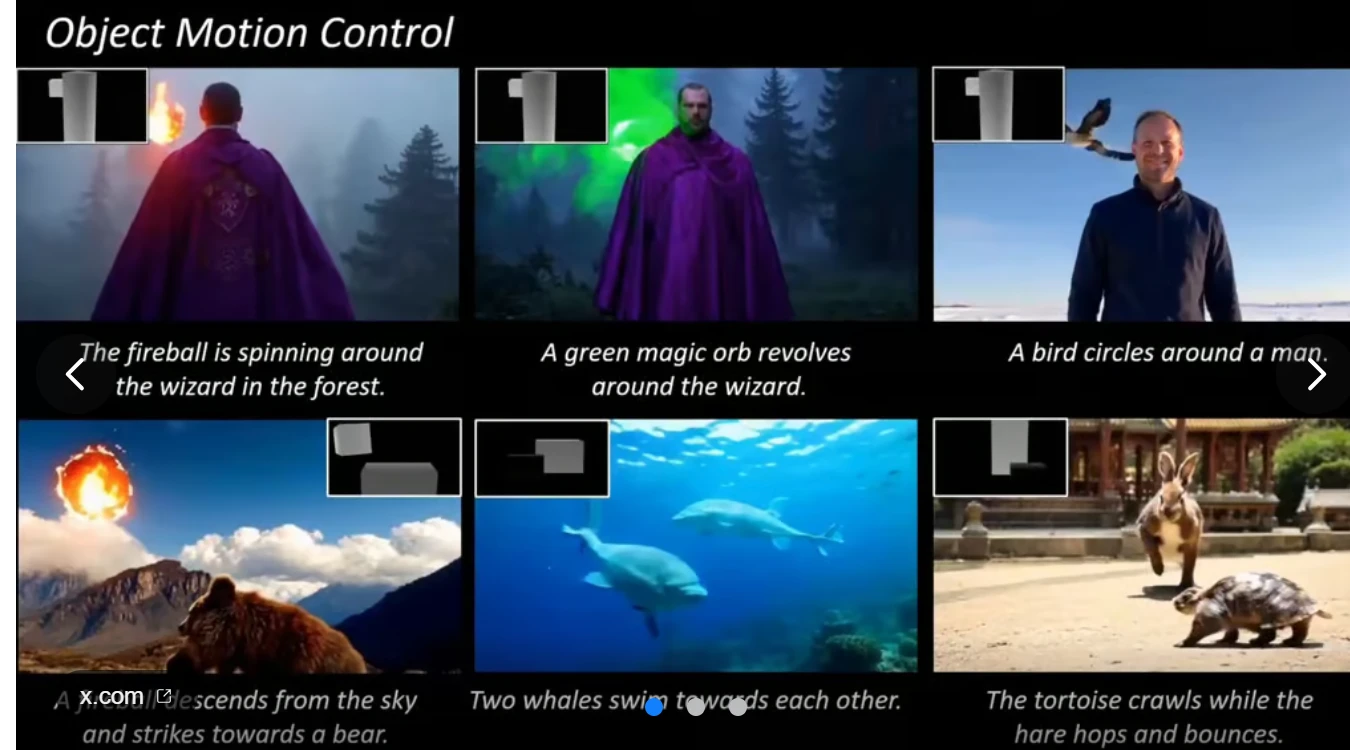
Experiments and Results: Across three typical scenarios, CineMaster's performance far surpasses existing SOTA methods, achieving precise control over objects and camera movements.
CineMaster Applications:
Creative Videos: Helping creators produce more personalized video works.
Advertising and Promotion: Providing precise and innovative advertising video production tools.
Education and Training: Enhancing the appeal of educational content through 3D models and animated scenes.
Filmmaking: Providing new production technology support for film and television content.
CineMaster has a significant impact across multiple fields, including content creation, advertising production, film special effects, and online education, enabling even non-professional users to create videos with cinematic visual effects.
Project Address:https://cinemaster-dev.github.io/