Script Planner Assistant▸
 AI Apps
 AI News

Darwin Model: A Large Model for Materials Science, Chemistry, and Physics
Darwin Model: A Large Model for Materials Science, Chemistry, and PhysicsIntroduction
The Darwin model is a large language model (LLM) specifically designed for the natural sciences (especially physics, chemistry, and materials science). It enhances the effectiveness of language models in scientific research by integrating structured and unstructured scientific knowledge.
Darwin Features:
Materials Design: The Darwin model is capable of self-designing new materials. By analyzing material properties and performance, it predicts their behavior under different conditions, thereby accelerating material discovery and development.
Scientific Q&A: The model incorporates a large amount of scientific question-answering data, enabling it to provide accurate information and answers during scientific research, helping researchers quickly access the knowledge they need.
Data Analysis: The Darwin model can process and analyze complex scientific data, identify patterns and trends within the data, and support the decision-making process in scientific research.
Interdisciplinary Research: Due to its powerful language processing capabilities, the Darwin model can facilitate collaboration between different disciplines and drive progress in multidisciplinary research.
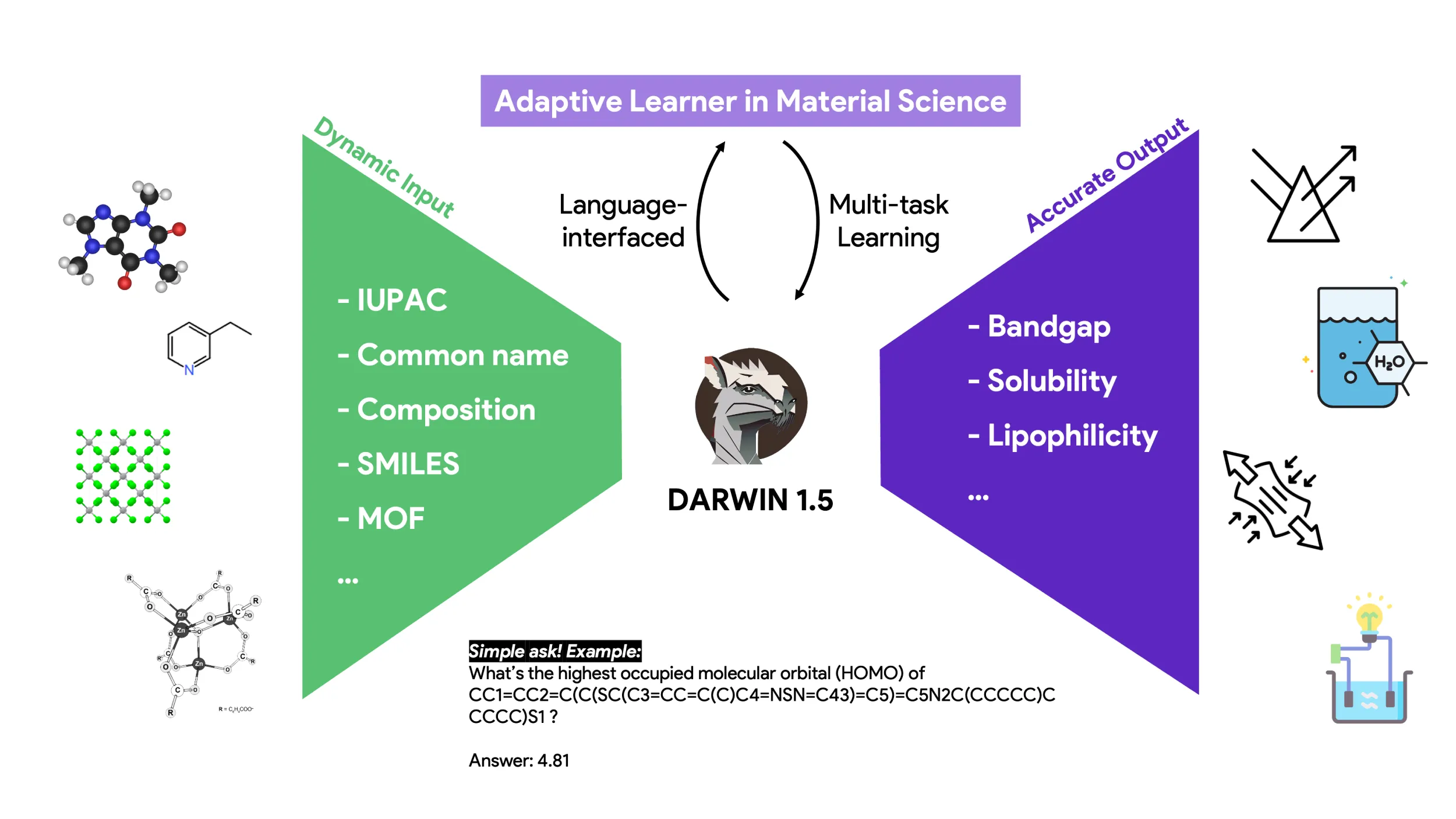
Technical Characteristics:
Multidisciplinary Integration: Darwin integrates knowledge from multiple fields such as physics, chemistry, and materials science, and is capable of handling complex cross-disciplinary tasks.
Scientific Instruction Generation (SIG): By automatically generating instruction data for scientific text, it reduces reliance on manual annotation and domain knowledge graphs, significantly improving the model's efficiency and accuracy.
Multi-task Learning: Darwin adopts a multi-task training strategy to reveal the intrinsic connections between scientific tasks, thereby enhancing the model's generalization ability and performance.
Open Source and Extensibility: Darwin is based on the open-source LLaMA model, supporting community contributions and extensions, with the flexibility to add new knowledge modules in the future.
Model Performance:
Surpassing GPT-4: In scientific question-answering and chemistry problem-solving tasks, the Darwin 7B model outperforms GPT-4 and fine-tuned GPT-3.5.
SOTA Results: In the MatBench materials science tasks, Darwin achieved state-of-the-art (SOTA) results in experimental bandgap prediction and metal classification tasks, surpassing specialized machine learning models.
Two-Stage Training Strategy: Through QA fine-tuning and multi-task learning, Darwin 1.5 significantly improved the model's performance in materials property prediction tasks, with improvements of up to 60%.
Application Scenarios:
Literature Review and Analysis: Helps researchers quickly sort through massive scientific literature and extract key information.
Experimental Design Optimization: Provides suggestions for optimizing experimental parameters by analyzing historical experimental data.
Materials Design and Prediction: Supports material property prediction, classification, and inverse design, accelerating the discovery of new materials.
Educational Assistance: Serves as an intelligent assistant for science education, providing personalized learning guidance and answering questions.
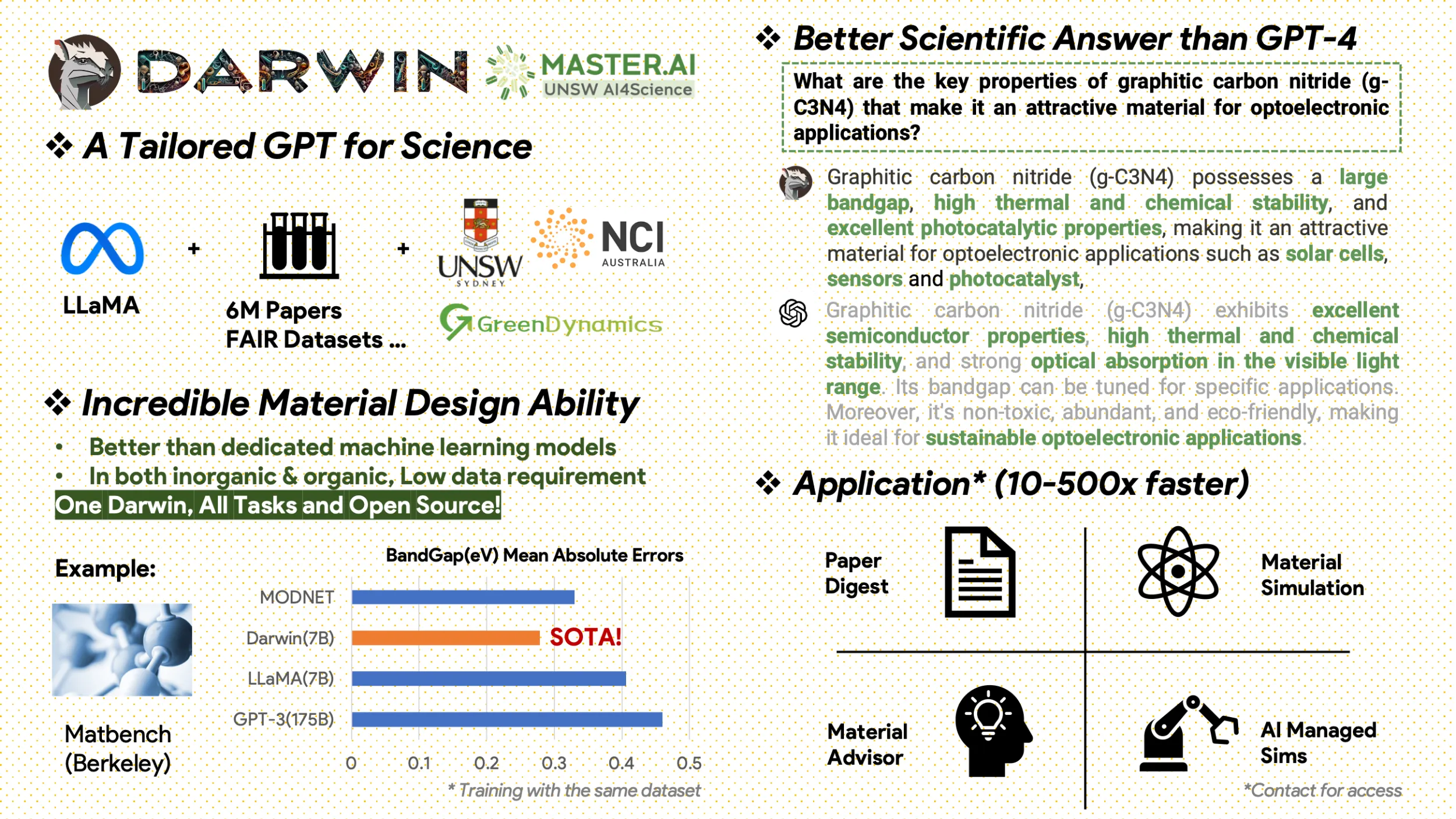
The latest version of the Darwin model, Darwin 1.5, further enhances its application capabilities in the field of materials science. This version integrates richer scientific Q&A data and materials science tasks, improving the model's accuracy and efficiency in materials property prediction and discovery. In addition, Darwin 1.5 adopts the Language-Interface Fine-Tuning (LIFT) framework, making the model more efficient and flexible when handling complex scientific problems.
In practical applications, the Darwin model is not limited to materials design but can also be used in biomedical fields such as drug development and disease diagnosis, demonstrating its cross-disciplinary potential. Through deep integration with scientific literature and datasets, the Darwin model can provide researchers with more precise scientific support and advance the process of scientific discovery.
The Darwin model is jointly developed by the University of New South Wales (UNSW) ai4Science and GreenDynamics AI. It is an open-source project focused on pretraining and fine-tuning the LLaMA model to enhance its performance in the scientific domain. Its core goal is to accelerate the scientific discovery process and reduce reliance on closed-source AI models through artificial intelligence-driven automation methods.
Darwin Code Repository:https://github.com/masterai-eam/darwin