Script Planner Assistant▸
 AI Apps
 AI News
TangoFlux: Text-to-Audio (TTA) Sound Effect Generation Model
TangoFlux: Text-to-Audio (TTA) Sound Effect Generation ModelIntroduction
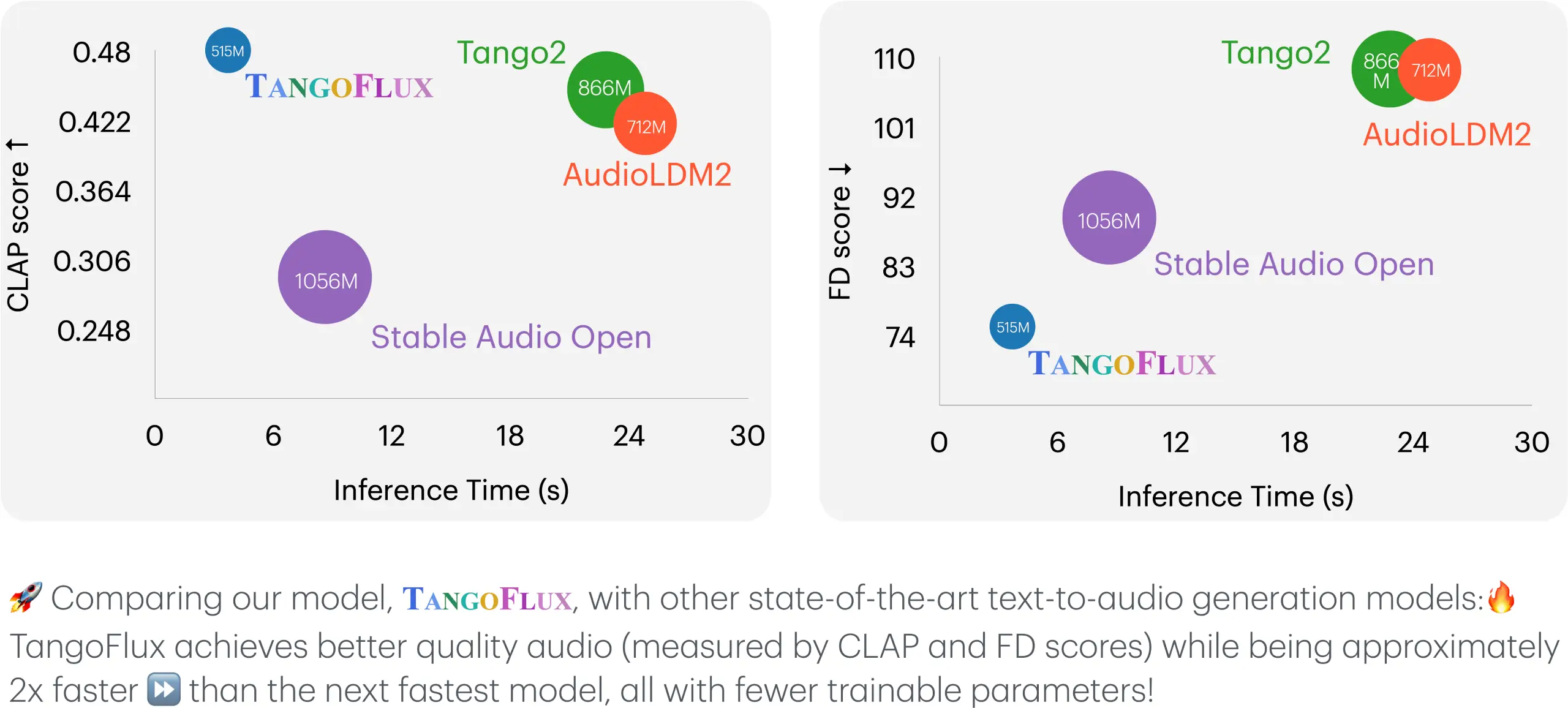
TangoFlux is an advanced text-to-audio (TTA) generation model developed in collaboration between the Singapore University of Technology and Design (SUTD) and NVIDIA. With approximately 515 million parameters, it can generate up to 30 seconds of 44.1kHz stereo audio in just 3.7 seconds on a single A40 GPU. TangoFlux can not only generate sound effects such as bird calls, whistles, and explosions, but also produce music.
TangoFlux Technical Principles
Variational Autoencoder: Uses a VAE to encode audio waveforms into latent representations and reconstruct the original audio from the latent representations.
Text and Duration Embeddings: Controls the content and duration of generated audio based on text encoding and duration encoding.
FluxTransformer Architecture: Combines Diffusion Transformer (DiT) and Multimodal Diffusion Transformer (MMDiT) to process text prompts and generate audio.
Flow Matching: Learns a mapping from a simple prior distribution to a complex target distribution to generate samples.
CLAP-Ranked Preference Optimization: Optimizes audio alignment based on iteratively generated preference data pairs.
Main Features of TangoFlux
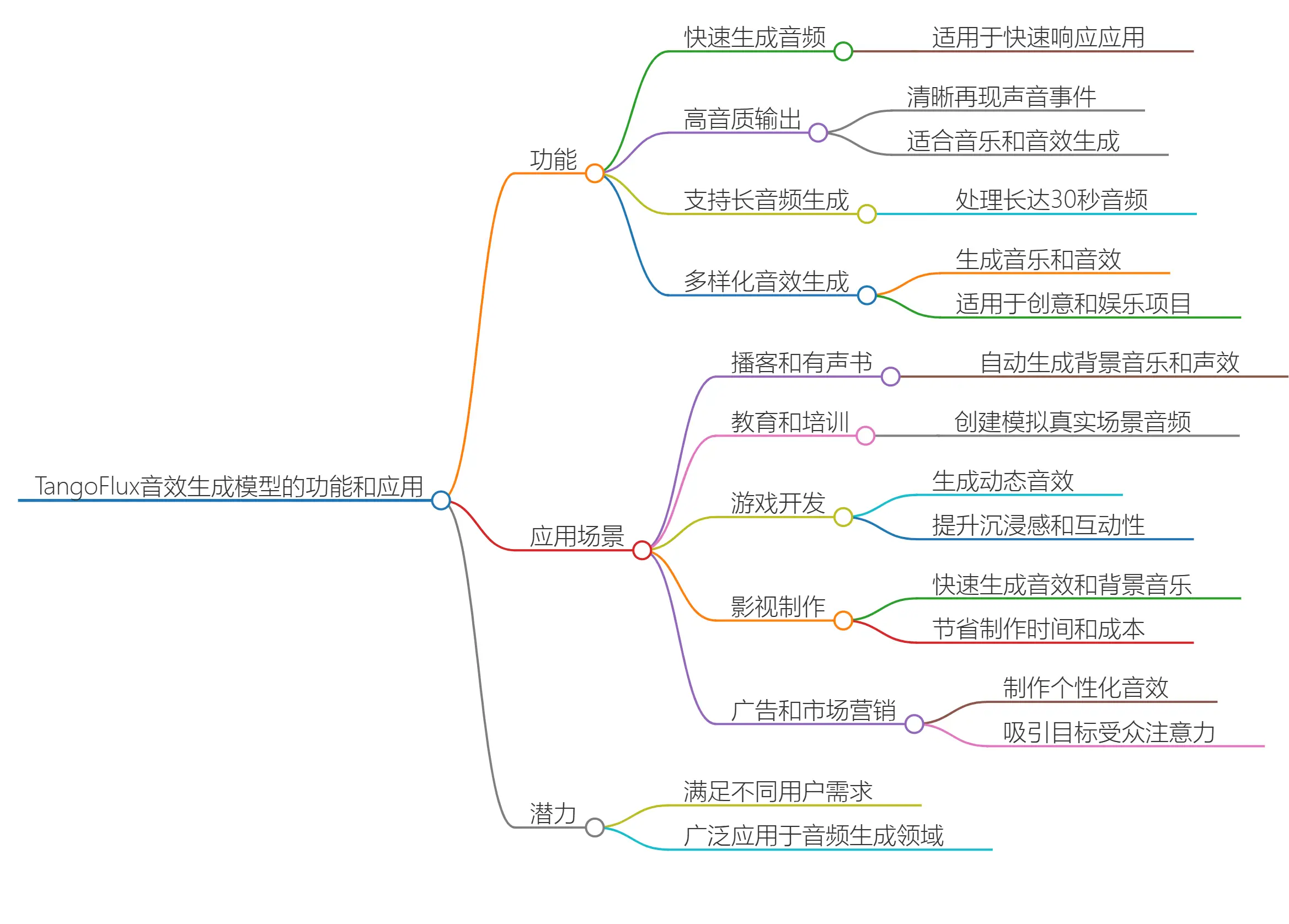
Fast Audio Generation: TangoFlux can generate high-quality audio content in a very short time, making it suitable for applications that require rapid response.
High-Quality Output: The generated audio is of high quality and can clearly reproduce various sound events, suitable for generating multiple types of audio such as music and sound effects.
Long Audio Generation Support: The model can handle audio generation tasks of up to 30 seconds in length, making it suitable for producing longer audio content.
Diverse Sound Effect Generation: TangoFlux can not only generate music but also various sound effects such as bird calls, whistles, and explosions, suitable for a variety of creative and entertainment projects.
TangoFlux Application Scenarios
Film and Game Audio Production: TangoFlux can quickly generate realistic sound effects, soundtracks, and voiceovers based on scripts or scene descriptions, shortening production cycles, reducing costs, improving audio quality, and enhancing game interactivity and immersion.
Source of Inspiration for Music Creation: Can generate diverse music segments according to creators' settings, helping to break through creative bottlenecks, promoting music innovation, and bringing more novel works.
VR and AR Experience Enhancement: Generates real-time realistic audio based on the virtual environment and user interaction, enhancing VR game immersion and strengthening the perception of virtual-real integration in AR applications.
Advertising and Marketing Audio Innovation: Generates unique audio based on advertising creativity and brand image, attracting consumers, evoking resonance, and enhancing brand awareness and reputation.
TangoFlux Project Resources
Project Website: tangoflux.github.io
arXiv Technical Paper: https://export.arxiv.org/pdf/2412.21037
TangoFlux also adopts the CLAP-Ranked Preference Optimization (CRPO) framework, which improves the model's audio alignment capability through iterative generation and optimization of preference data. This approach ensures that the generated audio is not only quality-guaranteed but also better aligned with user preferences and the intent of the input text. In addition, TangoFlux's training is based on non-proprietary datasets, making the model more open and accessible, promoting further research and applications.
TangoFlux is primarily applied to multimedia content creation, such as generating background music, sound effects, and voiceovers in film, gaming, advertising, and video production, thereby improving production efficiency and reducing costs. Its technical principles include Variational Autoencoder (VAE), text and duration embeddings, and the FluxTransformer architecture, which collectively support its efficient audio generation capabilities.
Related Information: