Script Planner Assistant▸
 AI Apps
 AI News

Investment Strategy Simulator
Investment Strategy SimulatorIntroduction
An investment strategy simulator is a tool that helps investors test and optimize their investment strategies through a simulated environment, without having to bear actual risk in real financial markets. These simulators typically use historical data, market models, and advanced computing techniques—such as neural networks, big data analysis, and cloud computing—to simulate the behavior of stock, futures, forex, and other markets.
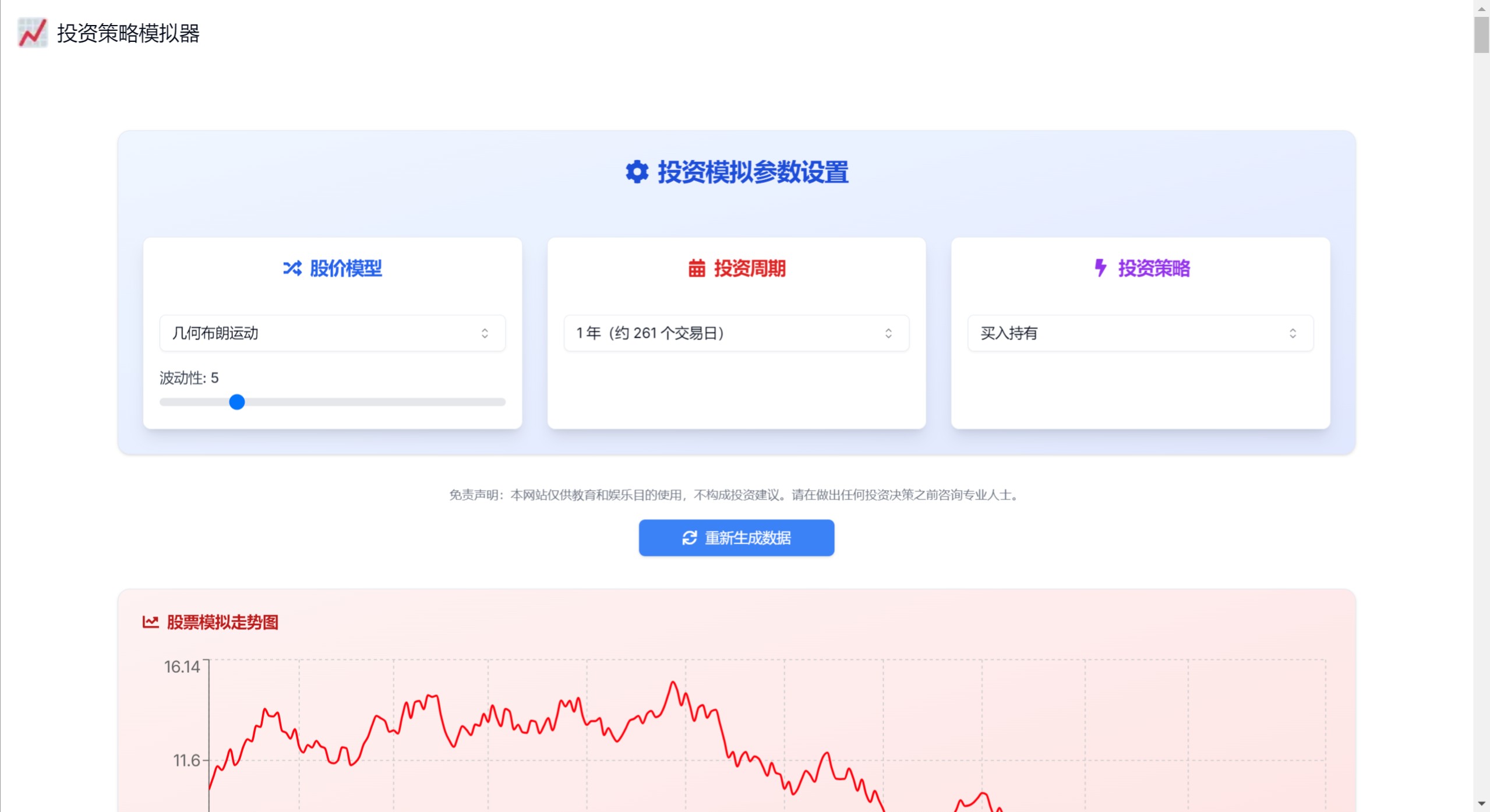
An investment strategy simulator helps investors simulate and compare the performance of different investment strategies under various market trends. These simulators usually provide intuitive visual interfaces and detailed data analysis, making it easier for users to understand and apply them. Users can test options, futures, or spot strategies in a simulated environment and observe their performance under different market scenarios.
Investment strategy simulators can also be used for educational purposes, strategy testing, or entertainment, helping users improve their investment skills in a risk-free environment. Some simulators also offer historical data backtesting capabilities to help users evaluate the long-term effectiveness of strategies.
Main Features and Characteristics of Investment Strategy Simulators:
Strategy Modeling and Testing: Users can build or select different investment strategies. The simulator performs backtesting using historical data to show how the strategy performs under various market conditions, including key metrics such as returns, risk, and maximum drawdown.
Visual Interface: Provides intuitive charts and data analysis to help users understand how the strategy works and its effectiveness, making it easier to adjust and optimize strategies.
Automated Trading Simulation: Some simulators support setting up automated trading rules, simulating buying or selling under specific conditions, and cultivating users' sensitivity to market timing.
Beginner-Friendly: For example, the Ruizhitou APP is designed so that even users with no prior background can easily get started, enhancing their understanding of quantitative strategies and trading discipline through simulated trading.
Education and Learning Tool: For investment beginners, simulators are an ideal platform for learning how the market works and testing theoretical knowledge, helping them grow in a pressure-free environment.
Strategy Optimization and Comparison: Users can compare multiple strategies to find the one that best suits them, and optimize strategy performance by adjusting parameters.
Real-Time and Historical Backtesting: Some advanced simulators are not limited to real-time market simulation but also offer historical data backtesting, allowing users to verify how a strategy would have performed in past specific market environments.
Combination of Quantitative and Manual Trading: For example, the Juejin online simulated trading system supports both quantitative strategy testing and manual trading functions, suitable for investors at different levels.
Online Tools and Applications: Such as the mentioned online investment strategy simulators, which provide convenient online access and enable users to conduct strategy research anytime, anywhere.
Market Adaptability: Simulators typically cover a variety of financial products, including stocks, futures, options, etc., to meet the needs of different investors.
Use Cases for Investment Strategy Simulators:
1. Investment Beginners: Learn and understand how different investment strategies work.
2. Experienced Investors: Test and optimize existing investment strategies and explore new investment methods.
3. Financial Educators: Used for classroom teaching demonstrations and case analysis.
4. Investment Advisors: Demonstrate potential outcomes of different strategies to clients and provide more intuitive investment advice.
5. Financial Researchers: Analyze strategy performance under various market conditions and conduct academic research.
6. Risk Managers: Evaluate the risk and return characteristics of different investment strategies.