Script Planner Assistant▸
 AI Apps
 AI News

StoryPlay AI: AI Scriptwriting Tool for Short Drama
StoryPlay AI: AI Scriptwriting Tool for Short DramaIntroduction
What is StoryPlay AI?
StoryPlay AI is a script creation platform for AI short dramas, developed by StoryPlayer (Hangzhou) Intelligent Technology. It is mainly used to write scripts for live-action short dramas, anime short dramas, and silly comedy manga dramas. StoryPlay uses its own self-developed short drama large model and multi-Agent workflow, covering the entire process from script planning and main-text writing to storyboard design, all of which can be completed on the platform with visual operation support.
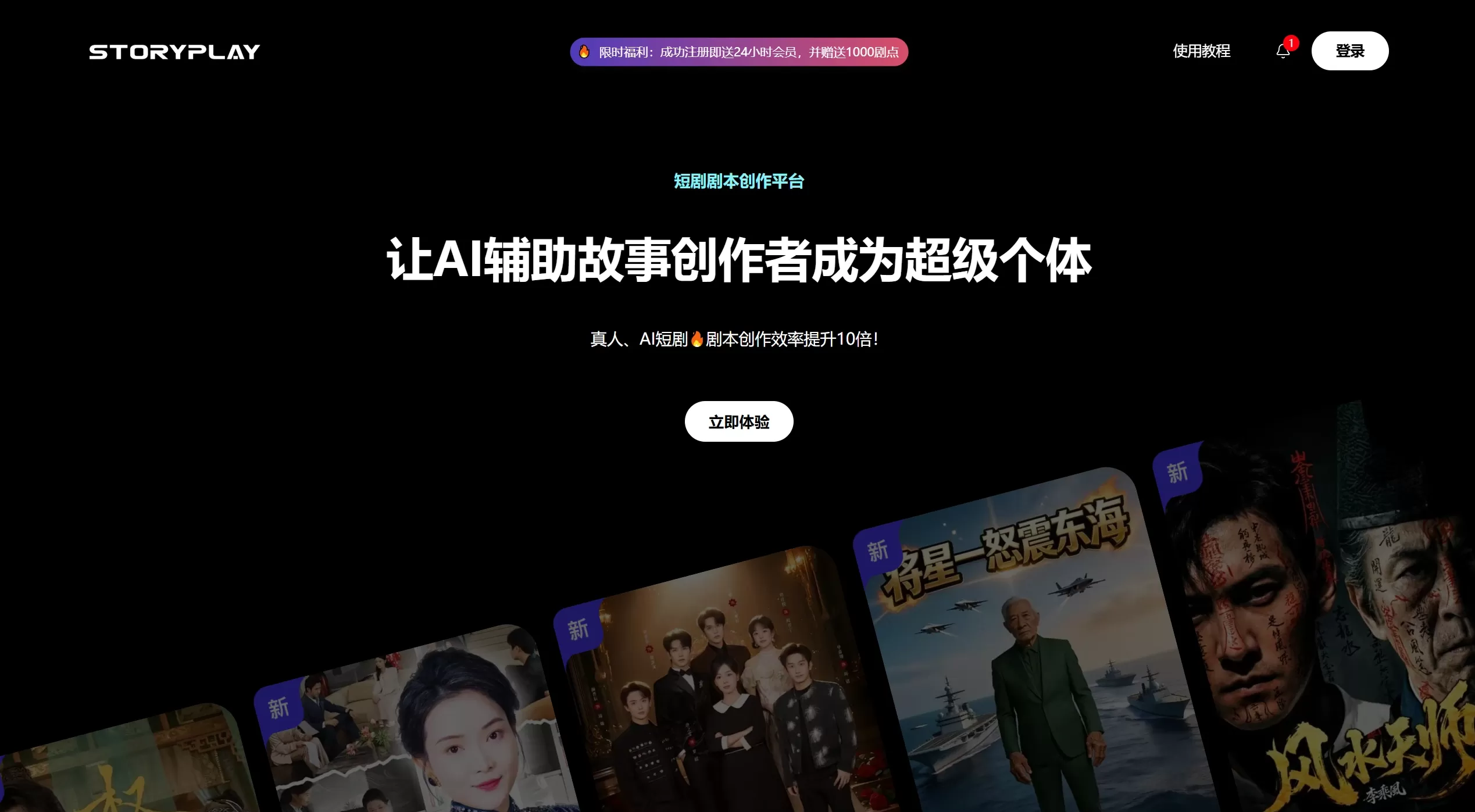
Features
AI Script Planning: Enter keywords or a rough idea, and the AI will generate several different story setup plans for you, including genre, core setup, target audience, and style. You can also adjust them yourself.
AI Script Creation: Based on a vertical short drama model, it automatically generates industry-standard script body, dialogue, scene descriptions, and action cues, with about 1,200 words per episode in a relatively standardized format.
Short Drama Breakdowns: Integrates heat index and view count data from platforms such as Hongguo, Hippo, Douyin, and Kuaishou, allowing you to break down the main storyline, character setup, and pacing points of hit titles to generate breakingdown reports without watching the videos.
Novel Decomposition / Web Novel Adaptation: Directly import the original novel text, no matter how long, and with one click break it down into chapter outlines, story synopses, character bios, and episode outlines, then convert it into a short drama script framework.
Script Decomposition and Rewriting: Import an existing script, automatically extract synopses, rough outlines, and episode outlines, and support imitation writing, simple rewriting, deep rewriting, and benchmark rewriting.
AI Character Bios: Generate three-dimensional character profiles based on the story synopsis, including personality, behavior lines, and relationship maps.
AI Single-Episode Polishing: Professionally polish scenes, actions, and dialogue in the script to increase conflict density and emotional intensity.
Storyboard Creation: Scripts are automatically converted into storyboards, with support for generating scene images and camera motion trajectory design.
Inspiration Planning and Title Generation: AI helps brainstorm genre setups and drama titles.
Script Evaluation: Perform quality evaluation on the output and provide optimization suggestions.
Multi-Agent Interactive Design: Use first-person or second-person interaction to modularize inspiration, character bios, and plot axis, increasing creative possibilities.
Application Scenarios
Short Drama Scriptwriting Creation: Quickly write short drama scripts suitable for platforms such as Douyin, Kuaishou, and Hongguo, saving time on benchmarking hit titles.
Web Novel IP Adaptation: Help web novel authors (such as contracted writers on Qimao and Fanqie) convert novels into short drama scripts, broadening monetization channels.
AI Short Drama Production Teams: Solve the problems of high script costs and slow output, enabling batch production at the hundred-yuan level.
Beginner Onboarding Teaching: Beginners can rely on AI assistance to quickly master script structure and pacing, overcoming the technical threshold.
Hit Title Research and Learning: Through the breakdown and decomposition features, quickly understand the narrative logic and pacing design of hit short dramas.
Team Collaboration: Supports real-time online collaboration for multiple users, suitable for script studios working together.
StoryPlay AI Pros and Cons
Pros
Strong Vertical Specialization: Focused on the short drama track, with model training covering hundreds of hit scripts, understanding industry pain points and satisfying beats.
Full-Process Coverage: From planning, decomposition, creation to storyboarding, everything is handled in one place, no need to switch between different tools.
Significant Cost Reduction and Efficiency Improvement: Officially claimed to boost efficiency by 5 to 10 times, producing a first draft for a 60-episode short drama for around 100 yuan.
No Obvious AI Traces: The generated content is close to real creative quality, with natural dialogue and plot progression; users say it "saves a lot of trouble."
Modular Flexibility: The number of episodes can be adjusted by yourself, such as freely changing 60 episodes, to fit projects of different lengths.
Fast Response Iteration: User feedback (such as adding episode count selection) can be quickly implemented.
Rich Teaching Resources: The community section features systematic screenwriting courses co-created by 9 top-listed screenwriters and 3 AI engineers.
Cons
Dialogue Needs Fine-Tuning: Although the generated dialogue is natural, personalization and colloquialism still require adjustment by the screenwriter.
Deep Creativity Still Depends on Humans: Core creativity and emotional nuance still need to be controlled by the creator; AI is better suited for drafts and frameworks.
Advanced Features Lack Transparency: There is relatively little public information about advanced features, pricing systems, and membership tiers.
Limited Mobile Support: Currently mainly a web version and mini-program, with no independent mobile app.
How to Use StoryPlay AI
Register and Log In: Go to the StoryPlay AI official website or WeChat mini-program to register an account.
Choose a Creation Mode:
Start from Scratch: Enter "Inspiration Planning," input your story idea, and the AI will generate basic or in-depth setup plans.
Benchmark Hit Titles: Use the "Short Drama Breakdown" feature to select quality short dramas under popular genres for breakdown and get the core framework with one click.
Adapt IP: Use "Novel Decomposition" to import a novel, extract the chapter outlines, and convert it into a script framework.
Optimize Manuscripts: Use "Single-Episode Polishing" or "Script Rewriting" to optimize existing drafts.
Interactive Generation: At critical points (such as character bios and plot axis), make first-person or second-person interactive choices, and the AI will automatically reconstruct subsequent plot.
Adjust and Export: Modify dialogues or scene descriptions as needed, and export in standard script format or storyboard script when complete.
Frequently Asked Questions
Q: Who is StoryPlay AI suitable for?
A: Short drama screenwriters, web novel authors, AI short drama production teams, and zero-based beginner creators.
Q: Can the generated scripts be used commercially directly?
A: The first-draft quality is close to submission level, but it is recommended that screenwriters polish and personalize before delivery.
Q: Does it support team collaboration?
A: Yes, you can invite other screenwriters to create together, with real-time editing and feedback.
Q: How is it different from using a general large model (such as ChatGPT) to write scripts?
A: StoryPlay AI is a vertical short drama model combined with emotional quantification engineering, specifically addressing the structure, rhythm, and hook issues of short dramas, rather than being a simple text generator.
Q: Does it support adapting long novels?
A: Yes, the platform does not limit context length, and novels of any length can be broken down.
Q: Are there copyright risks with the generated content?
A: Originally generated content is brand-new creation; for rewriting or imitation features, it is recommended to draw inspiration from the logic of publicly available hit titles for innovative borrowing, rather than directly plagiarizing.
Review
The biggest feature of the StoryPlay AI platform is its "emotional quantification engineering"—while ordinary AI is doing text continuation, StoryPlay AI is doing emotional arithmetic. It breaks stories down into characters, emotions, and events as drivers, performing strict logic verification and rhythm control during generation. In actual testing, in the 60-episode rough outlines directly output by the AI, the end of each episode can precisely hit an emotional climax or suspense point, understanding satisfying beats and face-slapping rhythm without human intervention. The generated drafts, in terms of conflict density and rhythm control, reportedly already surpass the submission level of many screenwriters on the market. A top screenwriter has called it the 'best creative software for short dramas among current AIs,' and the lead editor of a Hongguo hit short drama has directly called it an 'evangelist' (a blessing).
Related Information:
AI Short Drama Creation Platform