Script Planner Assistant▸
 AI Apps
 AI News

zKnown: A Personal Knowledge Assistant for Faster Reading
zKnown: A Personal Knowledge Assistant for Faster ReadingIntroduction
知了zKnown, formerly known as 知了阅读 (Zhiliao Reading), is an AI-Native personal knowledge assistant dedicated to information noise reduction and efficient reading. 知了zKnown uses AI to quickly summarize the key information of articles, helping users pre-screen content and improve reading efficiency.
知了zKnown supports multimodal content input and semantic search features. The product positioning has also evolved from the initial "reading efficiency tool" to the current "personal knowledge assistant". We have carried out a brand upgrade, evolving from "知了阅读" to "知了 zKnown", and adopted a new Logo.
What are the features of 知了zKnown?
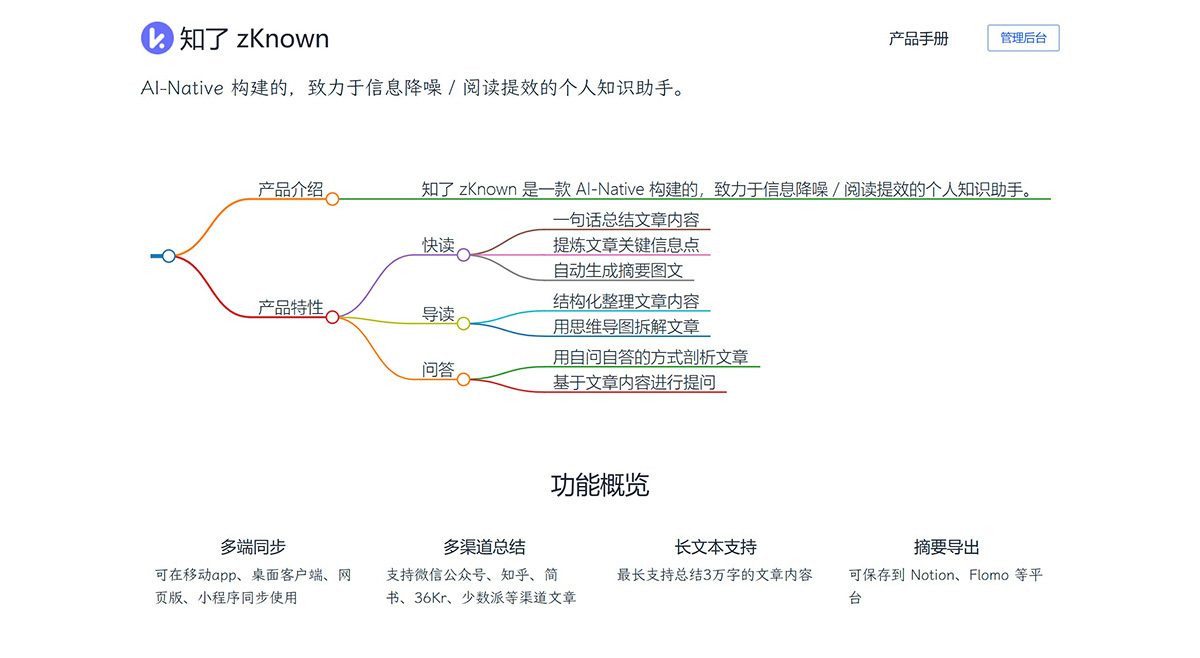
知了zKnown currently includes three core features: "Smart Summary + Content Clipping + Semantic Search".
1. Smart Summary
知了zKnown leverages the summarization capabilities of large AI models and uses Prompt Engineering techniques to quickly generate summaries for content shared by users, helping them pre-screen content and improve reading efficiency.
Summary output formats include:
One-sentence summary
Key information points
Key question answering
TOC content outline
Structured mind map
Smart categorization
Automated tagging
2. Content Clipping
When users browse content on other platforms, if they want to save the content or quickly grasp its key information, they can share it to "知了助手" (Zhiliao Assistant) at any time. 知了zKnown first uses AI capabilities to generate a summary of the user's forwarded content, then saves both the original content and the summary to the user's personal knowledge base for easy subsequent management.
View Summary Supported Platforms
3. Semantic Search
知了zKnown uses vector database storage and vector similarity matching techniques to achieve semantic search of knowledge base content. This includes two dimensions of search capabilities:
Single content retrieval Q&A
Full personal knowledge base content retrieval Q&A
When users forward content to "知了助手", after the content summary is generated, users can continue to ask questions about the content. 知了zKnown will perform similarity matching on the content, and send the matched content to the AI large model for Q&A. Single content Q&A can help users better understand the content.
All content previously forwarded by users is stored in the personal knowledge base. During periodic reviews, users can perform semantic search Q&A on personal knowledge base content. 知了zKnown uses vector similarity matching to first locate the referenced source of the content, then sends the matched content to the AI large model for Q&A. The personal knowledge base semantic search Q&A can help users achieve faster memory recall/positioning and source tracing.
What are the use scenarios of 知了zKnown?
Personal daily use:Add the 「知了助手」 enterprise WeChat account as a friend, and forward articles to view summaries.
Use in groups:Add the 「知了阅读」 personal WeChat account as a friend, pull 「知了阅读」 into the group, and automatically generate text and image summaries for links sent in the group.
Use in other scenarios:Integrate 知了zKnown's Summary API to enable the content summary feature in other scenarios through third-party applications.