Script Planner Assistant▸
 AI Apps
 AI News

ToucanTTS: A Massive Multilingual Model Covering 7,000+ Languages
ToucanTTS: A Massive Multilingual Model Covering 7,000+ LanguagesIntroduction
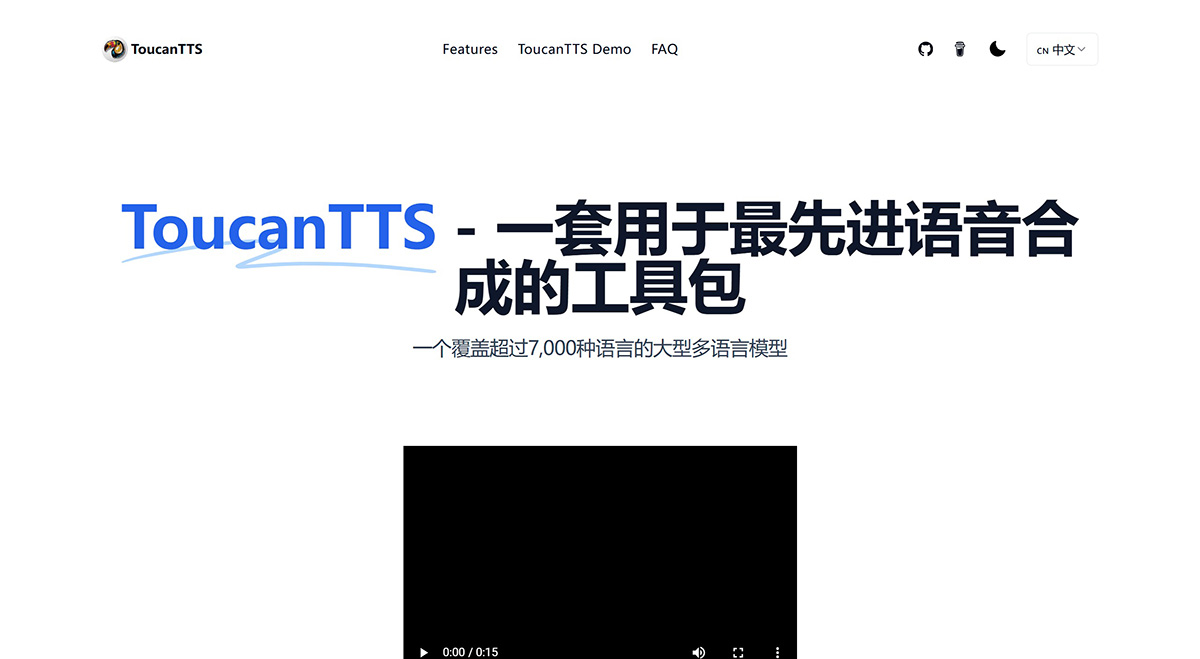
ToucanTTS, a toolkit for state-of-the-art speech synthesis, is a super comprehensive Text-to-Speech (TTS) model developed by the Institute for Natural Language Processing (IMS) at the University of Stuttgart. ToucanTTS is a large multilingual model covering more than 7,000 languages.
ToucanTTS not only supports multilingual capabilities but also features multi-speaker speech synthesis, allowing it to mimic the rhythm, stress, and intonation of different speakers.
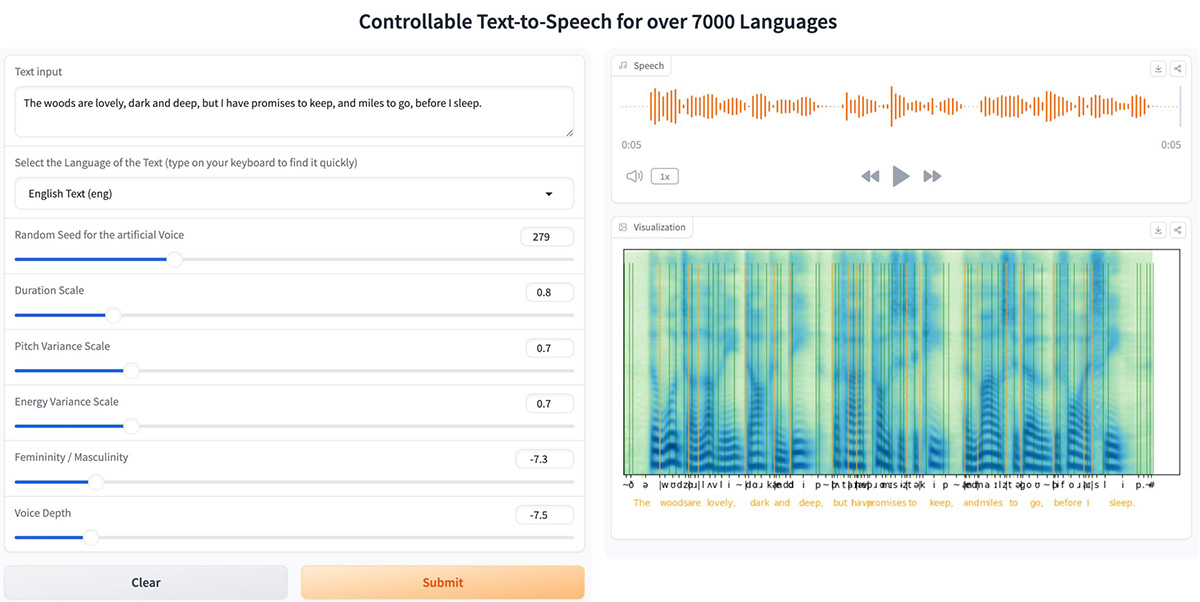
It also offers interactive demos for various applications, including voice design, style cloning, multilingual speech synthesis, and human-edited poetry reading, demonstrating its versatility and powerful performance.
ToucanTTS Features:
Multilingual Support: ToucanTTS is capable of synthesizing speech in more than 7,000 languages, making it the most multilingual TTS model available. This extensive language support caters to a wide international audience.
Multi-Speaker Speech Synthesis: ToucanTTS supports multi-speaker speech synthesis, enabling users to imitate the rhythm, stress, and intonation of different speakers. This is particularly useful for applications that require stylistic variety and voice customization.
Human-Computer Interactive Editing: ToucanTTS allows users to customize synthesized speech to meet specific requirements, which is especially useful for literary studies and poetry reading assignments.
Architecture: ToucanTTS is built upon the FastSpeech 2 architecture, with improvements inspired by PortaSpeech. It includes a normalizing flow-based PostNet and a standalone aligner trained with Connectionist Temporal Classification (CTC) and spectrogram reconstruction, enabling high-quality, natural-sounding speech synthesis.
Articulatory Representation: A unique feature of ToucanTTS is its use of articulatory representations of phonemes as input. Multilingual data can be leveraged to improve the quality and availability of speech synthesis for low-resource languages.
Interactive Demos: ToucanTTS provides interactive demos for various applications, such as voice design, style cloning, multilingual speech synthesis, and human-edited poetry reading. These demos showcase the versatility and robustness of the toolkit.
Training and Inference: The toolkit offers comprehensive instructions on installing dependencies, configuring storage, downloading pretrained models, and running training pipelines. It supports fine-tuning from pretrained models as well as training from scratch.
ToucanTTS Highlights:
Multilingual and Multi-Speaker Support: Through large-scale multilingual pretrained models, it supports multilingual speech synthesis covering more than 7,000 languages. It enables multi-speaker speech synthesis and clones prosody such as rhythm, stress, and intonation across speakers.
Human-Computer Collaborative Editing: Allows human-computer collaborative editing of synthesized speech, such as for poetry recitation and literary research.
Interactive Demos: Provides interactive demos for large-scale multilingual speech synthesis, cross-speaker style cloning, voice design, and human-edited poetry recitation
Architecture and Components: Primarily based on the FastSpeech 2 architecture, with several modifications, such as a normalizing flow-based PostNet inspired by PortaSpeech. Includes a self-contained aligner trained with CTC and spectrogram reconstruction for various applications. Pretrained models are provided for multilingual models, aligners, embedding functions, vocoders, and embedding GANs.
Ease of Use: Built entirely in Python and PyTorch, designed to be simple and beginner-friendly while remaining powerful.
Articulatory Representation: The IMS Toucan system uses articulatory representations of phonemes as input, allowing multilingual data to benefit low-resource languages.
ToucanTTS Applications:
Speech Synthesis for Multilingual Applications: With support for more than 7,000 languages, ToucanTTS is ideal for creating multilingual applications, such as global customer service platforms, educational tools, and accessibility features for non-native speakers.
Voice Design and Customization: The multi-speaker speech synthesis feature allows the creation of customized voices that can be used in a variety of applications, such as virtual assistants, audiobooks, and personalized marketing messages.
Human-Computer Interactive Editing: This feature is particularly useful in literary research and poetry reading assignments, where precise control over speech output is needed to meet specific stylistic requirements.
How to Use ToucanTTS?
Get started with ToucanTTS in just a few simple steps.
1. Download from GitHub
Download the code from GitHub. git clone https://github.com/2noise/ToucanTTS to download ToucanTTS
2. Install Dependencies
Before getting started, make sure you have the required packages installed. You will need torch and ToucanTTS. If not already installed, you can install them using pip:
3. Import the Required Libraries
Import the necessary libraries for your script. You will need torch, ToucanTTS, and Audio from IPython.display.
4. Initialize ToucanTTS. Create an instance of the ToucanTTS class and load the pretrained model.
5. Prepare the text. Define the text you want to convert to speech. Replace <YOUR TEXT HERE> with your desired text.
6. Generate Speech. Use the infer method to generate speech from the text. Set use_decoder=True to enable the decoder.
7. Play the Audio
Use the Audio class from IPython.display to play the generated audio. Set the sampling rate to 24,000 Hz and enable autoplay.
8. Complete the Script
ToucanTTS GitHub Link: https://github.com/DigitalPhonetics/IMS-Toucan
Online Demo Link: https://huggingface.co/spaces/Flux9665/MassivelyMultilingualTTS
Dataset Link: https://huggingface.co/datasets/Flux9665/BibleMMS