Script Planner Assistant▸
 AI Apps
 AI News

CogVideo: Generate Videos from Text Descriptions
CogVideo: Generate Videos from Text DescriptionsIntroduction
CogVideo is currently the largest general-domain text-to-video generation pre-trained model, containing 9.4 billion parameters. CogVideo effectively leverages the pre-trained text-to-image generation model (CogView2) for text-to-video generation, and employs a multi-frame-rate hierarchical training strategy.
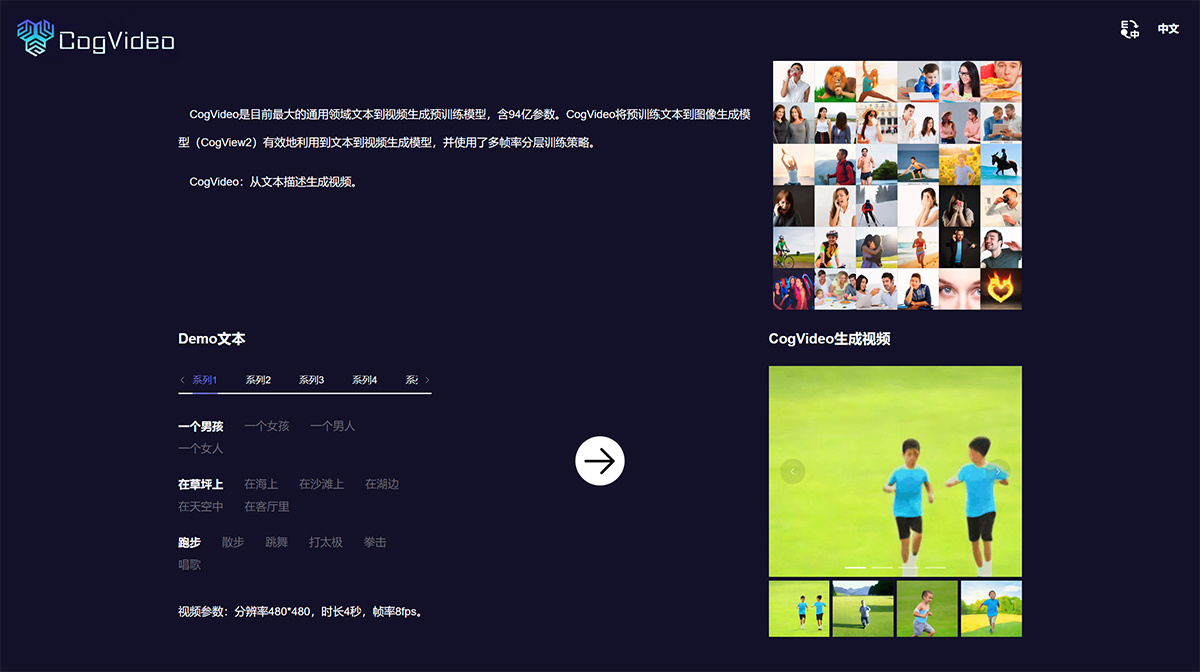
CogVideo is an open-source pre-trained text-to-video generation model proposed by Tsinghua University and BAai's Tang Jie team, which has attracted widespread attention on GitHub. The model's core technology is based on deep learning algorithms and model architecture, capable of converting text descriptions into vivid and realistic video content.
CogVideo adopts a multi-frame-rate hierarchical training strategy, achieving efficient conversion from text to video by inheriting the pre-trained text-image generation model CogView. In addition, CogVideo features advanced dynamic scene construction capabilities, able to generate 3D environments and animations based on detailed text descriptions provided by users. At the same time, CogVideo efficiently fine-tunes the pre-trained text-to-image model for text-to-video generation, avoiding the expensive full pre-training from scratch.
CogVideo's training is primarily based on a multi-frame hierarchical generation framework. It first generates several frames of images based on CogView2 from the input text, then increases the frame rate through frame interpolation to complete the generation of the overall video sequence. This training strategy endows CogVideo with the ability to control the intensity of changes during the generation process, helping to better align text and video semantics. The model uses 9.4 billion parameters, making it one of the largest general-domain text-to-video generation pre-trained models currently available.
CogVideo not only supports Chinese input but also provides detailed documentation and tutorials, making it convenient for researchers and developers to use and customize. Its open-source and easy-to-use features give it significant application value in the field of multimodal video understanding. In addition, the emergence of CogVideo marks a major advancement in AI technology in the field of video generation, providing disruptive imaginative space for future creation.
In summary, CogVideo, as a powerful text-to-video generation model, can effectively leverage pre-trained models to generate high-quality videos. However, the video generation process also faces some challenges, such as the scarcity and weak correlation of text-video datasets, which hinder the model's understanding of complex motion semantics. These all require further research and improvement.