
 Script Planner Assistant▸
 AI Apps
 AI News

DiffusionGPT: LLM-Powered Text-to-Image Generation
DiffusionGPT: LLM-Powered Text-to-Image GenerationIntroduction
DiffusionGPT, an all-in-one text-to-image generation system powered by LLM and developed by ByteDance, is specifically designed to generate high-quality images for different input prompts. Its main goal is to parse input prompts and determine the generative model that produces optimal results, characterized by high generalization, high effectiveness, and convenience.
What makes DiffusionGPT awesome is that it integrates expert image generation models from multiple domains. It then uses LLM to interface with these image generation models, allowing the LLM to process and understand various text prompts. Finally, based on the understood information, it selects the most suitable image model to generate images. In this way, just like GPT-4, you can draw images through chatting...
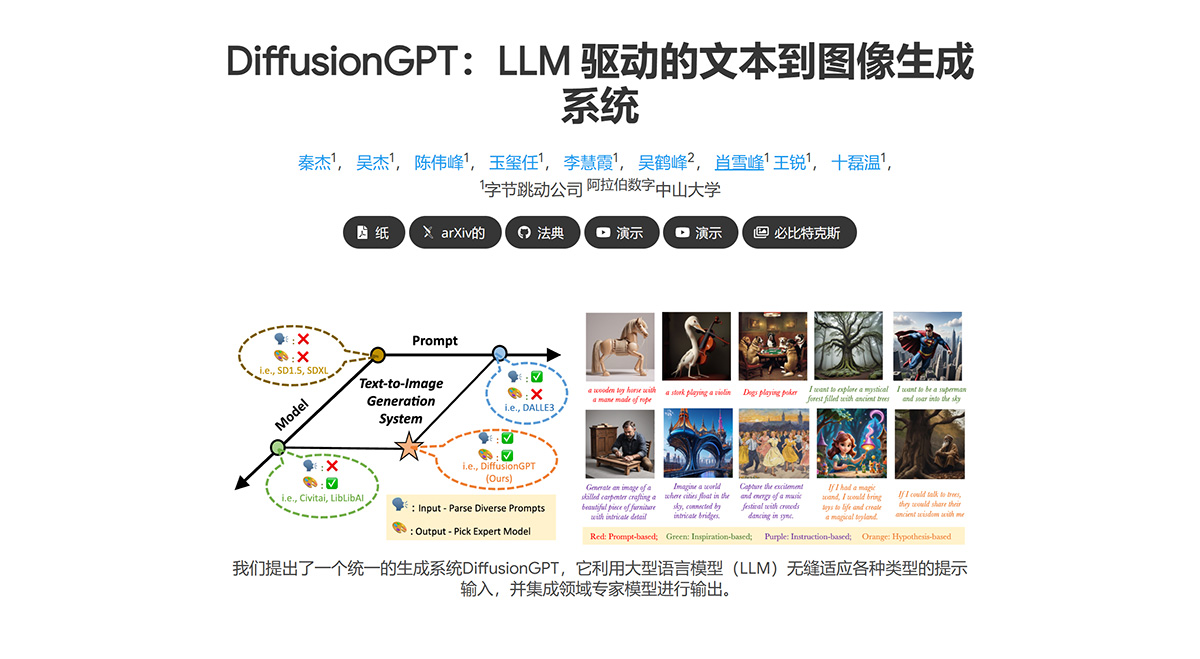
Main Features of DiffusionGPT:
1. Diverse Text Prompt Processing: DiffusionGPT can understand and process various types of text prompts, including specific instructions, abstract inspirations, complex assumptions, etc.
2. Integration of Multiple Domain Expert Models: The system integrates image diffusion models from multiple domains, with each model possessing professional image generation capabilities in its specific domain. Such models specialize in generating images in particular domains, such as natural landscapes, character portraits, artistic works, etc.
This means the system can not only generate ordinary images but also handle more specific and complex image generation tasks, such as images in specific styles or types, mimicking the style of particular artists, comic styles, or photographic techniques.
3. Driven by Large Language Models: DiffusionGPT uses large language models (LLM) to parse and understand the text prompts input by users. This process is similar to how other LLM-based systems (such as GPT-4) handle text, but is specifically applied to understanding instructions and descriptions used for image generation.
4. Intelligent Selection of Suitable Image Models: Based on its understanding of text prompts, DiffusionGPT can intelligently select the most suitable image generation model to generate images. This involves not only choosing the correct model but also adjusting generation parameters to best meet the user's needs.
5. Output of High-Quality Images: By precisely matching text prompts with the best generative model, DiffusionGPT can generate high-quality images that highly align with user requirements.
6. User Feedback and Advantage Database: By incorporating user feedback and an advantage database, the system can adjust model selection according to user preferences, improving the relevance and quality of image generation.
For example: During the early usage of the system, users may provide feedback on generated images, such as "the color of this image is too dark." DiffusionGPT utilizes such feedback to adjust its model selection, making future image generation more aligned with user preferences.
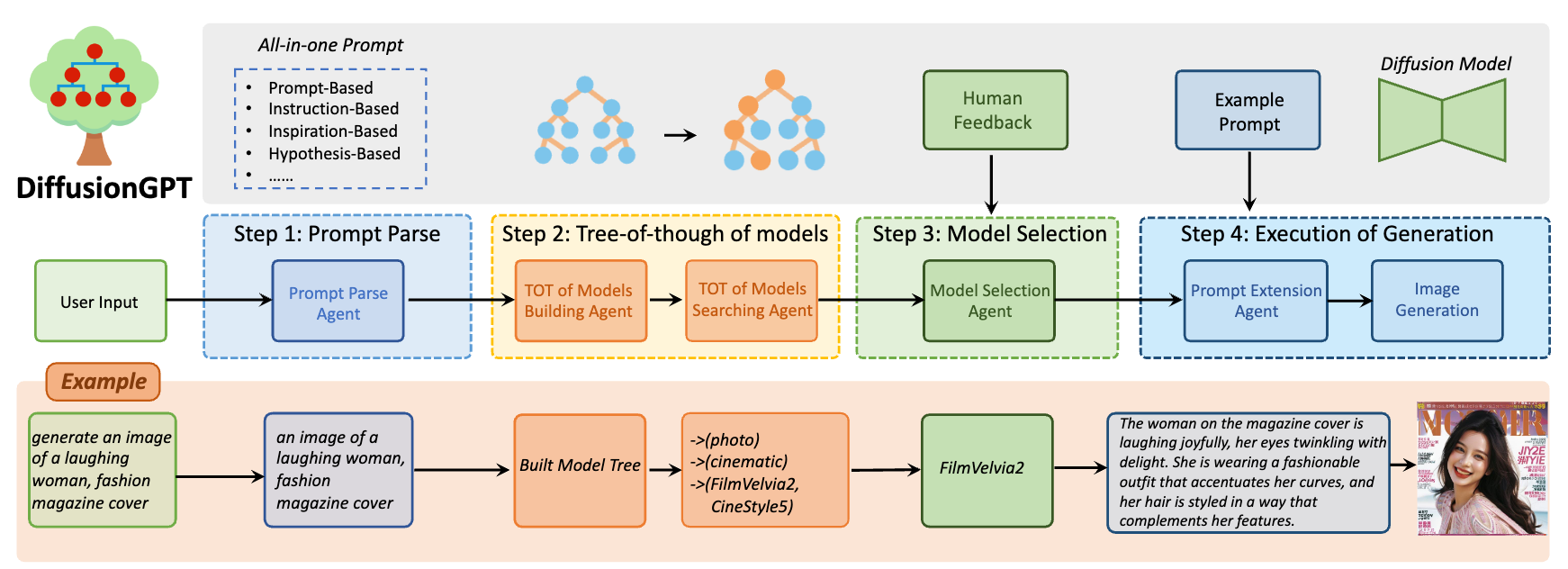
Main Working Principles of DiffusionGPT:
1. Input Parsing: Users provide text prompts, such as descriptions, instructions, or inspirations.
The large language model (LLM) is responsible for parsing these text prompts, understanding their meanings and requirements.
2. Tree-of-Thought Construction: According to different image generation tasks, the system constructs a "Tree-of-Thought," which is a structure that organizes different image generation models.
The Tree-of-Thought is based on prior knowledge and human feedback, covering expert-level models in multiple domains.
3. Model Selection: Based on the parsing results from LLM, the system determines the most suitable image generation model for the current text prompt through the Tree-of-Thought. During the selection process, user preferences and historical feedback may also be considered, and this information is stored in the advantage database.
4. Image Generation: Once a suitable model is selected, the model is used to generate images. The generated images will be closely related to the input text prompt and reflect the user's intent and preferences.
5. Result Output: The final generated images will be presented to the user.
These images can be diverse, including but not limited to specifically described scenes, conceptual artworks, or images that meet specific styles.
6. User Feedback Optimization Process:
User feedback on generated images is used to enrich the advantage database, thereby helping the system better understand user preferences and optimize subsequent model selection and image generation.
DiffusionGPT demonstrates a high degree of realism and detail when generating images in categories such as humans and scenes.Compared with baseline models (such as SD1.5), images generated by DiffusionGPT show significant improvements in visual fidelity and detail capture.DiffusionGPT outperforms traditional stable diffusion models in terms of image reward and aesthetic scores.In quantitative evaluation of image generation quality, DiffusionGPT exhibits higher scores, indicating that its generated images are more favored in terms of quality and aesthetics.














