
 Script Planner Assistant▸
 AI Apps
 AI News

AnyDoor_云技派,专注ai人工智能!
AnyDoor_云技派,专注ai人工智能!Introduction
AnyDoor, jointly developed by the University of Hong Kong, Alibaba, and Ant Group, can teleport any object from one photo into the world of another image.
AnyDoor Project URL:https://damo-vilab.github.io/AnyDoor-Page/
AnyDoor Online Demo URL:https://huggingface.co/spaces/xichenhku/AnyDoor-online
AnyDoor Features:
Object Moving: AnyDoor can be applied to fancy tasks such as object moving.
Object Swapping: AnyDoor can also be extended to perform object swapping.
Virtual Try-On: AnyDoor can also serve as a simple yet powerful baseline for virtual try-on. It can preserve the color, pattern, and texture of different clothes without the need for complex manual parsing.
Multi-Subject Composition: Since AnyDoor is highly controllable and can place objects at specific locations within a given scene, it can be easily extended to multi-subject composition.
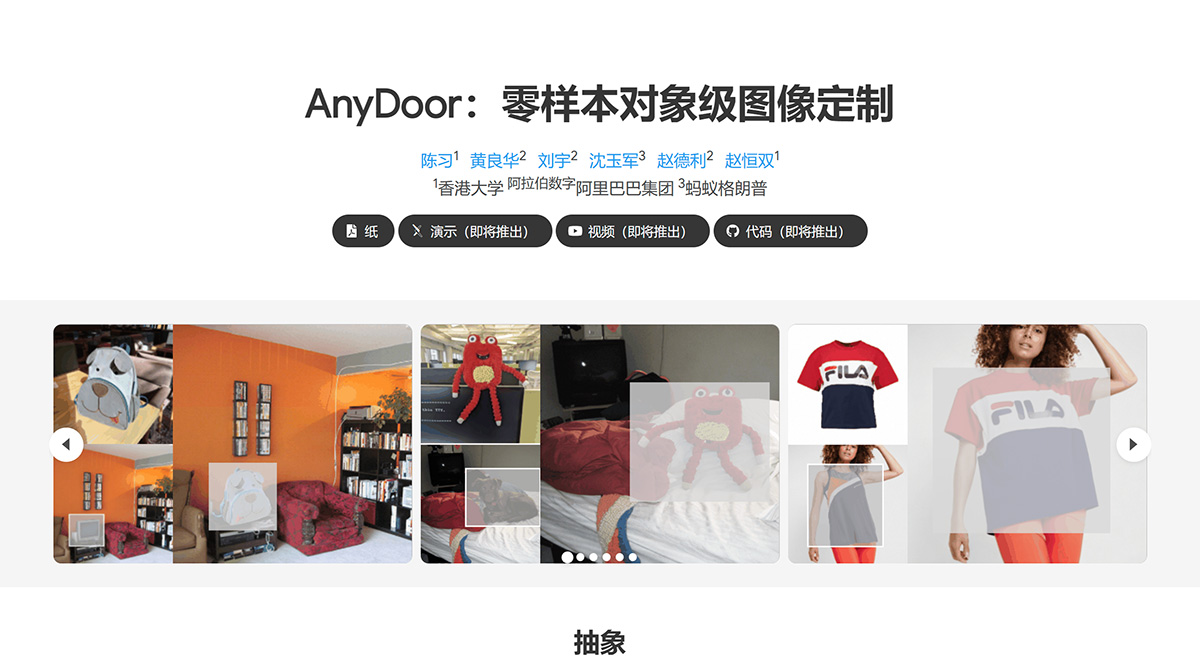
AnyDoor Use Cases:
In virtual try-on applications, users can quickly customize selected clothing onto their own photos.
In object moving applications, users can move a target object from one photo to a specified location in another photo.
In the design field, users can customize their designed furniture or decorations into different interior scenes for a more intuitive effect preview.
AnyDoor is a diffusion-based image generator capable of teleporting a target object into a new scene at a user-specified location in a harmonious way. Rather than tuning parameters for each individual object, our model is trained only once and effortlessly generalizes to various object-scene combinations during the inference stage. Such a challenging zero-shot setting requires sufficient representation for specific objects.
To this end, we complement the commonly used identity features with detail features, which are carefully designed to preserve texture details while allowing multiple local variations (e.g., lighting, orientation, pose, etc.), supporting the favorable integration of objects with different environments. We further suggest borrowing knowledge from video datasets, where we can observe various forms of a single object (i.e., along the time axis), thereby achieving stronger model generalization and robustness.
Extensive experiments have demonstrated that our method outperforms existing alternatives, as well as its great potential in real-world applications such as virtual try-on and object moving.














