Script Planner Assistant▸
 AI Apps
 AI News

Huawei Pangu AI Large Model
Huawei Pangu AI Large ModelIntroduction
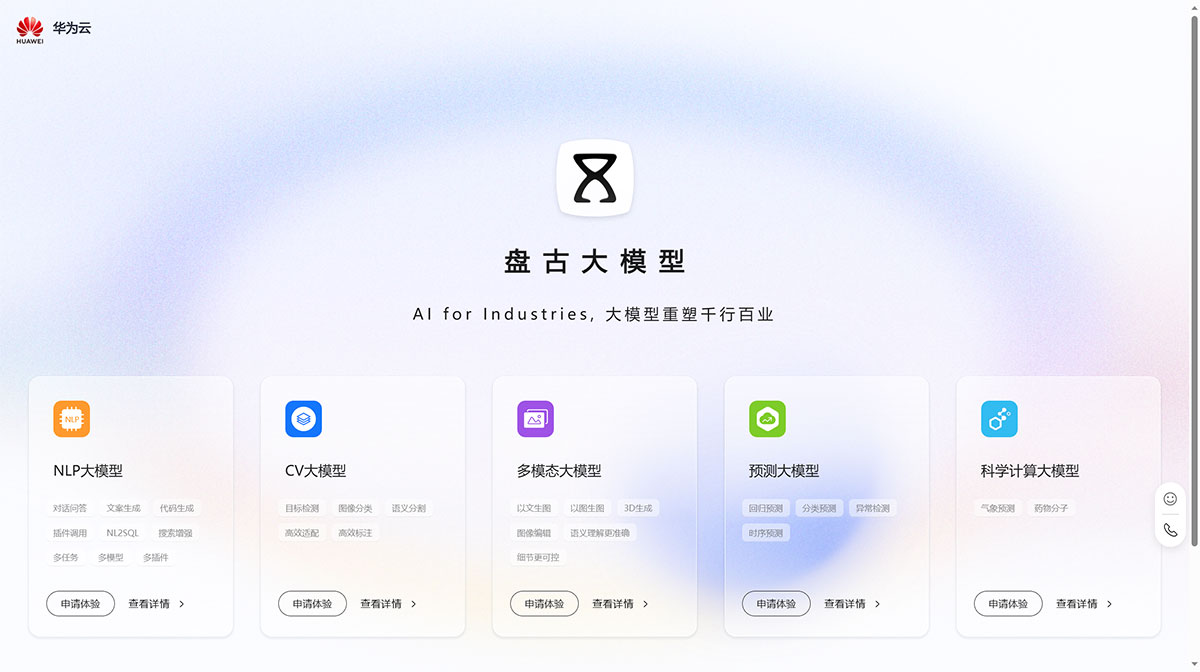
Huawei's Pangu AI large model is an artificial intelligence technology launched by Huawei Cloud. Centered on the philosophy of "AI for Industries," the large model includes models across multiple domains, including natural language processing (NLP) large models, computer vision (CV) large models, multimodal large models, prediction large models, and scientific computing large models.
The goal of the Huawei Pangu AI large model is to build a universal and easy-to-use AI development workflow that empowers more industries and developers, enabling industrialized AI development. It has already played a role in fields such as coal mining, railways, meteorology, finance, code development, and digital content generation, improving production efficiency and reducing R&D costs.
Specific details and technical implementation of the Huawei Pangu AI large model may require further reference to the relevant materials and documentation from Huawei Cloud.
Huawei Developer Conference 2023 (HDC.Cloud 2023): Huawei Developer Conference 2023_HDC.Cloud2023-Huawei Cloud (huaweicloud.com)
1. What is the Pangu large model used for?
The 3.0 version of the Pangu large model is an industry-oriented large model series featuring a "5+N+X" three-layer architecture: from the base layer of AI capabilities, to the industry-specific second layer, and then to the application layer with interfaces for various scenarios. Huawei continues to build new competitive advantages around deeply engaging in industries and serving developers.
Huawei Pangu Large Model
The first layer, L0: consists of Pangu's 5 foundation large models, including the NLP large model, vision large model, multimodal large model, prediction large model, and scientific computing large model. They provide a variety of skills to meet industry scenarios.
The second layer, L1: consists of N industry large models. These can be industry-general large models trained on publicly available industry data, covering areas such as government, finance, manufacturing, mining, and meteorology. Alternatively, based on customers' own industry data, customized dedicated large models can be trained for customers on top of Pangu's L0 and L1.
The third layer, L2: provides customers with more fine-grained scenario models. It focuses more on a specific application scenario or particular business, delivering out-of-the-box model services for customers.
2. Pangu large model application portal:
Applications for the Pangu large model are now open, and users can visit the official Pangu large model website to apply for an experience. The application portal is as follows: https://pangu.huaweicloud.com/
Pangu large model 3.0 application address: https://pangu.huaweicloud.com/
3. Main models of the Pangu AI large model:
1) Pangu NLP large model
The Pangu NLP large model can be used for content generation, content understanding, and more. It is the first to adopt an Encoder-Decoder architecture, balancing the understanding and generation capabilities of NLP large models while ensuring flexibility for embedding in different systems. In downstream applications, only a small number of samples and learnable parameters are needed to complete fast fine-tuning and downstream adaptation of the hundred-billion-parameter large model. In the 2019 authoritative Chinese language understanding benchmark CLUE ranking, the Pangu NLP large model ranked first in the overall ranking as well as in the classification and reading comprehension categories, refreshing three world records; it achieved an overall score of 83.046, with multiple subtask scores leading the industry, making it the pretrained model closest to the human understanding level (85.61).
2) Pangu CV large model
The Pangu CV large model can be used for classification, segmentation, and detection. It is also the industry's largest CV large model to first achieve on-demand model extraction, and the first to balance discriminative and generative capabilities. Based on model size and runtime speed requirements, models of different scales can be adaptively extracted, enabling rapid deployment of AI applications. Using hierarchical semantic alignment and semantic adjustment algorithms, it achieves better separability on shallow features, significantly improving few-shot learning capabilities and reaching an industry-leading level.
3) Pangu multimodal large model
The Pangu multimodal large model integrates language and vision cross-modal information to enable applications such as image generation, image understanding, 3D generation, and video generation. Its advantage lies in native Chinese support and superior Chinese understanding capabilities.
4) Pangu prediction large model
Targeting structured data and based on the Transformer neural network architecture, it can be used in application scenarios such as process indicator prediction, sales forecasting, and financial anomaly detection.
5) Pangu scientific computing large model
Targeting fields such as meteorology, pharmaceuticals, water services, machinery, and aerospace, it uses AI models to solve scientific computing problems faster and more accurately.
6) Pangu meteorological large model
The Pangu meteorological large model achieves weather forecast accuracy that surpasses traditional numerical methods for the first time, with a speed improvement of 1,000 times, providing second-level weather forecasts, such as 1-hour to 7-day predictions of variables including geopotential, humidity, wind speed, temperature, and air pressure. The international top academic journal Nature published in its main issue on July 6 (Beijing time) the independent research results of the Huawei Cloud Pangu large model R&D team—《Three-dimensional neural networks for accurate medium-range global weather forecasting》
7) Pangu drug molecule large model
The Huawei Cloud Pangu drug molecule large model empowers the entire chain of drug R&D tasks, aiming to help pharmaceutical companies and institutions significantly improve drug R&D efficiency.
4. What is the Pangu large model used for?
Huawei Cloud Pangu large model 3.0 has already played a role in fields such as coal mining, railways, meteorology, finance, code development, and digital content generation, improving production efficiency and reducing R&D costs.
The core positioning of Huawei Cloud Pangu large model is to empower all industries, divided into three layers: L0, L1, and L2. Different layers correspond to different stages at which artificial intelligence penetrates into industries, and in the future, AI will certainly bring new transformations to vertical industries.
The Pangu large model fundamentally addresses the challenges of traditional AI development, including workshop-style development, sample annotation, high costs, difficult model maintenance, insufficient model generalization, and shortages of industry professionals. Data shows that in 2022, Huawei Cloud Pangu large model mainly focused on AI for Industries, with the vision large model, for example, already validated in over 100 scenarios including industrial quality inspection, defect detection, and power line inspection.
Related news:
Huawei announces the launch of the "Pangu large model" AI in April