
 Script Planner Assistant▸
 AI Apps
 AI News
9 AI Comic Drama Skill Tools in 2026: From Script to Final Cut
小编 ·
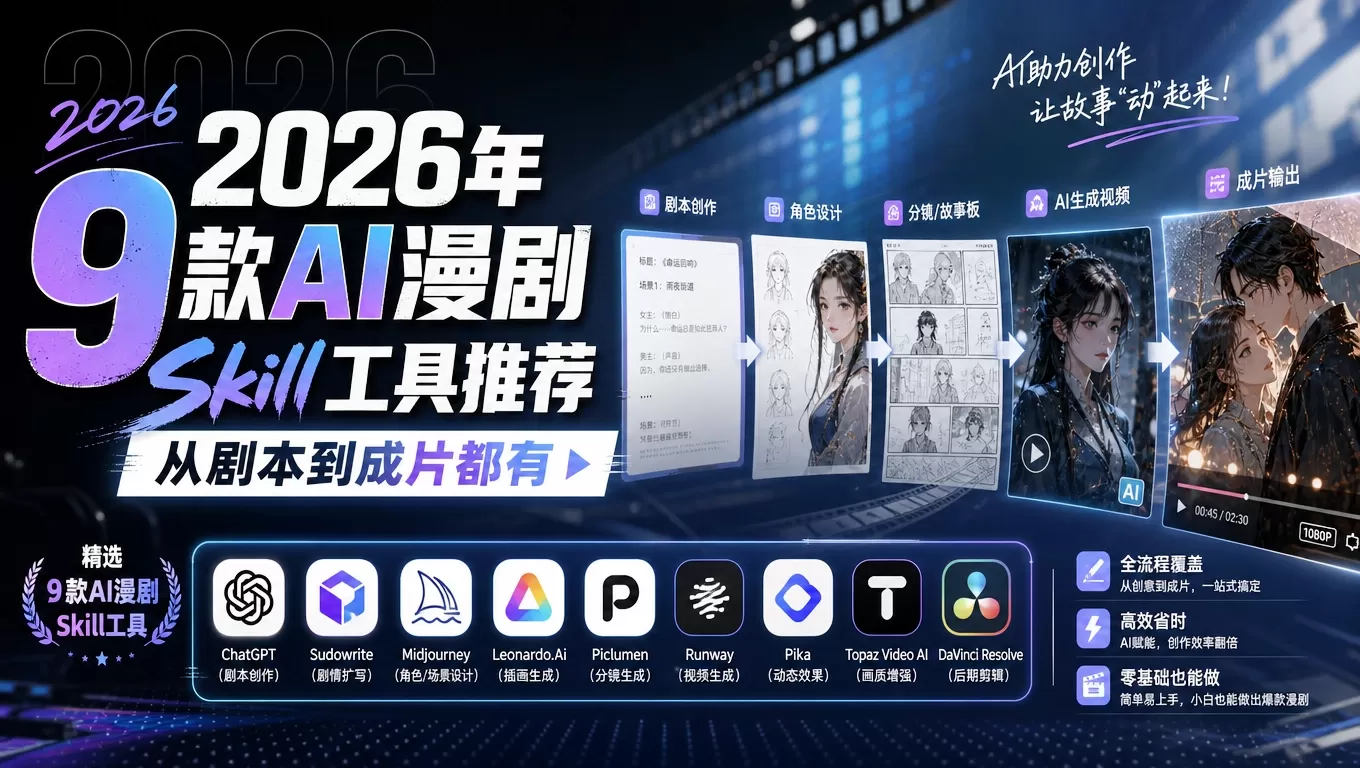
9 AI Comic Drama Skill Tools in 2026: From Script to Final Cut
This article features a curated collection of 9 practical AI comic-drama Skill tools for 2026, covering script adaptation, character consistency, and dynamic video production. It includes open-source projects and platform plugins to help you create high-quality comic-drama content efficiently and at low cost.
1. Drama-Skills
A short-drama creation workflow for screenwriters and comic-drama studios. Start with an idea or lengthy source material and turn it into episodic scripts, asset settings, image prompts, storyboard keyframes, and video prompts, while maintaining continuity throughout.
Key Features
Ten skills covering development, writing, assets, storyboarding, image prompts, video prompts, review, and other stages.
Each new project includes five Markdown files by default: screenplay, visual settings, storyboard, image prompts, and video prompts.
Prompts are previewed first and production is executed through externally configured adapters only after user confirmation.
Includes optional adapters for Seedance, GPT Image 2, and MiniMax Music; project files are not tied to a specific vendor.
Advantages
Developed from real production workflows, with thousands of AI short-drama and comic-drama projects completed from 2025 to the present.
Confirmation comes first: any change to content or inputs invalidates prior approval, and failed tasks cannot be retried without confirmation.
MIT licensed and compatible with Claude Code, Codex, and other environments that support Agent Skill.
URL: https://zenstory.ai/zh/drama-skills
2. jingju-skills (Whale Drama)
A Codex Skill for the complete AI comic-drama creation workflow. It is not a one-click video production tool, but rather an AI screenwriter, art director, and process director designed to transform comic-drama creation from random generation into a confirmable, reusable, and scalable workflow.
Key Features
Starts by asking about the story setting and novel genre, then produces a script outline, character profiles, character-consistency prompts, storyboard design, image prompts, optional ComfyUI generation parameters, image-to-video prompts, and optional final video generation through local video models/APIs.
Suitable for comic dramas, motion comics, photorealistic live-action dramas, narration dramas, AI short-drama storyboards, character reference images, image-to-video prompts, and batch production.
Stage gates: users must confirm the output of every critical stage. The workflow cannot proceed to storyboard image generation without approved character reference images, or invoke video models to produce final videos without approved image-to-video prompts.
Status labels: draft / approved / revision / rejected / selected / locked.
Advantages
When users have not provided a story setting or genre, the Skill asks for clarification instead of writing immediately.
Focuses on high-quality text assets and prompts; image and video generation are additional capabilities. When unavailable, only prompts and parameters are produced.
Transforms the production process from one dependent on personal experience into a confirmable, reusable standard workflow.
URL: https://github.com/jxshow/jingju-skills
3. ai-short-drama-production (Dramake / su-ai-short-drama)
Organizes AI short dramas, comic dramas, and narrative short videos from story intent into controllable production tasks. It supports script hooks, character/scene/prop assets, blocking diagrams, lighting diagrams, fight choreography, sketch-to-shot conversion, and pre-generation quality control. The necessary contracts are packaged with the Skill.
Key Features
Manifest-first, vendor-neutral contracts, offline recovery, cost gates, and subtitle and assembly planning.
Produces schema-valid production packs, fixed entity IDs, per-shot generation briefs, and editing handoffs.
Supports standalone short films, episodic dramas, and serialized series.
Combines the roles of short-drama product manager, screenwriter, storyboard artist, producer, and final-production engineer.
Advantages
Turns a rough idea into a complete short drama ready for publication on RedNote or Douyin through a five-step workflow: screenplay, storyboard images, video segments, and editing package.
Not tied to any specific AI vendor; the contract layer is packaged with the Skill.
Offers female-oriented and male-oriented versions (su-ai-short-drama) that share the same production logic while separately designing audience assumptions, genre libraries, and character motivations.
URL: https://github.com/doublesq97-ui/su-ai-short-drama
4. short-drama-write
A screenwriting Skill from drama-skills. It writes or revises production-ready Markdown scripts for individual Chinese comic-drama episodes and standardizes existing Chinese scripts while preserving the original text, previewing semantic changes, and publishing only after the creator approves them.
Key Features
Produces episode contracts, causal beats, production-ready scripts, and stable indexing.
Supports instructions such as “write or revise a short-drama episode,” “turn an outline into a script,” “refine scenes/dialogue,” “revise to remove formulaic language,” “polish to remove an AI-generated feel,” and “continue with the next episode.”
Turns episode intent into performable, traceable scenes that advance the story state; screenplay.md is the sole editable script source.
Does not handle assets, storyboards, media prompts, or final review.
Advantages
Preserves the author’s original text when standardizing existing scripts and previews semantic differences before publishing.
Includes revision instructions for removing formulaic language and AI-generated tone, helping scripts feel more human-written.
URL: https://github.com/zenstory-ai/drama-skills/tree/main/skills/short-drama-write
5. short-drama-develop
A story-development Skill from drama-skills. It develops Chinese novels, short-drama or comic-drama ideas, summaries, adaptation materials, or existing series notes into traceable adaptation proposals, dramatic directions, creative briefs, director statements, story engines, and episode maps.
Key Features
Supports multiple entry points: only an idea, genre, or emotional goal; an existing summary, novel, or adaptation material; a defined direction that only requires episode planning; or an existing script with no mandatory development files.
Produces a story engine, episode map, director statement, and creative brief.
Selects an appropriate writing approach based on the genre and production format.
Each proposed direction explains its dramatic promise, protagonist’s objective, conflict mechanism, recurring payoff, escalatable stakes, long-term termination condition, and main production burden.
Advantages
Lock in immutable facts, themes, characters, and ending commitments, while distinguishing open areas for exploration from formal constraints.
For long-form material, begin with semantic segmentation, a functional inventory, and candidate episode divisions; do not publish episodes directly based on regex matches for names or nouns.
When the direction is still unclear, propose candidates with different underlying mechanisms—for example, changes to the protagonist’s strategy, the source of conflict, or the stakes—rather than merely changing the title and wording.
URL:https://github.com/zenstory-ai/drama-skills/tree/main/skills/short-drama-develop
6. novel-to-script (DramaFlow webtoon-skill)
A skill package for adapting Chinese web novels into motion-comic or short-drama scripts. It converts Chinese web novels into a motion-comic script format that is ready for filming, editing, storyboarding, and voice-over.
Key Features
Supports project initialization, batch chapter processing, plot deconstruction, episode planning, script drafting, continuity tracking, and quality checks.
Workflow: project initialization → chapter splitting and indexing → plot deconstruction → episode planning → individual episode scripts → quality check → status update.
After a new character first appears in the script, add the corresponding entry to character-prompts.md, including at least a base prompt, three-view prompt, and consistency keywords.
After a new scene first becomes a primary location, add the corresponding entry to scene-prompts.md.
Advantages
Long-form continuity is maintained through files rather than conversational memory.
It does not transfer the novel sentence by sentence into the script, skip essential causal chains, or replace key dramatic actions with explanatory narration; every episode must end with a hook.
Any bridges added during adaptation must be noted in the “Adaptation Notes,” and new information about characters, abilities, factions, and foreshadowing must be added to the continuity ledger.
There is also a standalone version, novel-to-script, supporting an eight-part story-structure analysis and three output formats (standard screenplay/storyboard script/short-video script), with 20+ production elements such as shot numbers, camera movement, shot size, sound effects, and continuity.
URL:https://github.com/elfecho/DramaFlow
7. ManjuForge (Motion-Comic Forge)
An AI motion-comic serial-creation engine and standard Agent Skill that can be used in Agent Skills–supporting environments such as Hermes Agent, Claude Code, Codex, and GitHub Copilot. Enter a subject and character concept, and it outputs a complete script, storyboards (landscape 16:9 / portrait 9:16), voice-over copy, and AI image-generation prompts.
Key Features
Seven memory files and three engines: character profiles, worldbuilding, scene layouts, plot summaries, foreshadowing tables, story bibles, and character relationship maps; built-in Story Bible, Character Graph, and Foreshadow Engine.
Solves character inconsistency, lost foreshadowing, setting drift, and relationship confusion in long-running serials.
Supports cross-episode evolution: visual motifs, trust curves, and relationship stages.
Includes 13 scene-analysis cases and six major style templates.
Advantages
While mainstream tools address visual consistency, ManjuForge addresses story consistency. Its prompt output can be fed directly into any generation workspace.
In testing, “Code Son-in-Law” achieved zero consistency breakdowns across six episodes and a 100% foreshadowing payoff rate (all 11 threads resolved or advanced), with third-party ratings of A–A+ across six categories and an overall A+.
“Abyss Embers” required four fixes in E1, one in E2, and no fixes in E3–E5, with a six-dimension average of 91.1/100 per episode.
URL:https://github.com/mengxiujie/ManjuForge
8. DirectorSkill (shinkai-manga-skill)
A Claude Skill for generating AI motion comics in the style of Makoto Shinkai. Enter a story direction or script, and it outputs character lock profiles, a Makoto Shinkai–style storyboard script, and video prompts that can be pasted directly into video-generation tools.
Key Features
Three core outputs: character lock profiles that ensure consistency across shots; a Makoto Shinkai–style storyboard script including composition, color palette, duration, and narration; and video-generation prompts ready to paste into Seedance / Xiao Yunque.
Supports three input types: atmosphere or emotion keywords only; characters without a plot; or a complete script.
Includes a Makoto Shinkai aesthetic rule library: color philosophy, composition principles, narrative pacing, and signature visual elements.
Includes a viral-hit structure module that distinguishes which platforms’ distribution logic is compatible with Makoto Shinkai’s aesthetics and which would undermine the style.
Compatible with Seedance 2.0, Xiao Yunque, and Jimeng.
Advantages
As a style-preset Skill, it reduces the cost of tuning prompts when you have a clear stylistic requirement, eliminating the need to describe Makoto Shinkai’s composition, color palette, and narrative pacing from scratch.
Dual consistency locking for characters and style: character lock profiles prevent faces from changing across shots, while the aesthetic rule library prevents style drift.
URL:https://github.com/Toni-xie/DirectorSkill
9. ai-mandrama-skills
A Claude Code Skills package for producing Chinese-language AI motion comics or short dramas end to end with Dreamina CLI, edge-tts, and ffmpeg. Turn a one-line script into a finished 14-shot video with character voice-overs, subtitles, BGM, and SFX, delivered in both landscape and 9:16 portrait formats.
Key Features
Two Skills: ai-mandrama-pipeline, an end-to-end production pipeline, and edge-tts-chinese-roleplay, Chinese role-play TTS.
edge-tts-chinese-roleplay includes rate/pitch mapping tables for four voice categories and six emotions, and synthesizes audio and video with ffmpeg.
Depends on Dreamina CLI, edge-tts, and ffmpeg.
Supports dual-format output in landscape and 9:16 portrait.
Advantages
A lightweight terminal pipeline that takes a project from script to finished video within Claude Code.
A ready-to-use voice-over solution with built-in emotion and voice mappings for role-play TTS, eliminating the need to configure TTS separately.
Simple installation: after cloning the repository, symlink or copy the files to ~/.claude/skills/.
URL:https://github.com/cyuanxv/ai-mandrama-skills
How to Choose
| Requirement | Recommendation |
|---|---|
| No prior experience; needs a workflow with clear stage gates | jingju-skills |
| Lightweight terminal workflow with a ready-to-use voice-over solution | ai-mandrama-skills |
| Has an existing novel or web novel to adapt | novel-to-script / DramaFlow |
| Creating a serial motion comic and concerned about story inconsistency | ManjuForge |
| Team collaboration and standardized delivery | ai-short-drama-production |
| Clear stylistic requirements (e.g., Makoto Shinkai) | DirectorSkill |
| Needs a graphical interface and does not want to use the terminal | Openframe / ai-comic-studio |









