
 Script Planner Assistant▸
 AI Apps
 AI News
How to Choose a 3D Previsualization Platform? 2026 Top 6 Chinese 3D Director Tools
小编 ·

How to Choose a 3D Previsualization Platform? 2026 Top 6 Chinese 3D Director Tools
3D previsualization stage — how to choose? Below we recommend five domestic 3D directing stage creation tools: updream, AniShort, LibTV, Wondershare Filmora (Wanxing Juchang), JD Cloud Lingjing AI, and Meitu RoboNeo. All of them let you set up camera positions and character blocking inside a 3D white-box model, then hand the previsualization video over to AI for generation. Each has its own focus — Wondershare Filmora feels like stacking blocks, JD Cloud Lingjing aggregates multiple models, Meitu RoboNeo targets short-drama teams, and LibTV embeds the directing stage into a complete creation canvas. These tools help you avoid trial and error during short-drama production, make shots more controllable, and reduce the need for repeated random generation.
What is a 3D Previsualization Stage?
A 3D previsualization stage, also called a directing stage, is a digital 3D virtual space used to visually preview a scene's spatial layout, character blocking, and camera movement before committing to costly shooting or production. It solves the questions of "how to place it, how to move it, and how to shoot it."
Domestic 3D Previsualization Stage Video Generation Tools
1. updream Previsualization Stage
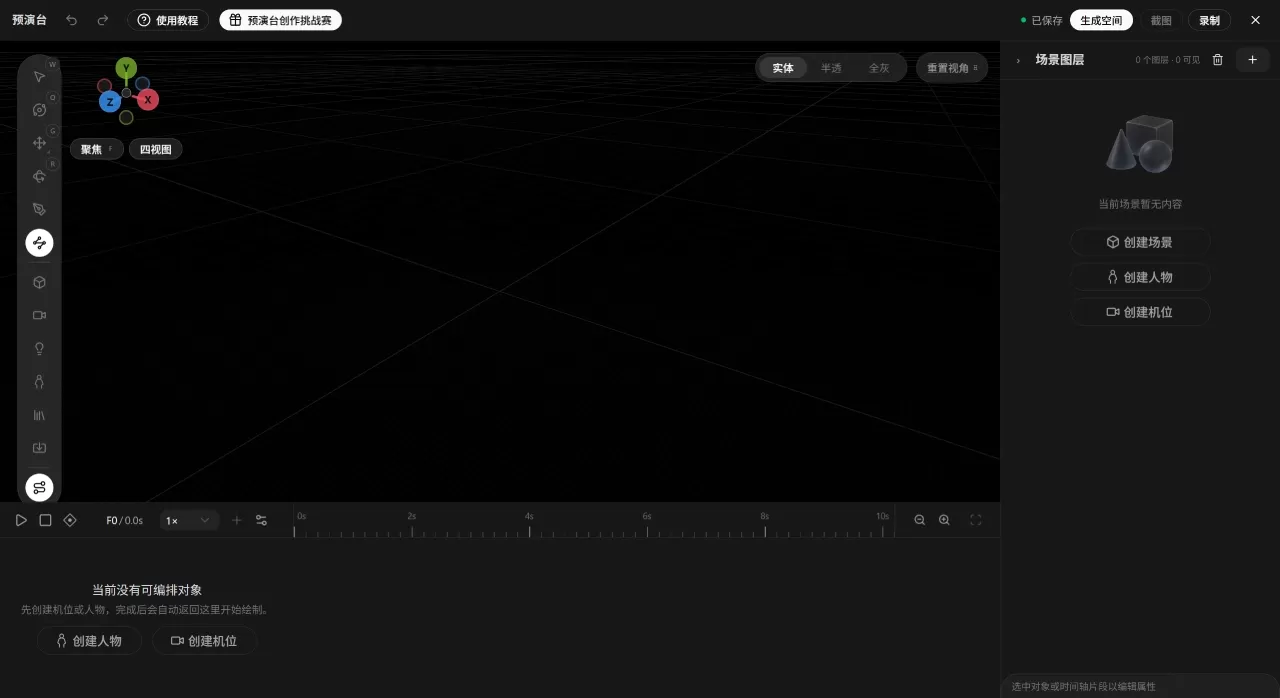
updream is an AI video creation tool from Bilibili. Its previsualization stage is used for 3D white-box previsualization. Upload a reference image to generate an editable white-box scene, arrange the camera and character blocking inside it, then hand the previsualization video over to an AI video model to produce the final visuals. This is far more controllable than relying solely on prompt-based random generation.
Features
Upload a front-facing, distortion-free reference image with a centered subject; in about 4–7 minutes it generates an editable white-box scene, supporting both indoor and outdoor settings as well as complex structures.
Drag to set camera trajectories and character blocking within the white-box scene, record motion using keyframes, export a white-box video, send it back to the Infinite Canvas, and hand it off to the AI video model for generation.
For complex scenes, upload 2–3 reference images from different angles to help restore details such as column spacing and corridor bridge heights.
The white-box video can be used with Seedance 2.5, Kling, Wan, and other models. The white-box only defines structure; lighting and materials are repainted by the subsequent AI generation step based on prompts.
Official Website: https://www.updream.cn
2. LibTV Directing Stage
LibTV is an AI video creation platform launched by Yanyu Technology in March 2026. It places scriptwriting, storyboarding, generation, and editing on a single Infinite Canvas, connected through nodes. Humans can operate directly on the canvas, and AI Agents can also be invoked via Skill interfaces. The 3D directing stage is a node within LibTV's canvas used to first set up character positions and camera angles before taking screenshots as model references.
Features
Double-click on an empty area of the canvas to create a new "Directing Stage" node. Inside, drag human figures to set positions and poses, and adjust camera angles manually.
Supports single and multi-character positioning; each character can be individually adjusted for position, rotation, and scale.
Once set up, click "Publish to Canvas" and the screenshot is used directly as a reference image for AI. The generated positions, angles, and framing essentially match what was arranged.
Upload an image and click "Panorama" to convert it into a 720° panorama for viewing the spatial effect together with the directing stage.
The platform also offers over 20 capabilities including character three-view sheets, multi-camera 9-grid layouts, and story progression 4-grid layouts, with access to models such as Kling AI, Seedance2.5, and HappyHorse.
Script, storyboard, shots, and editing all live on the same canvas; nodes can be connected or split, supporting real-time multi-user collaboration.
Official Website: https://www.liblib.tv
3. AniShort 3D Directing Stage
AniShort is an AI short drama end-to-end collaborative creation platform from Eight-Eight Digital. It adopts a "3D World + 3D Directing Stage" combination, positioning itself as industrial production for AI film and drama. The platform features a multi-canvas node-based workflow for team collaboration, currently producing over 40,000 videos and nearly a hundred AI films/dramas per day, with a cumulative total of more than 70,000 incubated projects. The 3D directing stage first uses AI to generate distortion-free, accurately proportioned 3D scenes from a single image. Creators then enter to perform directing operations, confirm the composition, and generate high-precision reference images that connect directly to video generation models. The platform claims a reduction in the random-generation rate by over 90%.
Features
Upload one image, and AI generates a distortion-free, accurately proportioned 3D scene. After entering the directing stage, use the mouse to drag and adjust character positions, action angles, props, lighting, and camera viewpoints.
Once the composition is confirmed, high-precision shot reference images are automatically generated and connected directly to image and video generation nodes. Videos are produced according to the reference images, reducing repeated trial and error.
The workflow is a visual node graph; nodes can be connected and reorganized, multiple users can edit the same canvas online simultaneously, comments can be anchored to frame images, audio tracks, or nodes, and three-tier permissions are supported.
Effect nodes and complete workflows can be saved as reusable templates, with reviews and version iterations accumulating into a team knowledge base. One-click style transfer supports 2D/3D/real-person multi-styles and multiple languages, allowing a single set of assets to cover different markets.
The Ani intelligent assistant automatically scans incomplete nodes, generates to-do lists, recommends next steps, and supports one-click execution, with the ability to be entrusted with automated end-to-end connections.
Official Website: https://anishort.ai
4. Wondershare Filmora (Wanxing Juchang) 3D Directing Stage
Wondershare Filmora is Wondershare's AI film creation platform, with the 3D directing stage launched in June 2026. It restructures AI video generation into a workflow of "spatial modeling — element scheduling — camera setup — generation," allowing camera direction to be done without a professional 3D background.
Features
Build scenes in 3D space, schedule actors and camera positions, adjust character poses — the operation feels like stacking building blocks.
Dual-mode real-time preview allows you to view the composition as you build, making it easy to control multi-character scenes and multi-camera shot transitions.
The Storyboard Director Agent combines directing, audiovisual language, and acting knowledge. Through the 3D directing stage, 720° panoramic space, and multi-dimensional camera scheduling, it controls character positioning, shots, dialogue pacing, and acting emotion.
Data shown on-site at WAIC 2026: storyboard first-pass usability rate of 80%, with a 10x efficiency improvement.
Official Website: https://reelmate.cn
5. JD Cloud Lingjing 3D Directing Stage
JD Cloud Lingjing is JD Cloud's enterprise-grade AIGC content generation platform, aggregating over 20 mainstream large models from China and abroad, covering e-commerce retail, advertising and marketing, film and short-drama scenarios, and more. The 3D directing stage was launched in August 2026, enabling creators to complete character scheduling, camera previsualization, spatial setup, and keyframe locking before generation.
Features
Timeline-based action previsualization supports complex motion trajectories and camera scheduling, such as a protagonist's dodge or a 180° orbiting camera move.
720° panoramic images provide a unified spatial reference for multi-camera shooting, ensuring spatial consistency between camera positions.
Integrates over 20 mainstream AI large models, including Vidu, Kling AI, Hailuo AI, etc., allowing switching within the same platform.
Supports three-tier permissions, consumption budget control, and usage analysis — suitable for team collaboration and cost management.
Official Website: https://lingjing.jdcloud.com
6. Meitu RoboNeo 3D Directing Stage
RoboNeo is an AI short-drama creation tool under Meitu, aimed at daily-update-level AI short-drama teams. The 3D directing stage was launched in the August 2026 update. Built around the short-drama production workflow, it uses Agents for directing, planning, scriptwriting, and art to collaborate, connecting script, storyboard, generation, editing, and output, addressing issues such as uncontrollable shots, high modification costs, and difficulty maintaining consistency.
Features
After dragging in a reference image, AI automatically identifies character positions, prop distribution, and camera angles, generating an editable 3D scene — no professional 3D skills or Prompt-based scene building required.
Build scenes, place props, adjust character positions and poses within the 3D directing stage, and choose shots such as overhead, follow, or close-up according to the plot.
Supports line-drawing annotation for camera movement — draw lines to control the direction of camera motion and character trajectories.
Connects the entire workflow of script, storyboard, generation, editing, and output. A unified project asset library manages characters, scenes, and props, supports cross-project reuse, and maintains consistency in characters and visual style.
Official Website: https://www.roboneo.com/









