
 Script Planner Assistant▸
 AI Apps
 AI News
Screenwriting Tutorial: From Zero to First Draft
小编 ·

Screenwriting Tutorial: From Zero to First Draft
This is a ready-to-execute beginner's tutorial on screenplay writing, covering script formatting standards, story structure, character design, dialogue writing, and a final draft checklist. First and foremost, a screenplay is not a novel. The core of screenplay writing is: telling a story through images and sound—you need a sense of visual imagery. Every line you write must ultimately be filmable and performable.
If you want to get started quickly, you can choose professional screenplay writing tools like Laper.
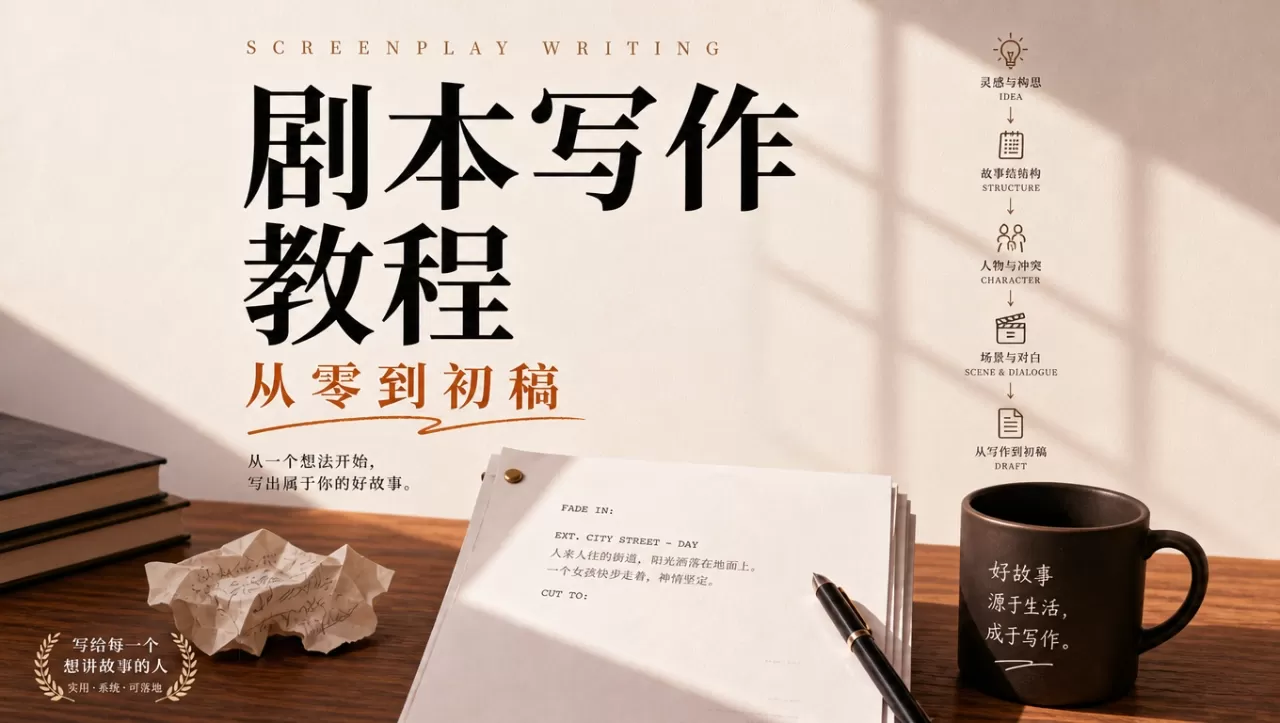
1. First, Decide What Kind of Script You're Writing
Different scripts have different formats and rhythms:
Feature film script: 90–120 pages, about one page per minute.
Short film script: 5–20 pages, focused on one event and one turning point.
TV series: 30/60 minutes per episode, with A/B/C storylines and end-of-act hooks.
Stage play: centered on dialogue, blocking, and act/scene structure.
Short video/short drama: hook viewers in the first 3 seconds, extremely fast pace, with a small climax in each episode.
As a beginner, you can start by practicing with a 5–10 minute short script.
2. Basic Format
A commonly used Chinese-language script format for reference:
1. INT. CAFE - DAY
Sunlight slants across the table. Lin Xia stares at her phone, the screen showing "Interview Failed."
She picks up her cold coffee and drinks it in one gulp.
A server walks over.
SERVER
Another refill?
LIN XIA
No thanks. I'm going to take back what's mine.
She stands up, the chair scraping the floor with a harsh sound.
CUT TO:
Key points:
Scene heading: INT./EXT., location, time.
Action description: present tense, only write what can be seen or heard.
Character name: on its own line, above the dialogue.
Dialogue: the words the character actually says aloud.
Parentheticals: use sparingly, only for tone or action that cannot be inferred from the dialogue.
Transitions: CUT TO, FADE OUT, FLASHBACK, etc.; use only when necessary.
For script formats and templates, you can refer to my previous article "Rebirth Revenge Short Drama Script Template, with Complete Script Sample"
3. Five Core Principles
Show, don't tell
Don't write "he was very angry"—write "he smashed the cup into the sink."
Every scene must have conflict
If a scene has no conflict, either cut it or merge it.
Characters must have goals
What does he want? Who or what is stopping him?
Scenes must have value change
The state at the opening and closing must be different: from hope to despair, from strangers to trust.
Visualize
If it can be expressed through action, don't use dialogue; if it can be expressed through imagery, don't use narration.
4. Story Structure: The Three-Act Beat Sheet
The most commonly used structure is generally as follows:
Act One: Setup
Opening image: show the protagonist's everyday world.
Inciting incident: an event disrupts the balance.
Debate: the protagonist hesitates, resists.
First act turning point: the protagonist is forced to set out.
Act Two: Confrontation
B-story: romance, friendship, mentor, subplot.
Midpoint: false victory or false defeat; the protagonist changes strategy.
Bad guys closing in: pressure ramps up.
All is lost: the darkest moment.
Soul night: the protagonist confronts an internal flaw.
Act Three: Resolution
Third act turning point: the protagonist gains a new insight.
Climax: the final showdown.
Final image: shows the protagonist's transformation.
One-line logline formula:
A 【flawed protagonist】, in order to 【goal】, must 【action】, or else 【stakes】.
5. Character Design
Main characters should have at least the following traits:
Desire: what does he want on the surface?
Need: what does he truly need?
Flaw: what prevents him from growing?
Opponent: who or what is stopping him?
Arc: from beginning to end, how does he change?
The opponent doesn't have to be a villain, but must have their own logic and pressure.
6. How to Write Dialogue
Good dialogue isn't casual conversation; it has the following qualities:
Has subtext: what's said isn't the same as what's thought.
Has a character voice: different characters speak differently.
Controls information: don't explain the entire backstory at once.
Concise: if one sentence will do, don't use three.
Minimal small talk: jump straight into conflict.
You can try the following exercise: take a conversation that "explains the plot" and rewrite it as two people testing each other while doing something.
7. How to Write a Scene
Ask yourself four questions for every scene:
What is whose goal?
What is the conflict?
Where is the turning point?
How does the outcome change the next step?
Tip: Enter late, leave early—don't start with a knock on the door, start with the door being kicked open; don't end with a handshake, end with the turn and walk away.
8. Writing Process
One-line logline: tell the story in one sentence.
Character bios: write half a page for each main character.
Story outline: beginning, development, turn, conclusion, around 1,000 words.
Scene-by-scene outline: for each scene, write the location, characters, goal, conflict, and turning point.
First draft: write it quickly, don't go back to revise.
Revision: let it sit for a few days, then re-read and cut anything that doesn't move the story forward.
Read aloud: read the dialogue out loud; if it sounds awkward, revise.
9. Common Mistakes
Characters are passive, only reacting, never acting.
Dialogue over-explains, like an instruction booklet.
Scenes have no conflict, just chatting.
The protagonist has no clear goal.
The antagonist is too weak or too stupid.
Over-describing camera angles, music, and actors' expressions.
Formatting is messy, making it hard for readers to scan.
Act One is too long, climax is too short.
10. Practice Checklist
Here are some practice scenarios you can try writing:
Write a 3-minute short film: a person must make a choice inside an elevator.
Write a conflict scene with no dialogue.
Take the same event and write it as a comedy, a tragedy, and a thriller.
Write a letter your character would never send.
Write a conversation where "both people are lying."
Summarize 10 of your favorite films in one sentence each.
Rewrite the ending of a film as the opposite.
Write a 10-page script with only two characters and one location.
Every day, observe a person and record their actions without judgment.
Finish a 5-minute short film first draft, then cut 20% of the words.
11.Classic Book Recommendations (by Learning Stage)
Beginner Foundations
"Screenplay: The Foundations of Screenwriting" (Syd Field): Proposes the "three-act structure" (setup, confrontation, resolution) and the concept of "plot points," adopted by over 400 universities worldwide and designated as a required text by the Beijing Film Academy.
"Save the Cat! The Last Book on Screenwriting You'll Ever Need" (Blake Snyder): Provides the 15-point "beat sheet" and a 10-genre story classification system; concise language, extremely practical, beginner-friendly.
"The Art of Dramatic Writing" (Lajos Egri): Emphasizes driving characters and plot through a "premise"; a classic that has been a bestseller for 70 years.
Intermediate Advancement
"Story: Substance, Structure, Style, and the Principles of Screenwriting" (Robert McKee): A systematic exposition of storytelling principles, hailed as the lifelong work of the "Godfather of Hollywood screenwriting," required reading at top film schools worldwide.
"The Tools of Screenwriting" (David Howard / Edward Mabley): The foundational work of the screenwriting program at the USC School of Cinematic Arts, using 16 classic scripts to demonstrate analysis.
Industry Practice
"The Screenplay" (Richard Walter): Textbook for the screenwriting program at the UCLA School of Theater, Film and Television, covering standard formatting, revision methods, and the real industry environment.
"No Secrets in Screenwriting" (Lu Wei, Wang Tianbing): A collection of practical experience and lessons from veteran Chinese screenwriter Lu Wei.
"Micro Short Drama Writing" (Xu Daojun, Liu Shijie, published 2026): Targeted at the current popular micro-short-drama track, covering genre, structure, characters, conflict, dialogue, and other elements.
Screenwriting Software
Laper, Final Draft, WriterDuet, Fountain
12. Script Checklist
After completing the first draft, check against the following list item by item:
□ Does the protagonist have a clear goal?
□ Does every scene have conflict and a turning point?
□ Does the dialogue have subtext?
□ Can Act One get into the action faster?
□ Does the midpoint shift the story's direction?
□ Is the climax resolved by the protagonist's own initiative?
□ Does the ending show the character's transformation?
□ If you cut any scene, will the story be affected?









