
 Script Planner Assistant▸
 AI Apps
 AI News
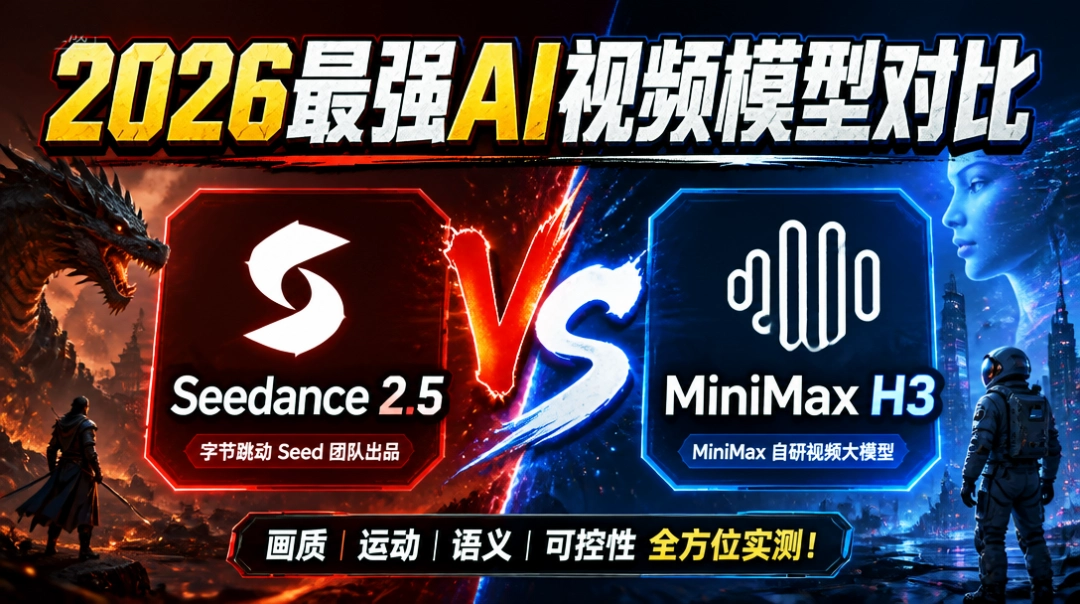
2026's Strongest AI Video Models Compared: Seedance 2.5 vs MiniMax H3
小编 ·

2026's Strongest AI Video Models Compared: Seedance 2.5 vs MiniMax H3
Both Seedance 2.5 and MiniMax H3 were released in late July 2026, but they take different paths: Seedance 2.5 pursues long video and fine-grained control, while MiniMax H3 bets on high resolution and unified multimodal generation.
So which one should we choose—Seedance 2.5 or MiniMax H3? This article will break it down dimension by dimension based on key indicators such as max duration, resolution, reference input capacity, audio generation, and open-source strategy, helping video bloggers and developers find the answer.
Core Parameter Comparison
| Dimension | Seedance 2.5 | MiniMax H3 |
|---|---|---|
| Publisher | ByteDance | MiniMax |
| Release Date | 2026.07.31 | 2026.07.31 |
| Max Duration | 30s native single shot, up to 180s in Ultra-Long mode | 15s |
| Max Resolution | 720p (1280×720) | 2K (2560×1440, on API) |
| Reference Input Capacity | Up to 50, including 30 images + 10 videos + 10 audio | Up to 15, including 9 images + 3 videos + 3 audio |
| Native Audio | Ambient sound + sound effects | 32kHz stereo, joint modeling of voice/sound effects/music |
| Open-source Weights | ❌ Closed source | ✅ H3-Base is open source, but with regional restrictions |
| Aspect Ratio Support | 6 ratios, including 1:1, 21:9 ultra-wide, etc. | Multiple |
| Signature Controls | Region-level editing, 3D preview camera control, @character role locking | First/last frame control, unified multimodal context |
Respective Strengths
Seedance 2.5 is best for:
Long-form narrative content: 30-second native single shot is twice that of H3, and the chained mode can reach 180 seconds—better for short films, advertising storyboards, and narrative continuity.
Complex reference workflows: 50 reference inputs mean you can load in plenty of style references, character images, and storyboards to create brand-consistent content.
Fine-grained post-production control: Region-level editing (change only part of the frame, keep the rest) and 3D preview camera control are friendlier for professional creators.
ByteDance ecosystem integration: Deep integration with TikTok, Jianying/Dreamina, Artlist, and other platforms.
MiniMax H3 is best for:
Image quality first: Native 2K output ranks it in the top tier for AI video—ideal for high-quality ads and product showcases.
Integrated sound: Stereo audio is generated via joint modeling rather than added in post, so audio-video sync feels more natural.
Developers/self-hosting: H3-Base weights are open-sourced—although limited to 768p and region-restricted, they offer more controllability for teams with GPU clusters.
Cost-effectiveness: 200 credits per generation on the API, half the price of Veo 3.1 (400 credits).
Real-World Use Scenarios
| Scenario | Recommendation |
|---|---|
| Creating 15–30s short videos/ads | Seedance 2.5 (duration advantage) |
| Creating 5–15s high-quality product showcases | MiniMax H3 (2K resolution) |
| Need cross-shot character consistency | Seedance 2.5 (@character syntax + better continuity) |
| Need integrated audio-video generation | MiniMax H3 (native stereo audio) |
| Self-hosting/local deployment | MiniMax H3 (open-source weights, but verify regional licensing) |
| Linked to TikTok/Douyin ecosystem | Seedance 2.5 |









