
 Script Planner Assistant▸
 AI Apps
 AI News
DeepSeek-V4-Pro vs Claude Fable 5: Coding, Pricing and Long-Context Tests
小编 ·

DeepSeek-V4-Pro vs Claude Fable 5: Coding, Pricing and Long-Context Tests
The comparison between DeepSeek-V4-Pro and Claude Fable 5 is a contest between ultimate cost-effectiveness and peak performance. DeepSeek-V4-Pro is the king of cost-effectiveness—"ninety percent of the capability at one-tenth the price"—while Claude Fable 5 is the top-tier flagship that aims for "the strongest coding and autonomous agent capabilities regardless of cost."
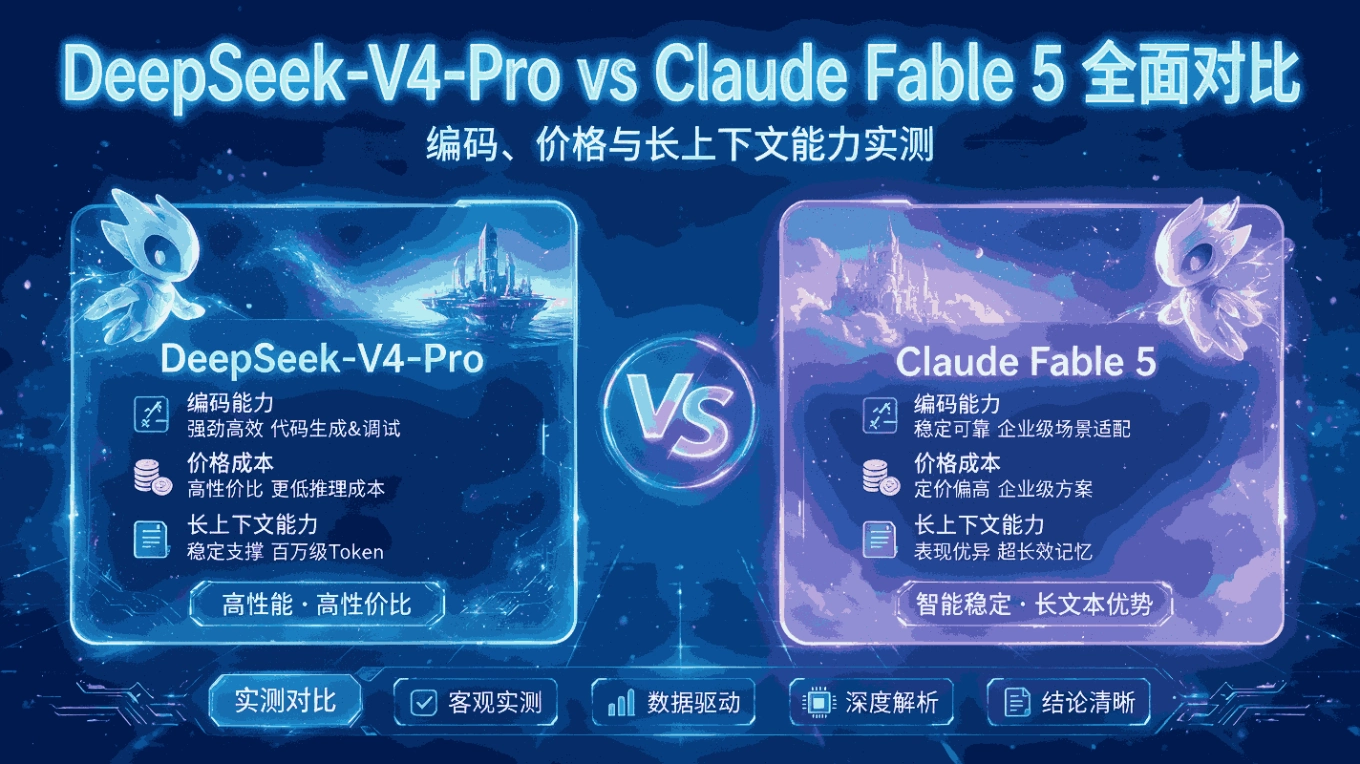
Core Parameter Comparison
| Dimension | DeepSeek-V4-Pro | Claude Fable 5 |
|---|---|---|
| Release Date | April 2026 (preview) | June 9, 2026 |
| Total Params / Active Params | 1.6T / 49B | Not disclosed (Mythos-class) |
| Context Window | 1M tokens | 1M tokens |
| API Pricing (per million tokens) | ~$0.44 input / ~$0.87 output | $10 input / $50 output |
| Open-Source Weights | Pro version not yet; Flash version open-source under MIT | Closed source |
| SWE-Bench Pro (coding) | ~73.8% | ~80–84.8% |
| Long-Horizon Autonomous Tasks (100+ steps) | ~42.1% success rate | ~82.9% success rate |
| Multimodality | Supported (PDF, images, scanned documents) | Supported (charts, screenshots, in-document images) |
| Availability | Preview API available; full GA expected mid-August 2026 | Globally available (restored on July 1, 2026) |
Comparison of Each Side's Strengths
DeepSeek-V4-Pro's advantages:
Crushing cost advantage. Based on a monthly workload of 100 million output tokens, V4-Pro costs about $348, while Fable 5 costs about $5,000—a gap of nearly 15×. For high-concurrency, high-throughput applications, this is a decisive advantage.
Long-context retrieval. On million-token-level document Q&A tasks (such as MRCR 1M and CorpusQA 1M), V4-Pro currently holds the best verified scores.
Coding agent ecosystem. It already officially integrates with mainstream coding agents such as Claude Code, OpenCode, and Cline, with well-developed tool calling and function calling support.
Claude Fable 5's advantages:
Coding quality. With SWE-Bench Pro above 80%, it currently leads in real-world capability to fix GitHub issues. If you need a model that independently handles complex codebases, writes tests, and refactors architecture, Fable 5 is more reliable.
Long-horizon autonomous agents. The success rate for continuous tasks of 100+ steps is 82.9%, nearly double that of V4-Pro. It's well suited for scenarios where the model needs to "work on its own for days," such as automatically setting up a database, writing APIs, testing, and fixing deployment errors.
Safety and predictability. It comes with multi-layer safety classifiers built in, silently degrading to Opus 4.8 when refusing high-risk requests—making it more controllable for enterprise deployments.
Pricing Comparison
Assume your application consumes 100 million input tokens + 50 million output tokens per month:
| Plan | Estimated Monthly Cost |
|---|---|
| DeepSeek-V4-Pro | ~$480 |
| Claude Fable 5 | ~$3,500 |
This gap means that the money you spend on Fable 5 for one month can keep V4-Pro running for seven months.
On the flip side, if your tasks require the model to run continuously for 8 hours to complete a complex engineering job, Fable 5 is more likely to succeed on the first try, while V4-Pro may require human intervention or multiple retries—so the hidden costs may not be lower.
How to Choose Between the Two
Choose DeepSeek-V4-Pro if you have the following needs:
Budget-sensitive, needing large-scale API calls
Primarily doing long-document analysis, RAG, and knowledge-base Q&A
The team already has a mature agent framework and is willing to build its own scaffolding
You need a self-hostable option (Flash version is already open-source; Pro version may follow in the future)
Choose Claude Fable 5 if your needs are as follows:
Coding is the core business, especially maintaining large legacy codebases
You need the model to autonomously execute multi-step, cross-day complex tasks
Enterprise compliance requirements are high, demanding built-in safety guardrails and audit logs
Budget is sufficient and you're willing to pay for "getting it right the first time"
Of course, the most pragmatic approach is to use both. For example, route everyday traffic and moderate-complexity tasks to V4-Pro, and for the hardest 10% of tasks—complex refactoring, long-horizon agents, and the like—route them to Fable 5. That's what I do.









